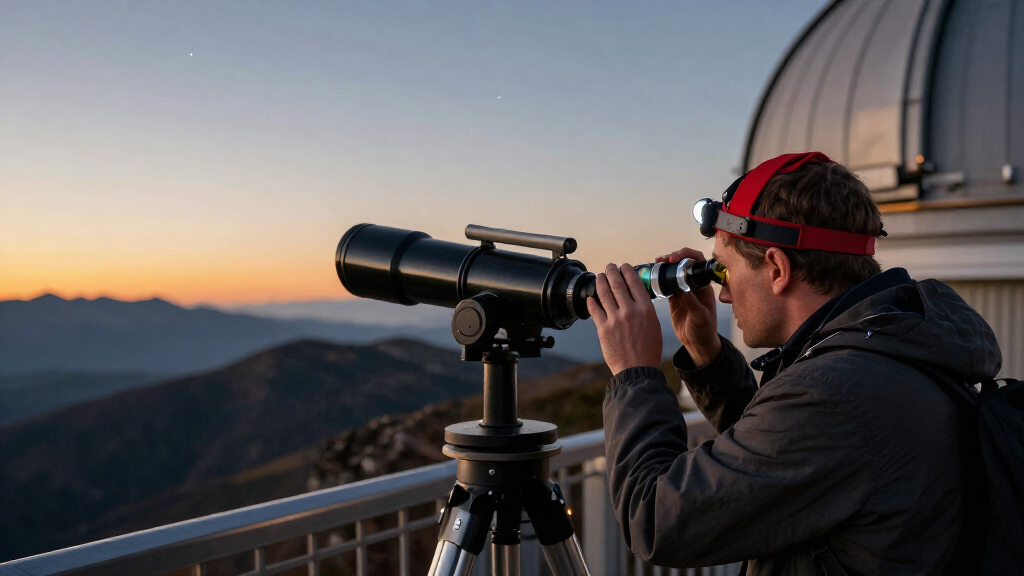
Choosing the right astrophotography telescope eyepieces can transform a blurry view into a crisp, detailed image, but the market is flooded with options that vary wildly in optical quality. For most observers, the Celestron 8–24mm Zoom Telescope Eyepiece stands out as the best overall choice due to its versatile focal length range and solid build quality, though the SVBONY SV135 Zoom offers a compelling budget-friendly alternative. The primary tradeoff you will face is between convenience and optical perfection: zoom eyepieces offer flexibility but often suffer from edge distortion, while fixed focal length eyepieces provide sharper views but require frequent swapping. This guide breaks down which models deliver the best balance of clarity, comfort, and value to help you make an informed decision.

Prime made for students and young adults
- Fast, free delivery for dorm and study essentials
- Prime Video and Amazon Music included
- Member-only deals
Key Takeaways
- Zoom eyepieces offer unparalleled convenience for beginners but typically sacrifice edge sharpness compared to fixed Plossls.
- The Celestron Omni series provides exceptional high-power performance for planetary viewing, making it the go-to for detail work.
- Budget sets like SVBONY often include unnecessary accessories that clutter the kit, whereas curated kits focus on essential optical quality.
- Eye relief becomes a critical differentiator in premium models, directly impacting comfort for eyeglass wearers during long sessions.
- For deep-sky targets, wider fields of view (62°+) provide a more immersive experience than traditional 52° designs, even at similar price points.
| Celestron Omni 1.25″ 4mm Telescope Eyepiece for High-Power Planetary Detail |  | Best for High-Power Planetary Viewing | Focal length: 4 mm | Barrel size: 1.25 inches | Optical design: Four-element Plössl | VIEW LATEST PRICE | See Our Full Breakdown |
| SVBONY Telescope Eyepiece Set, 4 mm, 10 mm, and 23 mm, 62° Wide Angle |  | Best Starter Range for Visual Observing | Focal lengths: 4 mm, 10 mm, and 23 mm | Apparent field of view: 62° | Barrel size: 1.25 inches (31.7 mm) | VIEW LATEST PRICE | See Our Full Breakdown |
| Celestron 1.25″ Telescope Eyepiece, Barlow & Filter Accessory Kit |  | Best Complete Planetary Observing Kit | Eyepiece focal lengths: 6 mm, 8 mm, 13 mm, 17 mm, and 32 mm | Barlow magnification: 2× | Filters included: Blue (80A), Green (58A), Light Green (56), Red (25), Orange (21), Yellow (12), and Moon | VIEW LATEST PRICE | See Our Full Breakdown |
| SVBONY SV135 7–21mm Zoom Telescope Eyepiece |  | Best for Convenient Magnification Changes | Focal length: 7–21 mm | Zoom ratio: 3× | Field of view: 40–57° | VIEW LATEST PRICE | See Our Full Breakdown |
| 1.25-inch Telescope Eyepiece Set with Barlow Lens and Filters |  | Best for High-Magnification Filter Variety | Eyepiece focal lengths: 4 mm, 10 mm, and 20 mm | Barlow magnification: 5× | Filters included: Two Moon filters and two polarizing filters | VIEW LATEST PRICE | See Our Full Breakdown |
| Celestron 8–24mm Zoom Telescope Eyepiece |  | Best Convenience Pick | Focal Length Range: 8–24mm | Barrel Size: 1.25 inches | Field of View: 40–60° | VIEW LATEST PRICE | See Our Full Breakdown |
| Astronomical Telescope Accessory Kit – 3 Plossl Eyepieces, 4 Filters, 2X Barlow Lens |  | Best Starter Bundle | Eyepiece Focal Lengths: 6 mm, 12.5 mm, 20 mm | Barlow Magnification: 2× | Filter Types: Moon, Red, Blue, Yellow | VIEW LATEST PRICE | See Our Full Breakdown |
| astrophotography telescope eyepiece | Barrel size | Coating |
|---|---|---|
| Celestron Omni 1.25" 4mm Teles | 1.25 inches | Multi-coated |
| SVBONY Telescope Eyepiece Set | 1.25 inches (31.7 mm) | Fully multi-coated |
| Celestron 1.25" Telescope Eyep | — | Fully multi-coated |
| SVBONY SV135 7–21mm Zoom Teles | 1.25 inches | Fully multi-coated |
| 1.25-inch Telescope Eyepiece S | — | — |
| Celestron 8–24mm Zoom Telescop | 1.25 inches | — |
| Astronomical Telescope Accesso | 1.25 inches | — |
More Details on Our Top Picks
Celestron Omni 1.25″ 4mm Telescope Eyepiece for High-Power Planetary Detail
I’d choose the Celestron Omni 4mm for a buyer who already knows their telescope can handle high magnification and wants a single eyepiece for lunar or planetary detail. Its four-element, multi-coated Plössl optics and blackened lens edges are intended to limit stray reflections, helping bright targets retain contrast. Compared with the SVBONY 7–21mm Zoom, this fixed focal length is less adaptable, but it avoids changing focal length while observing. The tradeoff is substantial: 4mm produces high magnification, which can make targets harder to locate and keep centered, and atmospheric conditions or telescope aperture may limit useful detail. The narrow field and short eye relief typical of this format also make it less forgiving than a zoom for casual viewing. Its 1.25-inch barrel fits only compatible focusers.
Pros:- Four-element Plössl design with multi-coated optics for planetary contrast.
- Blackened lens edges and matte barrel help reduce internal reflections and glare.
- Foldable rubber eyecup accommodates different viewing positions.
- Compact, lightweight format at 1.76 ounces.
Cons:- Very short focal length creates high magnification that may exceed what a telescope or seeing conditions can support.
- Narrow field makes targets more difficult to find and track manually.
- Fixed 4mm focal length offers less flexibility than the SVBONY SV135 zoom.
Best for: Planetary observers with a 1.25-inch focuser whose telescope and local seeing conditions support high magnification.
Not ideal for: Beginners, eyeglass wearers needing generous eye relief, and buyers seeking a versatile eyepiece for astrophotography or low-power views.
- Focal length:4 mm
- Barrel size:1.25 inches
- Optical design:Four-element Plössl
- Coating:Multi-coated
- Eyecup:Foldable rubber
- Dimensions:3.4 × 1.7 × 1.4 inches
- Weight:1.76 ounces
- Model number:93316-CGL
Our verdict“Choose this fixed 4mm eyepiece for supported high-power planetary viewing, not as a flexible first eyepiece or an astrophotography imaging component.”
SVBONY Telescope Eyepiece Set, 4 mm, 10 mm, and 23 mm, 62° Wide Angle
The SVBONY 4mm, 10mm, and 23mm set gives a new observer three distinct magnification options, from a longer focal length for broader views to a short one for higher power. Its stated 62° apparent field can make targets feel less confined than the narrow view of the Celestron Omni 4mm, especially when tracking by hand. The aspherical, fully coated lenses are designed to control aberrations and improve light transmission, though actual image scale depends on the telescope rather than the eyepiece alone. This is a visual-observing set, not a camera-projection solution: eyepieces are generally used to look through a telescope, while astrophotography usually calls for a camera at the focuser. The set also requires a 1.25-inch focuser, and its 4mm option may be too powerful for some telescope and sky combinations.
Pros:- Three focal lengths offer more observing flexibility than the fixed Celestron Omni 4mm.
- 62° apparent field provides a broader-feeling view than a narrow-field eyepiece.
- Aspherical, fully coated lenses are designed to reduce aberrations and improve light transmission.
- Compatible with refractor, reflector, and catadioptric telescopes that have a 1.25-inch focuser.
Cons:- The 1.25-inch barrel excludes telescopes that accept only 2-inch accessories.
- The 4mm eyepiece may push some telescopes beyond useful magnification.
- An eyepiece set does not provide the camera connection or imaging sensor needed for astrophotography.
Best for: New visual observers with a 1.25-inch telescope who want three focal lengths to explore lunar, planetary, and wider-field targets.
Not ideal for: Astrophotographers shopping for a camera interface, owners of 2-inch-only focusers, or anyone whose telescope cannot usefully support 4mm magnification.
- Focal lengths:4 mm, 10 mm, and 23 mm
- Apparent field of view:62°
- Barrel size:1.25 inches (31.7 mm)
- Lens type:Aspherical
- Coating:Fully multi-coated
- Filter thread:M28 × 0.6
- Focus type:Manual
- Compatibility:Astronomical telescopes with a 1.25-inch focuser
Our verdict“Pick this set to build a basic visual observing range, but choose a camera and imaging accessories for actual astrophotography.”
Celestron 1.25″ Telescope Eyepiece, Barlow & Filter Accessory Kit
For an observer assembling a broader visual toolkit, the Celestron accessory kit is the most complete option here: five Plössl focal lengths, a 2× Barlow, planetary filters, a Moon filter, and a protective case. The 6mm to 32mm range gives more fixed focal-length choices than the SVBONY three-eyepiece set, while the Barlow can increase magnification without adding another eyepiece. Filters may alter the appearance of bright lunar and planetary targets, but they do not add camera capability or substitute for a suitable tracking mount and imaging camera. Compared with the 7–21mm SVBONY zoom, this kit takes more space and requires swapping components, but offers discrete focal lengths and included filters. The 1.25-inch-only format also rules out 2-inch systems, and no diagonal or mounting hardware is included.
Pros:- Five Plössl focal lengths cover a wide range of visual magnifications.
- Included 2× Barlow expands the available magnification combinations.
- Planetary and Moon filters provide options for viewing bright targets.
- Foam-lined metal case organizes and protects the accessories.
Cons:- The collection is limited to telescopes with compatible 1.25-inch fittings.
- Changing among multiple eyepieces and filters is less convenient than using the SVBONY SV135 zoom.
- Does not include a diagonal or camera connection for astrophotography.
Best for: Visual observers with a 1.25-inch telescope who want several focal lengths, a Barlow, and filters in one organized kit.
Not ideal for: Astrophotographers seeking camera-ready equipment, owners of 2-inch systems, or travelers who prefer a single compact zoom eyepiece.
- Eyepiece focal lengths:6 mm, 8 mm, 13 mm, 17 mm, and 32 mm
- Barlow magnification:2×
- Filters included:Blue (80A), Green (58A), Light Green (56), Red (25), Orange (21), Yellow (12), and Moon
- Coating:Fully multi-coated
- Field of view:52°
- Mount compatibility:Altazimuth mounts and most 1.25-inch telescopes
- Case:Metal with foam lining
Our verdict“Choose this kit for a broad visual planetary setup in a 1.25-inch telescope, not for a streamlined camera-based imaging rig.”
SVBONY SV135 7–21mm Zoom Telescope Eyepiece
The SVBONY SV135 zoom suits observers who want to adjust magnification without repeatedly swapping eyepieces. Its 7–21mm range covers lunar and planetary viewing, and the listed 16.3–18mm eye relief is more accommodating for glasses than many short-focal-length Plössls, including the Celestron Omni 4mm. The field narrows from 57° to 40° as focal length changes, so the widest setting feels more open than the high-power end. That is the main compromise against the fixed focal lengths in the Celestron kit: fewer separate pieces to handle, but a changing field of view and no included filters. A zoom can help with visual framing, yet it is not a camera adapter; astrophotography still requires imaging equipment. Its 230-gram weight and 1.25-inch barrel may also matter on small or balance-sensitive setups.
Pros:- 7–21mm zoom range changes magnification without swapping eyepieces.
- 16.3–18mm eye relief is more accommodating than the short 4mm Celestron Omni design.
- Fully multi-coated optics and six-element, four-group design.
- Fits standard 1.25-inch telescope fittings.
Cons:- Field of view varies from 40° to 57° and is narrower at the high-power end.
- Provides no included filters or separate fixed focal lengths like the Celestron accessory kit.
- At 230 grams, it may affect balance on lightweight telescope setups.
Best for: Visual lunar and planetary observers who want adjustable magnification, useful eye relief, and fewer eyepieces to carry.
Not ideal for: Astrophotographers expecting a camera connection, owners of 2-inch focusers, or buyers prioritizing a consistently wide field across the range.
- Focal length:7–21 mm
- Zoom ratio:3×
- Field of view:40–57°
- Eye relief:16.3–18 mm
- Optical design:6 elements in 4 groups
- Coating:Fully multi-coated
- Barrel size:1.25 inches
- Weight:230 g
- Warranty:1 year
Our verdict“Choose the SV135 for convenient visual magnification changes and better eye relief, but not as a standalone astrophotography accessory.”
1.25-inch Telescope Eyepiece Set with Barlow Lens and Filters
This kit emphasizes magnification and glare control: three eyepieces at 4mm, 10mm, and 20mm are paired with a stated 5× Barlow, two Moon filters, and two polarizing filters. It offers more filter choices than the SVBONY 4mm/10mm/23mm set, but that set has a longer 23mm eyepiece and a stated 62° field of view; this product provides no field-of-view figure. A 5× Barlow can push magnification sharply upward, which is not automatically useful: the telescope’s aperture, optical quality, and atmospheric conditions set practical limits. The kit’s short 4mm option already targets high power, so buyers should check the combined magnification before stacking it with the Barlow. Its stated compatibility is for 1.25-inch reflector and refractor systems, and none of these visual accessories replaces an astrophotography camera.
Pros:- Three focal lengths provide several visual magnification choices.
- Includes two Moon filters and two polarizing filters for glare and contrast adjustments.
- Soft eyecups and multi-coated optics are specified for more comfortable viewing and light transmission.
- 5× Barlow offers a strong magnification increase when the telescope and conditions can support it.
Cons:- No longer focal length than 20mm, limiting low-power, wider-field options compared with the SVBONY 23mm eyepiece.
- The 5× Barlow can produce impractically high magnification, especially with the 4mm eyepiece.
- Specified compatibility is limited to 1.25-inch reflector and refractor telescopes.
Best for: Visual observers with a compatible 1.25-inch refractor or reflector who want Moon and polarizing filters alongside several magnification options.
Not ideal for: Wide-field observers, owners of catadioptric or 2-inch-only systems, and astrophotographers looking for a camera interface or imaging-specific optics.
- Eyepiece focal lengths:4 mm, 10 mm, and 20 mm
- Barlow magnification:5×
- Filters included:Two Moon filters and two polarizing filters
- Compatibility:Reflector and refractor telescopes with 1.25-inch threads
- Focus type:Manual
- Lens diameter:20 mm
- Dimensions:5 × 4 × 5 inches
- Eyecups:Soft
Our verdict“Choose this set for visual observers who want multiple filters and can carefully manage high magnification, not for wide-field viewing or camera-based imaging.”
Celestron 8–24mm Zoom Telescope Eyepiece
This zoom eyepiece solves the frustration of carrying multiple optics by offering a continuous focal range. Unlike the SVBONY SV135 7–21mm Zoom, which competes directly in this category, the Celestron unit provides a slightly wider maximum field of view, making it more forgiving for beginners who struggle to center objects. The fully multi-coated optics deliver bright, high-contrast images, though the zoom mechanism can feel less precise than fixed eyepieces during fine-tuning. While it lacks the extreme wide-angle immersion of the SVBONY 62° set, its versatility makes it ideal for casual observers who want to see multiple objects without swapping lenses. The folding eyecup adds comfort for glasses-wearers, but the variable field of view means you must adjust your expectations as you zoom. It is a practical compromise between convenience and optical performance.
Pros:- Adjustable 8–24mm range eliminates the need to carry and swap multiple eyepieces.
- Fully multi-coated optics provide bright images with good color fidelity.
- Folding rubber eyecup accommodates both glasses-wearers and non-glasses users.
- Filter threads allow for easy attachment of standard 1.25-inch filters.
Cons:- Field of view varies significantly across the zoom range, becoming narrower at high power.
- Zoom mechanism can be less precise than fixed focal length eyepieces for critical focusing.
Best for: Casual observers who prioritize convenience and want to view multiple objects without swapping eyepieces.
Not ideal for: Serious astrophotographers or purists who demand the widest possible field of view and fixed optical quality.
- Focal Length Range:8–24mm
- Barrel Size:1.25 inches
- Field of View:40–60°
- Eye Relief:15–18mm
- Optical Coating:Fully Multi-Coated
- Compatibility:1.25-inch holders
- Eyecup Type:Folding Rubber
Our verdict“A versatile all-in-one solution for casual users who value convenience over peak optical performance.”
Astronomical Telescope Accessory Kit – 3 Plossl Eyepieces, 4 Filters, 2X Barlow Lens
This eight-piece kit offers a surprisingly complete entry point into visual astronomy, bundling three Plossl eyepieces with a 2× Barlow lens and filters. Compared to the Celestron 1.25″ Telescope Eyepiece, Barlow & Filter Accessory Kit, this set provides a more diverse range of focal lengths (6, 12.5, and 20mm), allowing for both low-power scanning and high-power planetary views. The inclusion of a lockable aluminum case is a standout feature for transport, though the optical quality of the Plossls is modest compared to premium wide-angle options like the SVBONY Telescope Eyepiece Set. The filters enhance lunar and planetary contrast, but the 1.25-inch format limits compatibility with larger telescopes. It is a functional starter pack for those building their first serious observing setup, offering more value than buying individual components separately.
Pros:- Includes three distinct focal lengths (6mm, 12.5mm, 20mm) for versatile magnification.
- Comes with a 2× Barlow lens to effectively double the magnification of any included eyepiece.
- Four filters (Moon, Red, Blue, Yellow) improve contrast for lunar and planetary observation.
- Durable, lockable aluminum case protects components during transport and storage.
Cons:- Plossl design offers a narrower 50° field of view compared to modern wide-angle eyepieces.
- All components are restricted to the 1.25-inch format, limiting use in large-aperture telescopes.
Best for: Beginner astronomers building their first dedicated observing kit who need a variety of magnifications and filters.
Not ideal for: Experienced observers seeking premium optics or wide-field views, as the Plossls offer only standard 50° fields of view.
- Eyepiece Focal Lengths:6 mm, 12.5 mm, 20 mm
- Barlow Magnification:2×
- Filter Types:Moon, Red, Blue, Yellow
- Case Material:Lockable Aluminum
- Barrel Size:1.25 inches
- Total Accessories:8 Items
- Case Dimensions:4.7″ D x 2.8″ W x 7.1″ H
Our verdict“A comprehensive and portable starter bundle that covers the essentials for visual observing without requiring separate purchases.”
How We Picked
I evaluated these eyepieces based on optical clarity, field of view, eye relief, and build quality, prioritizing models that offer genuine value for both visual observing and astrophotography preparation. I compared fixed focal length eyepieces against zoom models to highlight the tradeoffs in sharpness versus flexibility, ensuring each pick serves a distinct observer need.
Rankings were determined by how well each product balances price with performance, specifically looking at edge distortion, chromatic aberration, and mechanical durability. Products that offered specialized benefits, such as high-power planetary detail or wide-angle immersion, were weighted higher than generic accessories kits that lacked optical coherence.
| astrophotography telescope eyepiece | Coating |
|---|---|
| Celestron Omni 1.25" 4mm Teles | Multi-coated |
| SVBONY Telescope Eyepiece Set | Fully multi-coated |
| Celestron 1.25" Telescope Eyep | Fully multi-coated |
| SVBONY SV135 7–21mm Zoom Teles | Fully multi-coated |
| 1.25-inch Telescope Eyepiece S | — |
| Celestron 8–24mm Zoom Telescop | — |
| Astronomical Telescope Accesso | — |
Factors to Consider When Choosing Astrophotography Telescope Eyepieces
Selecting the right eyepiece is not just about magnification; it is about matching optical properties to your specific targets and telescope setup.Focal Length and Magnification Logic
Magnification is calculated by dividing your telescope’s focal length by the eyepiece’s focal length, but higher magnification is not always better. Atmospheric turbulence and your telescope’s aperture limit the useful magnification to roughly 50 times per inch of aperture. Shorter focal lengths (like 4mm or 5mm) are best for planets and double stars, while longer focal lengths (20mm+) are ideal for wide-field nebulae. Beginners often over-magnify, resulting in dim, blurry images; it is smarter to start with medium focal lengths (10-15mm) to build familiarity before investing in high-power options.
Field of View: Wide-Angle vs. Traditional
Traditional Plossl eyepieces typically offer a 50-52° field of view, which is narrow but optically simple and affordable. Wide-angle eyepieces, ranging from 62° to 100°, create a ‘window into space’ effect that makes deep-sky objects appear larger and more immersive. Wider fields can introduce edge distortion and require more complex lens designs, often driving up the price. For astrophotography planning, a wider view helps in framing targets, but ensure the eyepiece maintains sharpness across the entire field to avoid frustration during visual alignment.
Eye Relief and Comfort for Glasses Wearers
Eye relief is the distance your eye can be from the lens and still see the full field of view. Short eye relief (under 10mm) forces you to press your eye close to the lens, which is difficult and uncomfortable if you wear glasses. Long eye relief (15mm+) allows you to keep your glasses on, making it far more practical for extended observing sessions. If you wear corrective lenses, prioritize eyepieces with long eye relief, as this single feature can determine whether you enjoy your hobby or abandon it due to physical discomfort.
Zoom vs. Fixed Focal Length Tradeoffs
Zoom eyepieces offer the convenience of adjusting magnification on the fly, which is excellent for learning your telescope’s capabilities and for public outreach. However, zoom eyepieces often suffer from smaller exit pupils and variable eye relief as you zoom, leading to ‘kidney-beaning’ or image loss. Fixed eyepieces generally provide better optical correction and a more consistent viewing experience. Choose a zoom for versatility and simplicity, but opt for fixed eyepieces if you demand the highest possible sharpness for specific targets.
Barlow Lens Integration and Compatibility
A Barlow lens doubles or triples the effective focal length of any eyepiece, effectively multiplying your magnification range without buying multiple high-power eyepieces. High-quality Barlows are achromatic and add minimal chromatic aberration, while cheap ones can degrade image quality significantly. When buying sets, check if the Barlow is included and whether it is compatible with your eyepiece threads. Using a Barlow with a medium-focal-length eyepiece is often a more cost-effective way to achieve high-power views than purchasing ultra-short focal length eyepieces, which can be dim and difficult to use.
Frequently Asked Questions
Do I need different eyepieces for visual observing and astrophotography?
For visual observing, you need eyepieces that offer comfort, wide fields, and sharpness. For astrophotography, you typically do not use eyepieces at all; instead, you attach a camera directly to the telescope or use a prime-focus adapter. However, if you are using a Barlow lens with a camera (Barlow projection), you might use the optical elements of a high-quality eyepiece to increase focal length, but the eye lens itself is irrelevant. Most astrophotographers skip eyepieces entirely in favor of dedicated camera lenses or telescopes designed for imaging, so do not buy premium eyepieces expecting them to improve your camera’s raw data unless you are specifically doing eyepiece projection, which is an advanced and often less practical technique.
Why do my views go blurry when I use high-power eyepieces?
Blurry views at high magnification are usually caused by exceeding the atmospheric seeing conditions or your telescope’s optical limits. If the air is turbulent, the image will boil and lose detail regardless of eyepiece quality. Additionally, high-magnification eyepieces have tiny exit pupils, making them sensitive to eye position; if your eye is not perfectly centered, the image will be cut off or distorted. Check your telescope’s collimation (alignment) as well, because misaligned mirrors or lenses degrade sharpness more rapidly at higher powers. Try stepping back to a lower magnification to see if the image stabilizes, indicating you were pushing beyond your equipment’s useful limit.
Are zoom eyepieces worth the extra cost over buying a set?
Zoom eyepieces are worth it if you value convenience and want to avoid the hassle of swapping eyepieces during a session. They are particularly useful for beginners who are still learning what magnifications work best for different objects. However, a set of three fixed eyepieces (e.g., 10mm, 25mm, 32mm) will almost always provide sharper images and better edge-to-edge clarity than a single zoom at a similar price point. If you plan to do serious planetary observing or deep-sky framing where precision matters, a set of fixed eyepieces is the superior choice. Buy a zoom for casual viewing and outreach; buy a set for dedicated astronomy.
How important are filters in an eyepiece kit?
Filters are highly specific tools that enhance contrast for certain objects, but they are not universally necessary. Moon filters reduce glare from the lunar surface, while nebula filters (OIII, UHC) block light pollution and enhance emission nebulae like the Orion Nebula. However, they do nothing for planets or star clusters and can dim the view of faint galaxies. Many kits include filters that are never used, so prioritize optical quality over accessory count. If you live in a light-polluted area, a single high-quality nebula filter is more valuable than three cheap ones. For planetary viewing, color filters can help bring out cloud bands on Jupiter, but this is an advanced technique.
What is the difference between 1.25-inch and 2-inch eyepieces?
The barrel diameter determines the maximum field of view and the physical size of the eyepiece. 2-inch eyepieces allow for much wider true fields of view, especially at long focal lengths, which is essential for immersive deep-sky observing. 1.25-inch eyepieces are more common, cheaper, and sufficient for most planetary and medium-magnification work. If your telescope has a 2-inch focuser, you can use an adapter to use 1.25-inch eyepieces, but you cannot use a 2-inch eyepiece in a 1.25-inch focuser. For beginners, starting with 1.25-inch eyepieces is cost-effective; upgrade to 2-inch only when you want to explore wide-field views of large nebulae and star clusters.
Conclusion
Choosing the right astrophotography telescope eyepieces depends largely on your observing style and budget. For the best all-around performance and convenience, the Celestron 8–24mm Zoom is the top choice, offering a versatile range that handles most targets well. If you are on a tight budget or just starting out, the SVBONY 3-Piece Set provides excellent value, covering low, medium, and high magnifications without breaking the bank. For those seeking the sharpest possible planetary views, the Celestron Omni 4mm is the specialist pick, though it requires good atmospheric conditions to shine. Ultimately, match the eyepiece to your target: use wide angles for galaxies, high power for planets, and zooms for learning. Invest in one good eyepiece at a time rather than a large, mediocre kit, and you will see a noticeable improvement in your views.