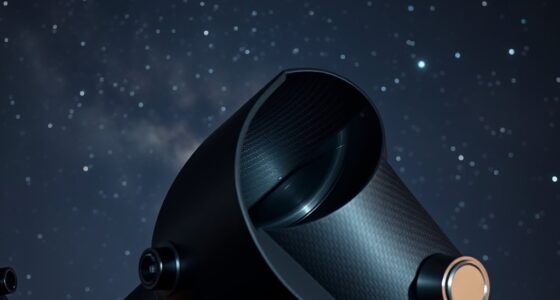
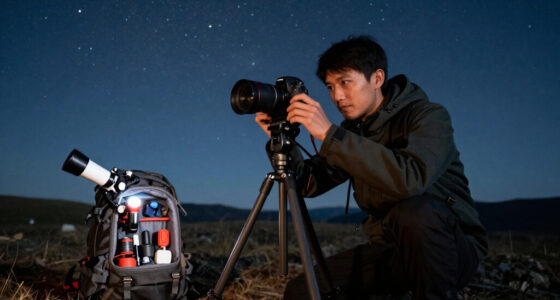
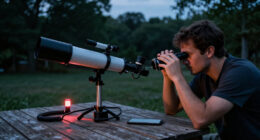
Wide-field astrophotography telescopes make it easier to frame large nebulae and star fields, but the right choice depends on how much control you want over imaging and setup. I name the Askar 71F my best overall pick for its dedicated flat-field refractor design, while the SVBONY SV545 stands out for its fast f/4.5 optics and the ZWO Seestar S30 Pro for an automated, self-contained approach. The main tradeoff is between hands-on optical flexibility and smart-scope convenience; aperture, focal length, camera compatibility, and portability also shape the decision. Read on for how these 11 options compare and which one fits your imaging style.

Prime made for students and young adults
- Fast, free delivery for dorm and study essentials
- Prime Video and Amazon Music included
- Member-only deals
Key Takeaways
- The Askar 71F leads as a dedicated wide-field choice: its 71mm f/6.9 ED quadruplet design is explicitly built around a flat imaging field, reducing dependence on a separate flattener.
- Fast optics and a wide view are not the same thing: the SVBONY SV545’s f/4.5 speed favors shorter exposure plans, but focal length and camera sensor size still determine how much sky fits in each frame.
- Smart scopes trade component choice for a simpler workflow: the Dwarf Mini, DWARF 3, Seestar S30 Pro, Seestar S30 Plus, and autofocus 4K model prioritize integrated operation over the flexibility of a separate camera and mount.
- The SVBONY lineup covers distinct imaging approaches: the SV550 bundle pairs a 122mm APO with a cooled camera, while the SV503 70mm includes a built-in flattener and the SV503 102mm is a larger ED refractor option.
- Portability and system control pull in different directions: compact automated scopes suit quick, low-setup sessions; optical-tube refractors offer more room to choose cameras and accessories, along with more gear and setup decisions.
| DWARFLAB Dwarf Mini Smart Telescope |  | Best Ultra-Portable Smart Pick | Objective lens diameter: 30 mm | Focal length: 150 mm | Field of view: 2.45° | VIEW LATEST PRICE | See Our Full Breakdown |
| Askar 71F 71mm f/6.9 ED Quadruplet APO Flat-Field Refractor Telescope |  | Best Dedicated Wide-Field Refractor | Aperture: 71 mm | Focal ratio: f/6.9 | Focal length: 493.9 mm | VIEW LATEST PRICE | See Our Full Breakdown |
| DWARF 3 Smart Telescope with App-Controlled Astrophotography |  | Best for Beginners and Multi-Use Imaging | Objective lens diameter: 35 mm | Focusing: Autofocus | Tracking: 4K auto-tracking | VIEW LATEST PRICE | See Our Full Breakdown |
| SVBONY SV545 203mm f/4.5 APO Petzval Astrophotography Telescope |  | Best Compact Full-Frame Astrograph | Focal length: 203 mm | Maximum aperture: f/4.5 | Optical design: 3-group, 5-element APO Petzval | VIEW LATEST PRICE | See Our Full Breakdown |
| SVBONY SV550 122mm APO Telescope with SV209 Field Flattener and SV405CC Cooled Camera |  | Best Complete Deep-Sky Imaging Bundle | Aperture: 122 mm | Native focal length and ratio: 854 mm, f/7 | Reduced focal length and ratio: 683.2 mm, f/5.6 | VIEW LATEST PRICE | See Our Full Breakdown |
| ZWO Seestar S30 Pro Smart Telescope |  | Best for Automated Deep-Sky Imaging | Mount: Alt-azimuth; supports equatorial mode | Focal length: 160 mm | Field of view: 4.6 degrees | VIEW LATEST PRICE | See Our Full Breakdown |
| Portable Smart Refractor Telescope with Autofocus and 4K Camera |  | Best for Screen-Based Versatility | Optical type: Refractor | Aperture: 80 mm | Focal length: 300 mm | VIEW LATEST PRICE | See Our Full Breakdown |
| SVBONY SV503 102mm f/7 ED Refractor Telescope |  | Best for Hands-On Wide-Field Control | Aperture: 102 mm | Focal length: 714 mm | Focal ratio: f/7 | VIEW LATEST PRICE | See Our Full Breakdown |
| ZWO Seestar S30 Plus Smart Telescope |  | Best Compact Smart Telescope | Objective lens: 30 mm, 4-element apochromatic lens with ED glass | Focal length: 160 mm | Focal ratio: f/5.3 | VIEW LATEST PRICE | See Our Full Breakdown |
| SVBONY SV530 ED Refractor Telescope, 80mm Aperture, 480mm Focal Length |  | Best for a Camera-Ready Flat Field | Optical design: Triplet refractor | Aperture: 80 mm | Focal length: 480 mm | VIEW LATEST PRICE | See Our Full Breakdown |
| SVBONY SV503 70mm ED Refractor Telescope with Built-In Field Flattener |  | Best Manual Wide-Field Value | Aperture: 70 mm | Focal length: 474 mm | Focal ratio: f/6.78 | VIEW LATEST PRICE | See Our Full Breakdown |
| wide field astrophotography telescope | Focal length | Aperture | Focal ratio |
|---|---|---|---|
| DWARFLAB Dwarf Mini Smart Tele | 150 mm | — | — |
| Askar 71F 71mm f/6.9 ED Quadru | 493.9 mm | 71 mm | f/6.9 |
| DWARF 3 Smart Telescope with A | — | — | — |
| SVBONY SV545 203mm f/4.5 APO P | 203 mm | — | — |
| SVBONY SV550 122mm APO Telesco | — | 122 mm | — |
| ZWO Seestar S30 Pro Smart Tele | 160 mm | — | — |
| Portable Smart Refractor Teles | 300 mm | 80 mm | f/8.89 |
| SVBONY SV503 102mm f/7 ED Refr | 714 mm | 102 mm | f/7 |
| ZWO Seestar S30 Plus Smart Tel | 160 mm | — | f/5.3 |
| SVBONY SV530 ED Refractor Tele | 480 mm | 80 mm | f/6 |
| SVBONY SV503 70mm ED Refractor | 474 mm | 70 mm | f/6.78 |
More Details on Our Top Picks
DWARFLAB Dwarf Mini Smart Telescope
The Dwarf Mini is the most travel-focused option here: at 840 g, it is much easier to pack than the 6.44 kg SVBONY SV550 setup. Its 150 mm focal length and 2.45° field of view suit wide views of larger targets, while automated target selection and tracking reduce the setup work for app-led sessions. Equatorial mode and exposures up to 90 seconds give it more deep-sky flexibility than a simple snapshot device, and built-in filters plus cloud processing can help in light-polluted locations. The tradeoff is its 30 mm objective and small sensor, which limit light gathering and image scale compared with the Askar 71F. It also depends on a smartphone and a nonstandard battery, so it is best for convenience rather than maximum image detail.
Pros:- Very light 840 g body is easy to carry to dark-sky sites.
- Automated target selection and tracking simplify locating subjects.
- Equatorial mode and exposures up to 90 seconds support deep-sky imaging.
- Built-in light-pollution filters and cloud processing add useful app-led tools.
Cons:- The 30 mm objective gathers less light than the Askar 71F’s 71 mm aperture.
- Smartphone app control is required for operation.
- Uses a nonstandard battery, which may complicate replacement or backup power.
Best for: Traveling beginners who want a lightweight, phone-controlled setup for wide sky scenes and automated target tracking.
Not ideal for: Imagers prioritizing fine detail, larger optics, or a conventional camera workflow; its 30 mm objective and app dependence are limiting.
- Objective lens diameter:30 mm
- Focal length:150 mm
- Field of view:2.45°
- Sensor:Sony IMX662, 1/2.8-inch
- Pixel size:2.9 μm
- Mount modes:Altazimuth and equatorial
- Maximum single-frame exposure:90 seconds
- Weight:840 g (1.85 lb)
Our verdict“Choose the Dwarf Mini for a compact, automated wide-field kit, not for maximum aperture or hands-on camera control.”
Askar 71F 71mm f/6.9 ED Quadruplet APO Flat-Field Refractor Telescope
The Askar 71F is the strongest fit for buyers who want a conventional refractor built around broad, corrected star fields. Its 71 mm aperture and 493.9 mm focal length offer a different balance from the short-focus DWARF Dwarf Mini: the Askar gathers more light and supports a camera-based imaging workflow, while the Mini is lighter and more automated. The air-spaced quadruplet APO design is intended to provide a flat field, reducing the need to solve edge-star curvature with a separate corrector. A rotating focuser makes framing easier when the camera orientation needs adjustment. This is not an all-in-one imaging system, though: focusing is manual, and the listed 4.5 kg item weight conflicts with the 2.5 kg telescope weight in the specifications. Buyers should verify what that weight includes before choosing a mount.
Pros:- Quadruplet APO optical design is suited to flat-field imaging without a separate flattener listed.
- 71 mm aperture gathers more light than the Dwarf Mini’s 30 mm objective.
- Rotating focuser allows camera framing without repositioning the whole telescope.
- Matte barrel interior helps reduce stray-light reflections.
Cons:- Manual focusing requires hands-on adjustment rather than automated focus.
- Listed item weight of 4.5 kg differs from the stated telescope weight of 2.5 kg.
- The 493.9 mm focal length gives a less expansive view than short-focus smart telescope designs.
Best for: Astrophotographers seeking a dedicated, flat-field refractor for camera-based wide-field imaging and who are comfortable focusing manually.
Not ideal for: Travelers seeking an integrated smart telescope or buyers who need dependable weight information before selecting a lightweight mount.
- Aperture:71 mm
- Focal ratio:f/6.9
- Focal length:493.9 mm
- Optical design:Air-spaced quadruplet APO refractor
- Field of view:6.97°
- Focuser:Manual, 360° rotation
- Telescope weight:2.5 kg stated; 4.5 kg item weight also listed
- Dovetail plate:230 mm Vixen
Our verdict“Pick the Askar 71F for a dedicated corrected refractor and camera workflow, provided you confirm its actual carried weight.”
DWARF 3 Smart Telescope with App-Controlled Astrophotography
The DWARF 3 makes the most sense for newcomers who want one compact system for night-sky sessions and daytime subjects. Its combination of telephoto and wide-angle imaging, automatic focus, and Auto GOTO offers more versatility than the astronomy-focused Askar 71F, which requires manual focusing and a separate camera workflow. App-based processing and 4K tracking make it easier to locate and follow targets without assembling a conventional imaging rig. The included carrying bag and magnetic filters also make transport and setup more straightforward. That convenience comes with a dependence on the dedicated app and cloud processing, so it offers less control over the image pipeline than the SVBONY SV550 bundle with its cooled camera. There is also a substantial weight discrepancy: the description says 1.35 kg, while the specifications list 2.28 kg.
Pros:- Telephoto and wide-angle imaging covers astronomy and daytime subjects.
- Auto GOTO, autofocus, and 4K tracking reduce manual setup.
- Cloud image processing avoids requiring a computer for basic enhancement.
- Carrying bag and magnetic filters are included.
Cons:- Image processing depends on the dedicated app and cloud computing.
- Listed weight of 2.28 kg conflicts with the 1.35 kg description.
- Offers less traditional camera and processing flexibility than the SVBONY SV550 bundle.
Best for: Beginners and outdoor observers who want app-guided sky imaging alongside wildlife, landscape, and panorama use.
Not ideal for: Astrophotographers who want independent control of processing or need a verified low carry weight; its cloud workflow and conflicting weight figures may be drawbacks.
- Objective lens diameter:35 mm
- Focusing:Autofocus
- Tracking:4K auto-tracking
- Mount modes:Altazimuth and equatorial mode
- Compatible devices:Smartphone, laptop, personal computer
- Listed item weight:2.28 kg; description states 1.35 kg
- Dimensions:2.56 × 8.74 × 5.59 in
- Battery:Lithium-ion battery included
Our verdict“Choose the DWARF 3 for accessible, multi-purpose app-guided imaging, but verify its weight and accept a cloud-dependent workflow.”
SVBONY SV545 203mm f/4.5 APO Petzval Astrophotography Telescope
The SV545 is the specialist pick for photographers who want a short-focus optical tube with full-frame coverage. Its 203 mm focal length and f/4.5 design favor broad deep-sky framing and comparatively short exposures, while the 44 mm image circle and built-in field flattener are aimed at keeping stars sharp across a full-frame sensor. That makes it a more camera-centered choice than the app-operated DWARF 3, and a much shorter-focal-length alternative to the SVBONY SV550, which reaches 683.2 mm with its reducer. The Petzval APO design also avoids the need to add a separate field flattener. The tradeoffs are a manual helical focuser, no included EAF for automated focusing, and no water resistance or image stabilization. This is an imaging tube, not a complete automated telescope setup.
Pros:- 44 mm image circle is specified for full-frame camera coverage.
- Built-in field flattener supports sharpness across the image field.
- 203 mm focal length and f/4.5 design suit broad deep-sky framing.
- Petzval APO optical design is intended to reduce chromatic aberration.
Cons:- Electronic focuser is supported but not included.
- Manual helical focusing requires adjustment during setup and imaging.
- Not water resistant and has no image stabilization.
Best for: Deep-sky imagers using full-frame cameras who want a short-focal-length astrograph with a built-in flattener.
Not ideal for: Beginners seeking an all-in-one smart telescope or anyone who needs included electronic focusing or weather protection.
- Focal length:203 mm
- Maximum aperture:f/4.5
- Optical design:3-group, 5-element APO Petzval
- Image circle:44 mm
- Focuser:Manual helical; supports EAF, not included
- Camera thread:M48
- Mount interface:Vixen dovetail
- Water resistance:Not water resistant
Our verdict“Choose the SV545 for full-frame wide-field imaging in a compact astrograph format, if you can supply your own mount, camera, and focusing solution.”
SVBONY SV550 122mm APO Telescope with SV209 Field Flattener and SV405CC Cooled Camera
The SV550 bundle is the most equipped option here for buyers building a conventional deep-sky imaging system: it pairs a 122 mm triplet APO with a reducer/flattener and a cooled color camera. The SV209 shortens the focal length from 854 mm to 683.2 mm, so the refractor gains a wider, faster configuration than its native f/7 setup while correcting field curvature. Compared with the SV545, it offers a larger aperture and an included camera, but its reduced focal length remains much longer than the SV545’s 203 mm, making it less suited to very expansive targets. The cooled IMX294 camera and USB 3.0 interface give this package a more complete imaging path than the Askar 71F alone. Its 6.44 kg optical tube and manual focus make it a heavier, more hands-on choice.
Pros:- 122 mm aperture gathers more light than the 71 mm Askar 71F.
- Included 0.8× reducer and field flattener provide a corrected f/5.6 setup.
- Cooled SV405CC camera with IMX294 sensor is included.
- Triplet APO lens with ED glass is designed to reduce chromatic aberration.
Cons:- The 6.44 kg optical tube is substantially heavier than the smart telescope options.
- Manual focusing requires user adjustment.
- Even with the reducer, its 683.2 mm focal length is less suited to very broad targets than the SV545.
Best for: Deep-sky imagers who want a larger-aperture refractor, a matched reducer/flattener, and a cooled color camera in one package.
Not ideal for: Travelers prioritizing low weight or photographers whose main subjects need an especially broad field at short focal length.
- Aperture:122 mm
- Native focal length and ratio:854 mm, f/7
- Reduced focal length and ratio:683.2 mm, f/5.6
- Optical design:FPL-51 triplet apochromatic lens with ED glass
- Field flattener:SV209 0.8× focal reducer and field flattener
- Camera:SV405CC cooled color astronomy camera
- Camera sensor:IMX294 color CMOS, 4/3 format, 11.7 megapixels
- OTA weight:6.44 kg (14.18 lb)
- Data interface:USB 3.0
Our verdict“Choose the SV550 bundle for a substantial, camera-equipped deep-sky rig, not for lightweight travel or the widest possible framing.”
ZWO Seestar S30 Pro Smart Telescope
The Seestar S30 Pro is my pick for buyers who want the telescope to handle much of the locating, tracking, and image processing. Its 4.6-degree field of view is wider than the S30 Plus’s 3-degree view, giving more room around extended targets and making it easier to frame larger sky scenes. Automatic mosaic stitching can extend that framing further, while apochromatic optics and built-in light-pollution filters support cleaner captures. At 3.64 lb, it is also easy to take to a darker site. The tradeoff is a specialized, app-led workflow: it is not intended for planetary observing, and stable deep-sky tracking requires the unit to remain stationary. Choose it over the manual SVBONY SV503 if automation matters more than direct control over a conventional optical tube.
Pros:- Automatic GoTo targeting and tracking simplify finding and following deep-sky objects.
- 4.6-degree field of view is wider than the S30 Plus’s 3-degree view.
- Apochromatic optics and built-in light-pollution filters support clearer captures.
- AI noise reduction and automatic mosaic stitching reduce processing and framing work.
Cons:- Not intended for planetary observation.
- The telescope must remain stationary for stable deep-sky tracking.
- App-based automation offers less direct control than a conventional refractor setup.
Best for: Beginners and mobile imagers who want app-guided deep-sky capture, automatic tracking, and a wide framing option without assembling a traditional imaging setup.
Not ideal for: Buyers focused on planetary imaging or those who want a conventional telescope with eyepiece-led observing and hands-on camera control.
- Mount:Alt-azimuth; supports equatorial mode
- Focal length:160 mm
- Field of view:4.6 degrees
- Imaging:Dual-camera 4K
- Focus:Autofocus and manual focus
- Power:Battery powered; one battery included
- Weight:3.64 lb
- Features:App control, GoTo targeting, automatic tracking, EQ mode, mosaic stitching, AI noise reduction, and anti-dew protection
Our verdict“Choose the Seestar S30 Pro if you want a portable, automated system with wider framing than the S30 Plus, but skip it for planetary work or traditional hands-on imaging.”
Portable Smart Refractor Telescope with Autofocus and 4K Camera
This smart refractor is the most screen-centered option here: it pairs autofocus and remote operation with a foldable display, 30 MP stills, and 4K video. That makes it more versatile for mixed daytime and nighttime use than the deep-sky-focused Seestar S30 Pro, especially for buyers who also want birdwatching and long-distance photography. Its 80 mm aperture and 300 mm focal length give it a different, longer setup than the Seestar’s 160 mm system, but the listed 350x maximum magnification should not be mistaken for a wide-field advantage. The tripod mount and up-to-six-hour battery life support portable sessions, though this is not a conventional equatorial astrophotography rig. Expanded storage requires an external card, and the battery runtime limits longer unattended sessions compared with a powered telescope setup.
Pros:- Autofocus and app or wireless remote controls reduce the need to touch the telescope during operation.
- Foldable external screen provides a viewing option beyond a smartphone or tablet.
- Captures 30 MP still images and 4K video.
- 4500 mAh battery supports up to six hours of operation.
Cons:- No field-of-view specification is provided, making wide-field framing harder to judge.
- Up to six hours of battery life can limit longer observing or imaging sessions.
- Expanded storage requires an external memory card.
Best for: Beginners who want one electronically controlled instrument for casual stargazing, Moon viewing, birdwatching, and recorded video, with a built-in screen for sharing views.
Not ideal for: Dedicated wide-field deep-sky imagers seeking a stated broad field of view, equatorial tracking, or long sessions without battery and storage planning.
- Optical type:Refractor
- Aperture:80 mm
- Focal length:300 mm
- Focal ratio:f/8.89
- Image capture:30 MP stills; 4K video
- Focus:Autofocus
- Battery:4500 mAh; up to 6 hours per charge
- Controls and display:Mobile app and wireless remote up to 85 ft; eyepiece and foldable external screen
- Storage support:External memory up to 512 GB
Our verdict“Pick this refractor for screen-based, multi-use observing and recording, but choose the Seestar S30 Pro or S30 Plus for a more clearly specified automated deep-sky workflow.”
SVBONY SV503 102mm f/7 ED Refractor Telescope
The SVBONY SV503 102mm suits imagers who would rather build a camera-and-mount system than rely on an app-controlled smart telescope. Its 102 mm aperture and 714 mm focal length provide a more conventional refractor platform than the Seestar S30 Pro, while the supplied 1.45-degree field of view is narrower than the smart telescope’s 4.6 degrees. That makes the SV503 less suited to very broad sky scenes, but a better fit for framing smaller deep-sky targets with a compatible camera. S-FPL51 ED glass helps control color fringing, and its 1:10 dual-speed focuser offers fine manual adjustment. The 360-degree rotator helps align a camera without turning the tube. This is a manual-focus optical tube, though, and a finderscope is not included; unlike the Seestar models, it also leaves imaging automation and tracking to the buyer’s other equipment.
Pros:- 102 mm aperture provides a larger refractor platform than the smart telescopes in this lineup.
- S-FPL51 ED glass helps reduce chromatic aberration and color fringing.
- 1:10 dual-speed focuser and 90 mm focus travel support fine manual adjustment.
- 360-degree field rotator helps align a camera without rotating the telescope tube.
Cons:- Its 1.45-degree field of view is narrower than the Seestar S30 Pro’s 4.6-degree view.
- Manual focus and a separately arranged mount make setup less automated.
- A finderscope is not included.
Best for: Intermediate imagers who already have, or plan to choose, a suitable mount and camera and want a 102 mm ED refractor with precise manual focusing.
Not ideal for: Beginners seeking one-tap imaging, automatic target finding, or a particularly broad field for large nebulae and Milky Way scenes.
- Aperture:102 mm
- Focal length:714 mm
- Focal ratio:f/7
- Field of view:1.45 degrees
- Optical glass:S-FPL51 ED
- Focuser:Manual dual-speed, 1:10
- Focus travel:90 mm
- Field rotator:360 degrees
- Weight:3.95 kg
Our verdict“Choose the SV503 if you want a hands-on 102 mm ED refractor for camera-based imaging, but favor the Seestar S30 Pro for wider framing and automated operation.”
ZWO Seestar S30 Plus Smart Telescope
The Seestar S30 Plus is the more compactly equipped smart choice for buyers who want automated capture and a wide-angle camera in one portable package. Its main telescope gives a 3-degree field of view, narrower than the S30 Pro’s 4.6 degrees, while the separate wide-angle camera’s 43.5-degree view suits broad sky scenes and star trails. That split gives it a distinct role: the Pro offers wider telescope framing, but the Plus adds a very broad auxiliary view and includes a tripod and carry case. Its 30 mm apochromatic ED lens and app-managed locating, focusing, tracking, and stacking keep the workflow approachable. The compromise is 2K rather than 4K imaging, plus digital viewing through the app rather than an eyepiece. Equatorial operation also requires a separately acquired compatible tripod setup.
Pros:- Lightweight 3.6 lb body ships with an aluminum tripod and carrying case.
- Apochromatic ED optics help reduce color distortion.
- App automates target locating, focusing, tracking, stacking, and post-processing.
- 43.5-degree wide-angle camera view complements the 3-degree telescope field.
Cons:- The main telescope’s 3-degree field is narrower than the S30 Pro’s 4.6-degree field.
- 2K capture offers less resolution than the S30 Pro’s dual-camera 4K imaging.
- Equatorial mode requires a compatible tripod arrangement purchased separately.
Best for: Traveling beginners who want a compact, bundled smart telescope for deep-sky targets, star trails, landscapes, and very broad sky framing.
Not ideal for: Imagers who prioritize higher-resolution capture, a wider main telescope field than the S30 Pro, or eyepiece-based viewing.
- Objective lens:30 mm, 4-element apochromatic lens with ED glass
- Focal length:160 mm
- Focal ratio:f/5.3
- Telescope field of view:3 degrees
- Wide-angle camera field of view:43.5 degrees
- Camera resolution:2K stills and video
- Weight:3.6 lb (1.65 kg)
- Dimensions:3.1 × 5.49 × 8.3 in
- Included accessories:Magnetic filter, aluminum alloy tripod, carrying case, USB-C cable, and guides
Our verdict“Choose the S30 Plus for compact travel, included accessories, and a very wide auxiliary camera view; choose the S30 Pro for wider telescope framing and 4K imaging.”
SVBONY SV530 ED Refractor Telescope, 80mm Aperture, 480mm Focal Length
The SVBONY SV530 stands apart from the smart telescopes through its conventional camera-first design and built-in field flattener. That integrated correction can simplify a wide-field imaging train by reducing the need to add a separate flattener, while the 480 mm focal length and f/6 ratio offer a shorter imaging setup than the SV503 102mm’s 714 mm focal length. Its 80 mm triplet optics, FK-61 ED glass, and broadband coatings are intended to control color and stray light, though the product is explicitly not an APO. The 1.5-degree listed field is not especially broad beside the Seestar S30 Pro’s 4.6 degrees, so this is better for a camera-and-mount rig than sweeping sky coverage. Manual focusing remains the norm, but the dual-speed focuser and EAF mounting compatibility give more room to refine or automate focus.
Pros:- Built-in field flattener avoids adding a separate flattener to the imaging train.
- 480 mm focal length and f/6 ratio provide a shorter setup than the SV503 102mm.
- 2.5-inch 10:1 dual-speed focuser supports precise manual focus.
- Preset mounting holes support compatible electronic focusers.
Cons:- Product is explicitly not an APO, despite its ED glass.
- Manual focusing is required unless a compatible electronic focuser is added.
- The 1.5-degree listed field is narrower than the Seestar S30 Pro’s 4.6-degree view.
Best for: Camera-based imagers who want an 80 mm refractor with a built-in field flattener, manual fine focusing, and compatibility with selected electronic focusers.
Not ideal for: Beginners wanting a self-contained automated telescope, or wide-sky imagers who need a field broader than the listed 1.5 degrees.
- Optical design:Triplet refractor
- Aperture:80 mm
- Focal length:480 mm
- Focal ratio:f/6
- Glass:FK-61 ED
- Field of view:1.5 degrees
- Field correction:Built-in field flattener
- Focuser:2.5-inch 10:1 dual-speed rack-and-pinion; 60 mm stroke
- Weight:9 lb
Our verdict“Pick the SV530 for a camera-ready refractor with an integrated field flattener, but choose a smart telescope for wider framing and automated capture.”
SVBONY SV503 70mm ED Refractor Telescope with Built-In Field Flattener
The SV503 70mm is a strong fit for buyers who want a flat astrophotography field without a separate flattener. Its built-in correction is designed to keep stars sharper toward the frame edges, while the 474mm focal length gives it a wide-field orientation suited to larger sky targets. ED glass helps limit color fringing, and the dual-speed focuser makes fine manual adjustments easier than a basic single-speed design.
Compared with the Askar 71F, this SVBONY offers a similarly compact aperture class but relies on manual focusing rather than an automated imaging workflow. Its 2.69kg tube is also a more manageable starting point than larger-aperture options such as the SVBONY SV550 122mm. The tradeoff is that no finderscope is included, and the supplied data lists an altazimuth mount rather than a tracking equatorial mount, so serious long-exposure imaging calls for suitable additional equipment.
Pros:- Built-in field flattener avoids needing a separate correction lens.
- ED optics help reduce chromatic aberration and color fringing.
- Dual-speed focuser allows more controlled fine focusing.
- Relatively light 2.69kg optical tube is easier to handle than larger-aperture refractors.
Cons:- No finderscope is included, adding an accessory to source for locating targets.
- Manual focusing lacks the convenience of autofocus or motorized focusing.
- The listed altazimuth mount is not a substitute for a tracking setup needed for long exposures.
Best for: Astrophotographers seeking a lightweight 70mm ED refractor with built-in field correction who are comfortable adding a tracking mount and focusing by hand.
Not ideal for: Beginners seeking a complete, automated imaging setup, or long-exposure imagers who do not already have a suitable tracking mount and camera accessories.
- Aperture:70 mm
- Focal length:474 mm
- Focal ratio:f/6.78
- Optical design:ED refractor with built-in field flattener
- Focuser:Dual-speed manual focus
- Mount type:Altazimuth
- Optical tube length:47.4 cm
- Item weight:2.69 kg
Our verdict“Choose the SV503 70mm if you want a compact, manually focused refractor with built-in field correction and plan to provide your own tracking setup.”
How We Picked
I compared each model through the needs of wide-field imaging: whether its optical design supports a usable, corrected field; how its aperture, focal ratio, and focal length shape framing and exposure; and whether it is a complete automated system or an optical tube intended for a user-built setup. I also weighed camera compatibility, portability, setup demands, and the likely learning curve, since a telescope that fits a buyer’s workflow can matter more than a headline specification.
The order favors products with a clear fit for wide-field astrophotography and a coherent balance of imaging capability and usability. The Askar 71F ranks first as a dedicated flat-field refractor; the SV545 earns a distinct place for its fast optics, while smart scopes rank for their integrated convenience rather than component flexibility. Models with bundled cameras or built-in correction can reduce system-matching work, but they may offer less freedom than a telescope paired with separately chosen equipment. Product names and listed specifications guide this comparison; I do not treat every listed feature as proof of performance under all sky, camera, or mount conditions.
Factors to Consider When Choosing Wide Field Astrophotography Telescopes
Before choosing by aperture or a product label, decide what you want the telescope to do as part of a complete imaging system. I would start with the target size, camera sensor, tracking setup, and the amount of assembly you are willing to manage. These factors can prevent a common mismatch: buying an appealing telescope that frames the wrong targets or requires more supporting equipment than expected.
Match Focal Length to the Targets You Want to Frame
Focal length, together with the size of your camera sensor, sets the actual field of view. A shorter focal length generally frames larger nebulae and broad star fields more easily, while a longer one makes smaller targets occupy more of the image. Do not use the “wide-field” label alone as a substitute for checking framing; two scopes can have different fields even when both are sold for astrophotography. Use a field-of-view calculator with your intended camera before buying, and check whether your favorite targets fit with room for composition. A mismatch can leave you cropping heavily or wishing you had chosen a longer focal length. For a first dedicated rig, choosing around your most frequent targets is usually more useful than trying to cover every target with one telescope.
Treat Focal Ratio as One Part of Exposure Planning
A lower focal ratio can collect light more quickly for a given image scale, which can help when imaging under limited clear skies. It does not, on its own, guarantee cleaner images or better results: tracking accuracy, focus, sky brightness, camera sensitivity, and total exposure time all play a part. Faster systems can also make focus and optical correction more demanding, and they may call for careful matching of camera and accessories. A slower refractor can remain a sensible choice when its field correction and handling suit your targets and workflow. Compare focal ratio alongside focal length and sensor size rather than choosing by the fastest specification. Think of speed as a workflow advantage with tradeoffs, not a complete measure of imaging quality.
Check How the Imaging Field Is Corrected
Stars near the edge of an image can reveal whether the optical system is well matched to the camera sensor. Some refractors are designed with field correction built in, while others need a separate flattener or reducer to produce a flatter image across the frame. A built-in solution can simplify spacing and accessory choices, but it may tie you more closely to the telescope’s intended configuration. With a separate corrector, check the required back focus, adapter threads, and sensor coverage before ordering. Buyers often overlook those mechanical details and discover that a camera will not reach the specified spacing with the adapters they own. If you expect to change cameras later, include the cost and compatibility of future correction hardware in your system plan.
Decide Between a Smart Scope and a Modular Rig
Smart scopes combine optics, camera, tracking, and software in a package aimed at reducing setup and component matching. That makes them appealing for short sessions, travel, or buyers who would rather operate an app than assemble a rig. Their integrated design can limit your choice of cameras, mounts, and processing workflow, so check what the system lets you control before treating convenience as a complete substitute for flexibility. A conventional refractor calls for a mount, camera, power plan, and compatible accessories, but each part can be selected or upgraded separately. The common mistake is comparing the telescope alone against a complete smart scope without counting the extra gear needed to make the refractor system work. Choose based on whether you value a ready-to-run setup or the ability to shape the imaging system around your preferences.
Plan Around Mount Capacity, Tracking, and Power
The telescope is only one load on the mount: camera, adapters, guide equipment, and cabling add weight and can affect balance. A mount that tracks well enough for visual observing may not hold stars sharply during long exposures, especially as the imaging load grows. Before committing to a larger refractor, check the mount’s imaging capacity and leave room for the rest of the rig rather than relying only on its maximum payload figure. Smart scopes reduce some of this matching work through an integrated design, though they still need a stable placement and a power plan suited to the session. Also account for transport, setup space, and cable management, which can determine how often a system gets used. Paying for a larger telescope without budgeting for adequate tracking support can deliver less benefit than choosing a smaller, well-supported setup.
Pay More for Capabilities You Will Use
Extra aperture, a cooled camera bundle, or built-in field correction can be worthwhile when those features address a real limitation in your current setup. A packaged camera-and-telescope combination may reduce compatibility work, but it can narrow future camera choices compared with buying an optical tube on its own. Newer imagers may get more useful sessions from a portable automated scope than from a complex rig that takes longer to assemble and learn. Experienced imagers may prefer modular components that allow gradual upgrades, even when the initial setup requires more research. Check what is included, what must be purchased separately, and whether the system can grow with your plans. The right upgrade is the one that improves your actual imaging workflow, not simply the one with the longest feature list.
Frequently Asked Questions
Can I use a wide-field telescope for visual observing as well as astrophotography?
Many refractors can serve both purposes, but the best configuration for imaging is not automatically the most convenient for visual use. Imaging may require a camera, field corrector, and precise back-focus spacing, while visual observing needs an eyepiece and suitable focus travel. Smart scopes are generally designed around their integrated imaging workflow rather than conventional eyepiece observing. Before choosing a dual-purpose refractor, check whether it reaches focus with the eyepieces you plan to use and whether camera accessories can be removed without difficult reconfiguration. If imaging is the main goal, prioritize camera compatibility and field correction first, then confirm that visual use is supported.
Do I need a separate field flattener for a wide-field refractor?
Not always: some designs include field correction, while others require a separate flattener or a reducer-flattener. The need depends on the telescope’s optical design and the camera sensor you plan to use, since a larger sensor can expose edge distortions that are less apparent on a smaller one. Check the manufacturer’s correction requirements and the recommended spacing before buying accessories. A corrector that is mechanically incompatible or set at the wrong distance may leave stars distorted at the edges. If ease of setup matters, a design with correction built in can reduce parts to match, while a separate corrector may give you more configuration options.
Should I choose a smart telescope or a refractor that takes a separate camera?
Choose a smart telescope if an integrated, app-led workflow and reduced component matching matter more than selecting each part of the system. Choose a separate-camera refractor if you want greater control over camera choice, mount, and future upgrades, and are prepared to configure those pieces. Compare the complete system rather than the telescope alone: a refractor setup may also need a mount, camera, adapters, power, and field correction. Smart designs can be easier to transport and start using, but their integrated hardware may limit changes later. Your tolerance for setup and your interest in processing should guide the decision as much as the optical specifications.
How can I tell whether a telescope will frame my intended nebula or star field?
Use the telescope’s focal length and the camera sensor dimensions in a field-of-view calculator, then compare the resulting frame with a chart or image of your target. The same telescope can produce noticeably different framing with different sensors, so do not judge from focal length alone. Include a little space around the target if you want room for composition or cropping, and check whether nearby objects fit in the same frame. If the field is too tight, a shorter focal length or a compatible reducer may help; if it is too broad, a longer focal length may suit that target better. Confirm reducer compatibility and the resulting image scale before making that change.
What supporting equipment should I budget for with an optical-tube refractor?
Plan for a tracking mount, a compatible camera, the adapters needed to connect it, and any field corrector required by the optical design. Depending on your imaging plan, you may also need a guide setup, dew control, a reliable power source, and software for capture and focusing. The exact list varies with the telescope and whether you already own astronomy gear, so check the included accessories rather than assuming the product name describes a complete imaging system. Mount capacity should account for the full assembled load, not only the bare telescope. Comparing that complete setup against an integrated smart scope gives a more useful picture of the effort and flexibility involved.
Conclusion
For a dedicated wide-field refractor, I would start with the Askar 71F as the best overall because its flat-field design gives the roundup a clear imaging-first choice. The SVBONY SV545 is my pick for buyers prioritizing fast optics, while the SV550 package suits those who want a larger APO paired with a cooled camera rather than sourcing every core component separately. For beginners who want fewer setup decisions, I would look first at the ZWO Seestar S30 Pro or compare the other integrated smart scopes by their particular workflow; their convenience comes with less hardware freedom. The SVBONY SV503 70mm stands out for a compact refractor approach with a built-in flattener, while the SV503 102mm is a larger ED option for buyers building around a separate imaging system. My best-value recommendation is the SVBONY SV530 80mm for shoppers seeking a conventional 80mm ED refractor, provided its camera correction and accessory needs fit their setup. Choose by target framing and the complete imaging workflow first; those decisions will narrow this lineup more reliably than aperture alone.