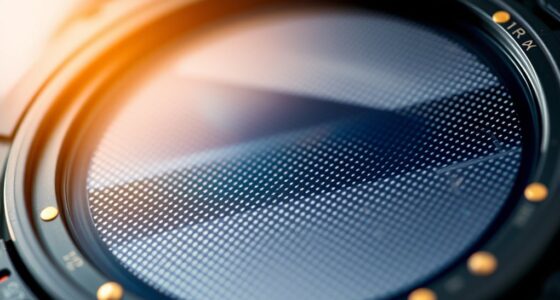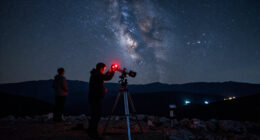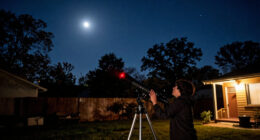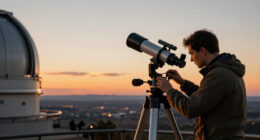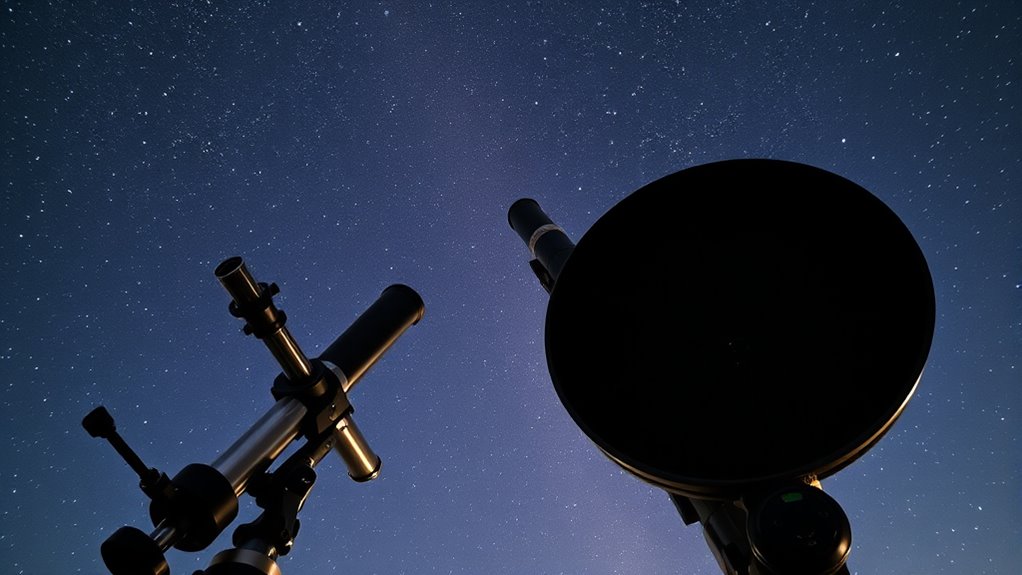

When choosing between a refractor or reflector for deep-sky imaging, consider your priorities. Refractors offer sharp, high-contrast images with minimal maintenance but usually have smaller apertures. Reflectors provide larger apertures at a lower cost, ideal for capturing faint objects, though they require regular collimation. Both types have benefits; understanding these differences can help you pick the best telescope for your astrophotography goals. Keep exploring to uncover more details to guide your choice.

Prime made for students and young adults
- Fast, free delivery for dorm and study essentials
- Prime Video and Amazon Music included
- Member-only deals
Key Takeaways
- Reflectors typically offer larger apertures at a lower cost, enhancing deep-sky object detail and faint object visibility.
- Refractors provide sharper, high-contrast images with minimal maintenance, ideal for consistent deep-sky imaging.
- Reflectors require regular collimation but allow for bigger mirrors, improving light gathering for faint objects.
- Refractors are more compact and easier to use, making them suitable for portable deep-sky observation setups.
- Choice depends on priorities: refractors for ease and clarity, reflectors for maximum light collection and detail.
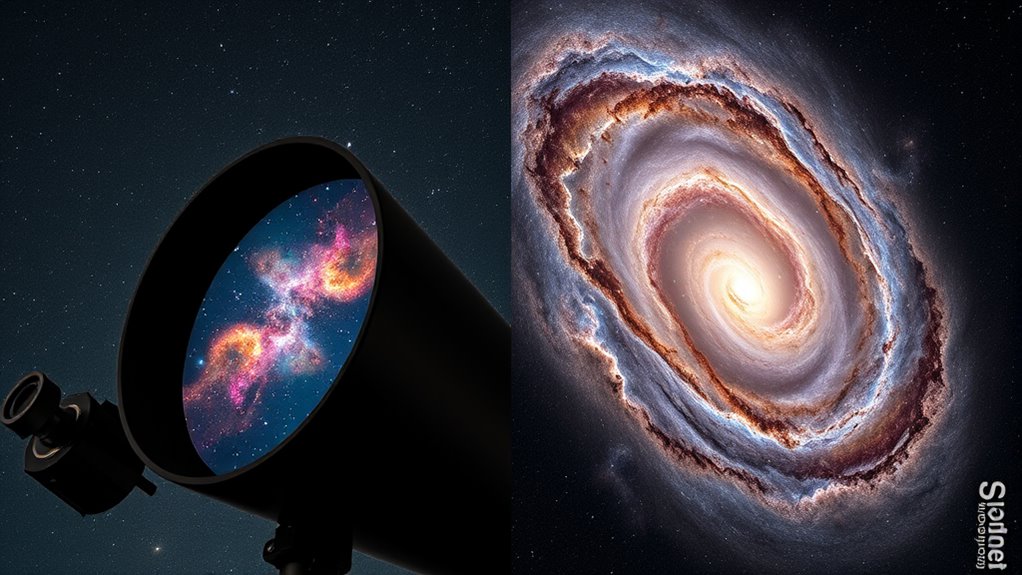
When choosing a telescope, understanding the differences between refractors and reflectors is essential, as each type offers unique advantages suited to different stargazing needs. For deep-sky imaging, these distinctions become particularly important because they influence image clarity, ease of use, and overall performance. One of the key factors to consider is lens quality, which directly affects the sharpness and contrast of the images you capture. Refractor telescopes use lenses to focus light, and high-quality lenses reduce chromatic aberration, ensuring clearer, more precise images. Conversely, reflectors rely on mirrors, which don’t suffer from chromatic aberration, but the mirror’s quality and coating are crucial to minimizing distortions and maximizing light transmission.
Mirror size is another critical aspect when evaluating reflectors for deep-sky imaging. Larger mirrors gather more light, making faint nebulae, galaxies, and star clusters more visible and detailed. While refractors tend to have smaller apertures due to their design constraints, reflectors can be built with significantly larger mirrors at a more affordable cost. This advantage allows you to capture more detail in dim objects, which is vital for deep-sky astrophotography. However, bigger mirrors also mean more maintenance, such as regular collimation, to keep the optical path aligned and ensure optimal image quality.
Larger mirrors improve faint object detail but require more maintenance like collimation.
Refractors generally offer more straightforward operation with minimal maintenance, making them appealing if you want consistent, sharp images with less fuss. Their sealed tube design helps prevent dust and misalignment issues, which is especially beneficial for beginners or those who prefer a more plug-and-play approach. Reflectors, on the other hand, often provide larger apertures at a lower price point, giving you the power to resolve finer details in faint objects. This makes them a popular choice among serious astrophotographers aiming to push the limits of deep-sky imaging. Additionally, advancements in optical technology continue to improve the performance and affordability of both types, expanding options for enthusiasts at all levels.
Ultimately, your choice depends on what you prioritize: if you want crisp, high-contrast images with minimal fuss and don’t need the largest aperture, a high-quality refractor might be best. If your goal is to capture faint, distant objects with maximum detail and you’re prepared for some maintenance, a reflector with a large mirror is the way to go. Both types can produce stunning deep-sky images, but understanding how lens quality and mirror size impact performance helps you select the best telescope for your astrophotography journey.
high quality refractor telescope for astrophotography
As an affiliate, we earn on qualifying purchases.
As an affiliate, we earn on qualifying purchases.
Frequently Asked Questions
How Do Temperature Changes Affect Each Telescope’s Performance?
Temperature changes can impact your telescope’s performance through thermal expansion and cooling effects. As temperatures fluctuate, materials in your refractor or reflector expand or contract, potentially causing misalignment or focus shifts. Cooling effects can lead to fogging or dew on lenses and mirrors, reducing image clarity. To maintain ideal performance, allow your telescope time to reach thermal equilibrium, and use dew shields or heaters if necessary, especially during rapid temperature drops.
Which Telescope Type Is Better for Astrophotography Beginners?
You’ll find that refractors are better for astrophotography beginners because of their straightforward mounting compatibility and high lens quality. Like a reliable compass guiding you through unfamiliar terrain, a refractor’s simplicity helps you focus on capturing stunning images without fuss. Reflectors, while powerful, often require more maintenance and precise alignment, making them less beginner-friendly. Start with a quality refractor, and you’ll enjoy clearer, easier imaging journeys.
What Maintenance Is Required for Refractor Versus Reflector Telescopes?
You’ll need to regularly check optical alignment, especially for reflector telescopes, to guarantee sharp images. Refractors require less maintenance, mainly occasional cleaning of lenses with proper procedures. Reflectors need periodic collimation to keep mirrors aligned, along with cleaning of the mirrors and tubes to prevent dust buildup. Both types benefit from careful handling and storage to avoid damage or misalignment, keeping your telescope performing at its best over time.
How Do Size and Weight Impact Portability and Storage?
Size and weight are like the anchor and sail of your telescope journey, shaping your experience. Larger, heavier models challenge mounting options and make transportation a chore, limiting your ability to explore different skies easily. Smaller, lightweight telescopes offer greater portability and easier storage, fitting comfortably into closets or car trunks. Your choice affects how effortlessly you can set up, move, and enjoy deep-sky imaging under the stars.
Are There Specific Celestial Objects Better Observed With One Type?
You’ll find refractors excel at observing planets and brighter deep-sky objects because they reduce chromatic aberration, providing sharp images. Reflectors are better for faint, extended objects like galaxies and nebulae, as they handle light pollution more effectively and don’t suffer from chromatic aberration. If your focus is on deep-sky imaging in areas with light pollution, a reflector might give you clearer, more detailed views compared to a refractor.
large aperture reflector telescope for deep-sky imaging
As an affiliate, we earn on qualifying purchases.
As an affiliate, we earn on qualifying purchases.
Conclusion
When choosing between refractors and reflectors for deep-sky imaging, consider your budget and imaging needs. Reflectors often offer larger apertures at lower costs, making them popular among amateur astronomers. Did you know that over 60% of deep-sky imagers prefer reflectors for their affordability and performance? Whichever you pick, remember that the right telescope can turn your stargazing dreams into stunning astrophotos. Happy observing!
telescope collimation tools for reflectors
As an affiliate, we earn on qualifying purchases.
As an affiliate, we earn on qualifying purchases.
compact refractor telescope for beginners
As an affiliate, we earn on qualifying purchases.
As an affiliate, we earn on qualifying purchases.
Fall Picks
fall essentials
As an affiliate, we earn on qualifying purchases.