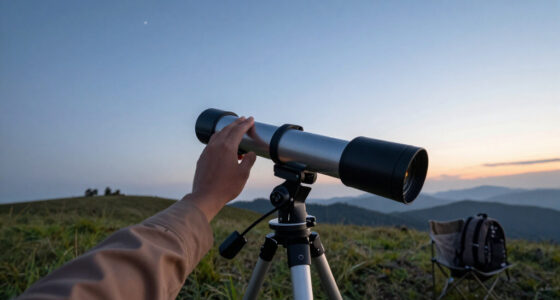
Understanding F/ratio helps you see how quickly your telescope gathers light and how bright your images will be. A lower F/ratio (fast telescope) means brighter images and better performance for astrophotography, while a higher F/ratio (slow telescope) produces sharper, more detailed views of planets and the Moon. Knowing this balance allows you to choose the right telescope for your goals. Exploring further will reveal how to optimize your observing experience based on F/ratio insights.

Prime made for students and young adults
- Fast, free delivery for dorm and study essentials
- Prime Video and Amazon Music included
- Member-only deals
Key Takeaways
- F/ratio indicates how fast a telescope is, with lower ratios being “faster” and gathering light more quickly.
- A lower F/ratio results in brighter images, ideal for observing faint objects and astrophotography.
- Higher F/ratio telescopes produce sharper, more detailed images but with less brightness.
- F/ratio is calculated by dividing the focal length by the aperture size; smaller values mean faster optics.
- Matching F/ratio to your observing goals enhances image brightness, detail, and overall viewing experience.

When choosing a telescope, understanding its F/ratio is essential because it directly influences how bright and sharp your images will be. The F/ratio, or focal ratio, is the telescope’s focal length divided by its aperture size. This number determines how fast the telescope can gather light and how the image will appear through your eyepiece. A lower F/ratio means the telescope has a larger aperture relative to its focal length, which results in a brighter, more detailed view of faint objects like galaxies and nebulae. Conversely, a higher F/ratio indicates a longer focal length and a smaller relative aperture, producing sharper images but with less brightness. The aperture size plays a key role here. It’s the primary factor that affects how much light your telescope can collect. Larger apertures gather more light, making faint objects appear brighter and more visible. When you choose a telescope with a big aperture, you’ll notice enhanced image brightness, which is particularly useful for astrophotography and observing dim celestial bodies. The F/ratio amplifies this effect because it determines the speed at which light is gathered and how the image is rendered. For example, a telescope with an aperture of 200mm and a focal length of 800mm has an F/4, meaning it’s a fast telescope suitable for capturing bright images quickly. On the other hand, a 200mm aperture with a 2000mm focal length results in an F/10, making it a slower telescope that produces more detailed but dimmer images. Additionally, understanding the relationship between F/ratio and light-gathering ability can help optimize your observational or imaging experience. Understanding how F/ratio impacts image brightness helps you match a telescope to your observing goals. If you want to view faint deep-sky objects or do astrophotography, you’ll likely prefer a telescope with a lower F/ratio, as it allows you to capture more light in shorter exposure times. For planetary or lunar observations where detail and sharpness are more important than brightness, a higher F/ratio can be advantageous.
best astrophotography telescope with low F/ratio
As an affiliate, we earn on qualifying purchases.
As an affiliate, we earn on qualifying purchases.
Frequently Asked Questions
How Does F/Ratio Affect Telescope Portability?
A lower f/ratio makes your telescope more portable because it often results in a more compact design. When you choose a faster telescope, it’s easier to carry and set up, fitting into smaller spaces. This improves portability considerations, especially if you travel frequently or have limited storage. So, if portability matters most, look for telescopes with a lower f/ratio to enjoy a lightweight, convenient setup.
Can F/Ratio Improve Image Resolution?
F/ratio doesn’t directly improve image resolution, but it can enhance image clarity and optical precision. A lower f/ratio, or faster telescope, allows you to see brighter images, making details stand out more clearly. This improved brightness helps you discern finer features, indirectly boosting the perceived resolution. So, while it doesn’t change the fundamental resolving power, a suitable f/ratio can make your observations sharper and more detailed.
Is a Lower F/Ratio Better for Astrophotography?
Think of a lower f/ratio as the open window to the universe—it’s better for astrophotography because it offers a wider field of view and faster image capture. A low f/ratio allows for higher magnification without sacrificing image brightness, making it easier to capture faint objects. So, if you’re chasing detailed deep-sky shots, a lower f/ratio telescope is your best friend for clearer, more vibrant astrophotos.
How Does F/Ratio Influence Eyepiece Choice?
Your telescope’s f/ratio influences eyepiece choice because it affects eyepiece compatibility and the field of view. A faster f/ratio (lower number) requires eyepieces with a wider eye relief and better correction for aberrations. It also offers a wider field of view, ideal for deep-sky objects, but may demand more specialized eyepieces. Conversely, slower f/ratios are more forgiving, allowing a broader selection of compatible eyepieces.
What Is the Impact of F/Ratio on Telescope Maintenance?
Think of your telescope as a diva demanding constant pampering. A faster f/ratio means more frequent optical alignment checks and delicate coating maintenance, as light-speed optics are more prone to misalignment and coating wear. You’ll spend extra time ensuring lenses stay pristine and aligned, or risk blurry views. Basically, a low f/ratio’s like a high-maintenance celebrity—glamorous but requiring ongoing care to keep its shine.
high aperture telescope for deep-sky observation
As an affiliate, we earn on qualifying purchases.
As an affiliate, we earn on qualifying purchases.
Conclusion
Now that you understand f/ratio, you realize it’s the secret sauce behind a telescope’s speed and light-gathering power. Choosing the right f/ratio can make your stargazing experience feel like wielding a cosmic superpower. Remember, a small change can transform a faint smudge into a breathtaking masterpiece of the universe. So, embrace this knowledge—you’re now equipped to *uncover* the stars’ deepest secrets with the precision of a celestial wizard.
compact telescope for planetary viewing
As an affiliate, we earn on qualifying purchases.
As an affiliate, we earn on qualifying purchases.
telescope with adjustable F/ratio
As an affiliate, we earn on qualifying purchases.
As an affiliate, we earn on qualifying purchases.
Fall Picks
fall essentials
As an affiliate, we earn on qualifying purchases.