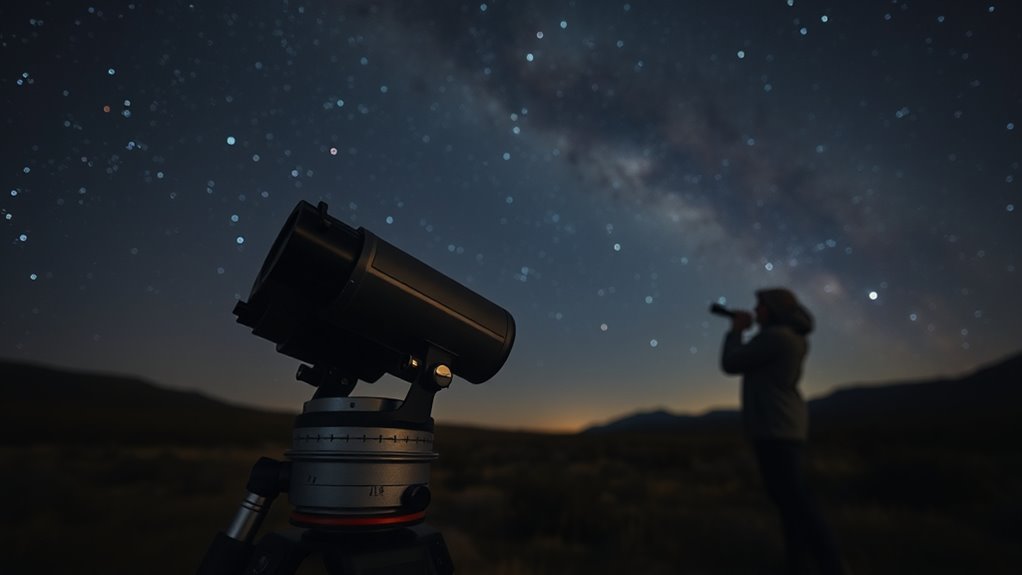
To perform portable polar alignment with a star tracker, start by leveling your mount and roughly aiming it toward Polaris or a calibration star. Use the star tracker’s built-in scope or reticle to refine the alignment, centering bright stars accurately. Regularly recheck and adjust as needed, especially when moving to new locations. Good calibration guarantees precise tracking for astrophotography. Keep exploring to discover more tips for achieving ideal portable polar alignment.
Key Takeaways
- Use a portable mount and star tracker with built-in polar scopes or reticles for quick alignment in the field.
- Roughly aim the mount toward Polaris or a calibration star before fine-tuning.
- Level the mount with a bubble level to eliminate tilt errors during alignment.
- Center Polaris or calibration stars in the viewfinder or camera to refine polar alignment.
- Repeat calibration at each new location to maintain accurate star tracking during portable astrophotography.
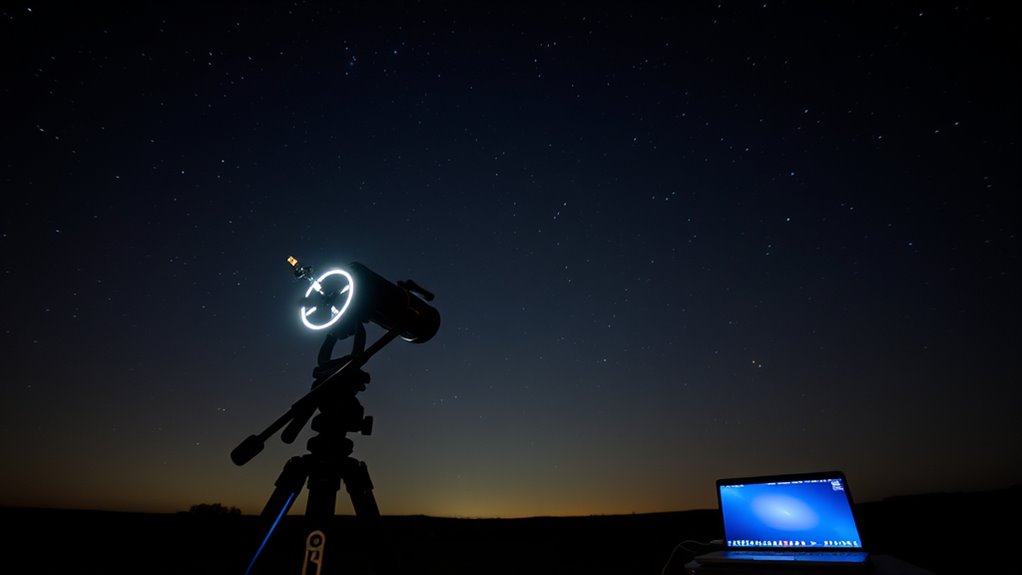
Ever wondered how astronomers achieve precise polar alignment using a star tracker? It’s all about meticulous mount alignment and star tracker calibration. When you’re working in the field or setting up a portable observatory, these steps become even more essential because you don’t have the luxury of permanent, fixed setups. A properly aligned mount ensures your star tracker can accurately follow celestial objects, making the entire process of astrophotography or deep-sky observation much smoother.
First, you need to focus on mount alignment. This involves ensuring that your telescope mount is correctly oriented with the Earth’s rotational axis. Unlike permanent installations, portable setups often require quick, reliable methods. You typically start by leveling the mount using a bubble level, which helps eliminate tilt errors. Then, you roughly point the mount toward Polaris, the North Star, if you’re in the northern hemisphere. Many portable mounts have built-in polar alignment scopes or reticles that assist you in this step. However, for higher precision, you’ll want to perform a star tracker calibration.
Begin by leveling your mount and roughly aiming at Polaris for quick, reliable polar alignment.
Star tracker calibration is the process of fine-tuning your device to recognize the celestial environment accurately. It involves aligning the star tracker’s internal sensors with the actual sky position. When you calibrate your star tracker, you’re essentially teaching it to interpret star positions correctly, which is crucial for achieving precise polar alignment. Many modern star trackers come with software that guides you through calibration steps. Typically, you’ll select calibration stars, which are bright and easily identifiable, and then let the device analyze their positions. This process helps compensate for any mechanical or optical imperfections, ensuring the tracker’s data aligns perfectly with the true sky.
For portable applications, calibration often needs to be repeated each time you set up in a new location or after moving your equipment. This might sound tedious, but it’s essential for high accuracy. After calibration, you refine your mount alignment by centering Polaris or the chosen calibration star in your eyepiece or camera. As you do so, the star tracker uses its calibration data to adjust its understanding of the sky’s orientation relative to your mount. This step ensures your mount’s polar axis is aligned precisely with the celestial pole, minimizing drift over long exposures.

Equatorial Mount Star Tracker with Ball-Head Gimbal for Astrophotography
- Material: PETG and carbon fiber shell
- Control Chip: EESP32S dual-core processor
- Rotation Support: Stellar, moon, custom speeds
As an affiliate, we earn on qualifying purchases.
As an affiliate, we earn on qualifying purchases.
Frequently Asked Questions
Can Star Tracker Polar Alignment Be Used for Astrophotography?
Yes, star tracker polar alignment is ideal for astrophotography. It guarantees your mount is precisely aligned with Earth’s axis, resulting in sharp, long-exposure images. Using portable alignment techniques, you can quickly calibrate your star tracker in the field, saving time and effort. Proper star tracker calibration helps you achieve accurate polar alignment, making it easier to capture stunning astrophotos without the need for complex setups or permanent installations.
How Does Weather Affect Star Tracker Accuracy?
Weather considerably impacts star tracker accuracy, especially through atmospheric turbulence and cloud cover. Turbulence causes star images to twinkle and shift, making precise alignment difficult. Cloud cover blocks your view of stars altogether, preventing effective calibration. To get the best results, choose clear, stable nights with minimal turbulence. Keep in mind that even slight atmospheric disturbances can reduce your star tracker’s precision, so patience and ideal weather conditions are key for accurate polar alignment.
What Are Common Troubleshooting Steps for Misalignment?
Did you know that up to 30% of misalignments are due to simple calibration errors? To troubleshoot, first check your mount calibration, ensuring all settings are accurate. Next, verify your firmware is up to date, as outdated software can cause misalignment issues. If problems persist, reset the star tracker and re-calibrate, making sure to follow the manufacturer’s instructions closely. These steps often resolve most common misalignment problems efficiently.
Is Prior Astronomy Experience Necessary for Portable Alignment?
No, prior astronomy experience isn’t necessary for portable alignment. While beginner skills can help you understand star patterns and movements, the process is designed to be user-friendly. With clear instructions and practice, you can learn to align effectively even without prior knowledge. The key is to follow step-by-step guides, use the star tracker consistently, and gain confidence through hands-on experience.
How Long Does a Typical Star Tracker Polar Alignment Take?
You can typically complete a star tracker polar alignment in about 10 to 20 minutes. It involves mount calibration and using the polar scope to fine-tune your alignment. The process feels like a dance between adjusting your mount and peering through the polar scope, making it efficient even for beginners. With patience, you’ll have your mount precisely aligned, ready to capture stunning night sky images in no time.

Astromania Polar Alignment Scope for EQ-3 Equatorial Telescope Mount
- Compatible Mount: Designed for EQ3 mounts
- Quick Alignment: Achieve accurate polar alignment rapidly
- Enhanced Astrophotography: Supports long exposure astrophotography
As an affiliate, we earn on qualifying purchases.
As an affiliate, we earn on qualifying purchases.
Conclusion
Mastering polar alignment with a star tracker is like tuning a fine instrument—you’ll find harmony in your observations when everything lines up perfectly. With portable methods, you can navigate the night sky’s vast symphony effortlessly, even on the go. Trust your star tracker as your compass, guiding you through the celestial maze. When aligned accurately, the universe opens up in breathtaking clarity, revealing its secrets just like a well-played melody that resonates long after the notes fade.

Camco Camper/RV Level – Features Bullseye Bubble Level Design for Fast Settling – Reads 360-Degrees Simultaneously – Can be Mounted or Free Standing (25573)
- 360-Degree Bubble Level: Reads level from all angles
- RV Level Indicator: Shows when RV is level
- Versatile Mounting Options: Mounts or stands freely
As an affiliate, we earn on qualifying purchases.
As an affiliate, we earn on qualifying purchases.

PINPOINT® High-Precision pH Calibration Fluids Kit (pH Buffer Solution), 12 piece Set – pH 4.000, 7.000, 10.000
- High-precision calibration fluids: Ensures accurate pH calibration
- Ready to use: No mixing required
- Field portable: Suitable for on-site use
As an affiliate, we earn on qualifying purchases.
As an affiliate, we earn on qualifying purchases.