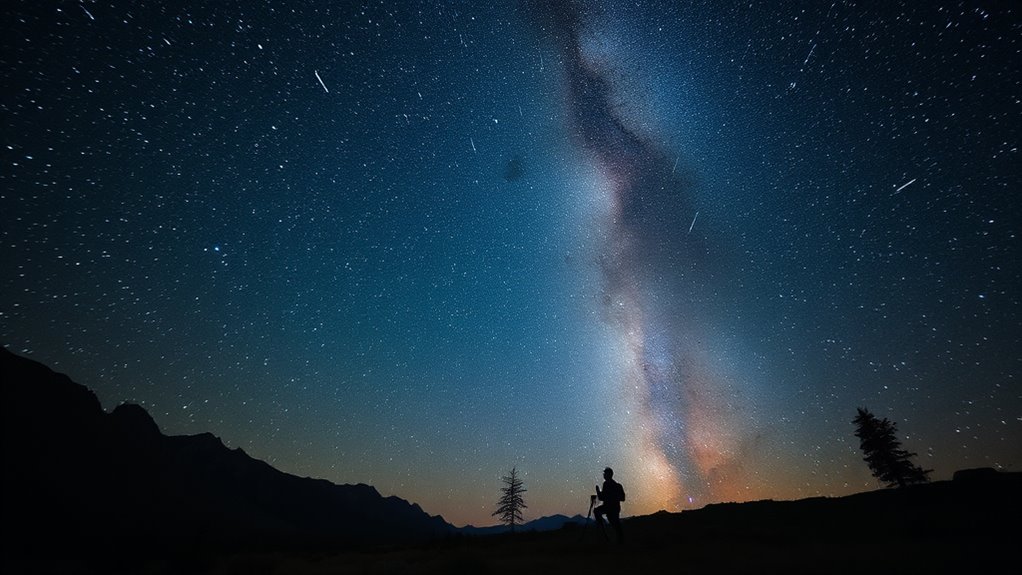

To plan your night for the Leonid Meteor Shower 2025, check the moon phase and weather forecast to guarantee dark, clear skies. Head to a location far from city lights, bring warm clothes, a blanket, and a reclining chair for comfort. The peak will likely be early morning hours when meteor activity is highest. With the right preparations, you’ll enjoy a breathtaking display of shooting stars—keep going to discover more about this spectacular cosmic event.
Key Takeaways
- Check moon phases and weather forecasts to ensure clear, dark skies for optimal viewing during early morning hours.
- Find a dark, open area away from city lights to enhance visibility of the meteors.
- Prepare comfortable seating, warm clothing, and blankets for a long, patience-required night.
- Be aware that meteor activity peaks in the early morning hours of 2025 for the best viewing experience.
- Understand the shower’s origin from Comet Tempel-Tuttle to appreciate the cosmic spectacle.

Are you ready to witness a spectacular celestial event? The Leonid meteor shower of 2025 promises to be an unforgettable display of shooting stars streaking across the night sky. As you prepare for this cosmic spectacle, understanding what makes these meteors so enthralling can enhance your experience. The meteoroid composition of the Leonids plays a significant role in their brilliance and frequency. These meteoroids originate from Comet Tempel-Tuttle, a short-period comet that orbits the Sun roughly every 33 years. When Earth passes through the debris trail left by the comet, tiny particles—meteoroids—enter our atmosphere at incredible speeds, often over 70 kilometers per second. As they collide with atmospheric gases, they burn up, creating the bright streaks we see as meteors. The composition of these meteoroids varies; many contain metallic elements and silicate minerals, which contribute to their luminous display. Some meteoroids are fragile, disintegrating quickly, while others are more robust, producing longer-lasting trails. This diversity influences the intensity and appearance of the shower.
Additionally, understanding the meteoroid composition and its impact on the shower’s display can deepen your appreciation for the event’s natural beauty. Historically, the Leonid meteor shower has fascinated skywatchers for centuries. Records date back to the 18th century, where early observations documented intense storms of meteors that seemed almost biblical in scale. Remarkably, in 1833, the Leonids produced what was then considered a meteor storm, with thousands of meteors per hour visible across North America. These extraordinary displays prompted scientific interest, leading to a deeper understanding of meteoroids and their origins. Over the years, astronomers have tracked the shower’s periodic peaks, confirming its connection to Comet Tempel-Tuttle. The 20th and 21st centuries saw increasingly detailed observations, using both visual reports and advanced technology like radar and photography, to study the shower’s behavior. Knowing this history helps you appreciate the significance of the upcoming 2025 event, as it’s part of a pattern that has long enthralled humanity.
To make the most of your night, check the moon phase and weather forecast beforehand. Clear, dark skies away from city lights will give you the best view. Bring a blanket, some warm clothes, and perhaps a reclining chair, so you can comfortably gaze upward for hours. Remember, the meteors will appear randomly, but during peak times—predicted for the early morning hours—you’ll likely see the most activity. Keep in mind that the intensity of the shower can vary based on how much debris the Earth encounters that year. With a little patience and preparation, you’ll join countless others in witnessing the magic of the Leonids, a celestial event rooted in centuries of observation and cosmic debris. Get ready to be amazed by the night sky’s fiery display.

Romswi 2Pack 4-Position Reclining Camping Chair with Removable Footrest, 2-in-1 Adjustable Portable Lounge Chair with Cooler Bag, Cup Holder, Side Pockets & Carry Bag for Outdoor, Mesh Black
- Versatile 4-in-1 Design: Switch between chair and lounger with footrest
- Adjustable Recline Angles: Four positions from 100° to 150°
- Heavy-Duty Support: Supports up to 300 lbs with reinforced frame
As an affiliate, we earn on qualifying purchases.
As an affiliate, we earn on qualifying purchases.
Frequently Asked Questions
What Is the Best Time of Night to View the Leonids?
You should aim to view the Leonids after midnight when the sky is darkest and light pollution from urban areas diminishes. Late at night, typically between 1am and 3am, offers the best chances to see shooting stars clearly. Avoid brightly lit areas, and find a spot far from city lights for ideal viewing. This guarantees minimal light pollution, providing a better experience of the meteor shower.
How Does Moon Phase Affect Viewing Conditions?
The moon phase plays a vital role in your viewing conditions. During a new moon, moonlight interference is minimal, and sky brightness stays low, giving you a clearer view of the meteors. Conversely, a full moon brightens the sky, reducing visibility of the faint shooting stars. To maximize your experience, plan your watch during a new moon or when the moon is below the horizon, ensuring ideal darkness for viewing.
Are There Specific Locations Ideal for Viewing?
Think of the sky as a canvas, and you want it as dark as possible for the most vivid strokes of shooting stars. You should head to rural locations, far from city lights, where the darkness lets the meteors shine brightest. These dark skies provide the ideal setting, offering unobstructed views of the Leonid Meteor Shower. Your best chance for a spectacular display lies in these remote, light-pollution-free spots.
Will Weather Predictions Impact the Viewing Experience?
Weather predictions definitely affect your viewing experience. Keep an eye on the cloud forecast, as heavy cloud cover can obscure the meteors, making it harder to see the shower. Clear skies are ideal, so plan your night around weather updates. If clouds threaten, consider moving to a higher or more open location with less atmospheric interference. Staying flexible based on the forecast ensures you’ll have the best chance to enjoy the shooting stars.
How Can I Photograph the Leonid Meteor Shower Effectively?
To photograph the Leonid meteor shower effectively, use star trail photography techniques by setting your camera on a tripod and using long exposures. Adjust your camera settings to a wide aperture (like f/2.8), a low ISO (800-1600), and a shutter speed around 20-30 seconds. Consider using a remote shutter or timer to prevent shake, and focus on a dark, clear sky for the best results.
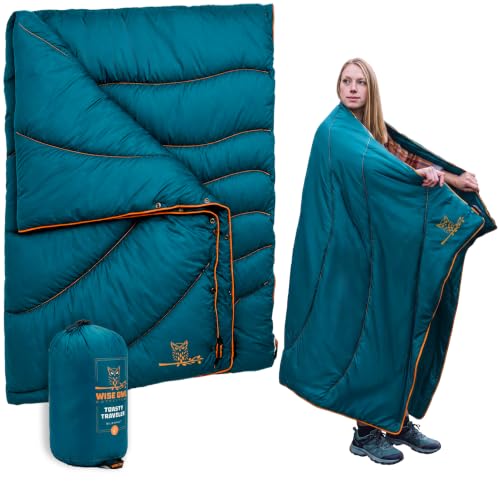
Wise Owl Outfitters Camping Blanket, Packable Puffy Quilt for Backpacking
- Warm Insulation for Cold Weather: Provides cozy warmth even when wet
- Full-Body Coverage Size: Unfolds to 6.5' x 4.5' for full coverage
- Water-Resistant Durable Shell: Repels moisture with nylon shell and coating
As an affiliate, we earn on qualifying purchases.
As an affiliate, we earn on qualifying purchases.
Conclusion
So, gear up and grab your blanket—your once-in-a-lifetime chance to chase those elusive shooting stars. Who knows? Maybe you’ll catch a glimpse of a cosmic miracle or just end up tangled in your own lawn chair. Either way, you’re officially part of the star-struck crowd, living out your celestial dreams. Just don’t forget to wish upon a meteor—after all, what’s the worst that could happen? Live a little, and let the night work its magic.

90mm Telescope for Adults High Powered, Magnification 180X
- Optical System: 90mm aperture with coated lenses
- Magnification Range: 24x to 180x with accessories
- Eyepieces Included: 25mm and 10mm eyepieces
As an affiliate, we earn on qualifying purchases.
As an affiliate, we earn on qualifying purchases.

National Geographic Backyard Guide to the Night Sky, 2nd Edition
As an affiliate, we earn on qualifying purchases.
As an affiliate, we earn on qualifying purchases.