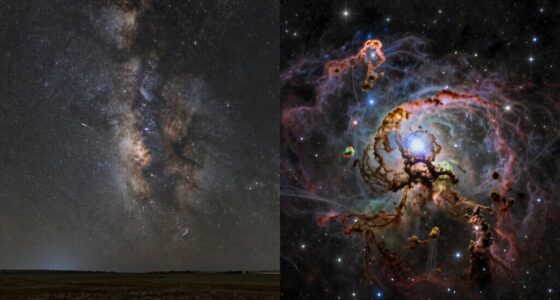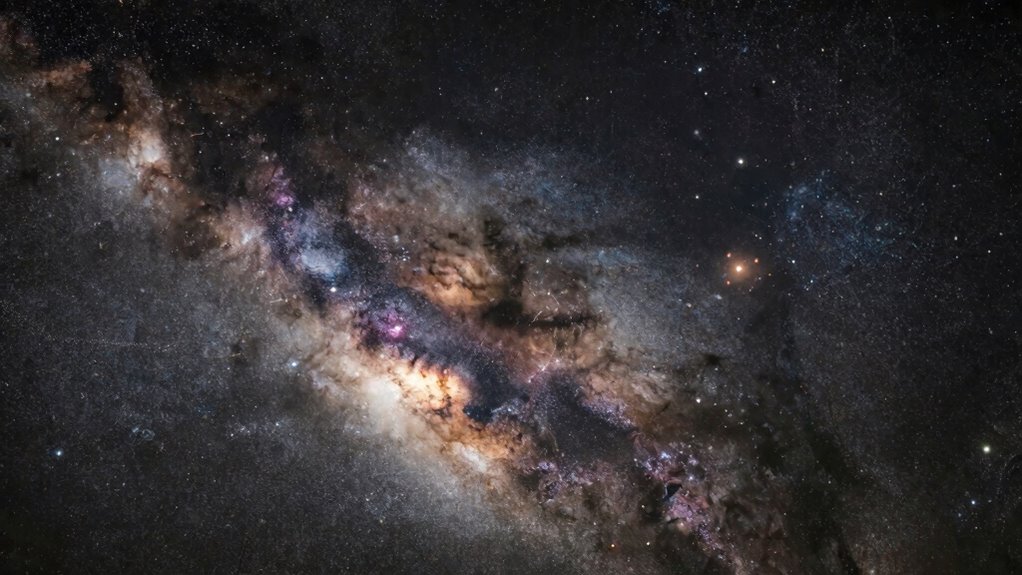
If you’re serious about astrophotography, you’ll find RAW files far superior because they preserve every detail from your camera sensor. RAW captures the full dynamic range, subtle colors, and faint features like stars and nebulae that JPEGs often lose due to compression. This flexibility is essential for post-processing, fixing exposure issues, and recovering faint signals. To discover how RAW can maximize your space images, keep exploring the benefits it offers for your astrophotography journey.
Key Takeaways
- RAW files retain all sensor data, allowing for superior detail recovery and precise adjustments essential for faint space objects.
- RAW offers greater flexibility for noise reduction, contrast, and color calibration, crucial for high-quality astrophotography.
- JPEG compression discards subtle details, limiting post-processing capabilities and reducing the visibility of faint celestial features.
- RAW captures a wider dynamic range, preserving faint stars and nebulae that JPEGs often lose due to compression and clipping.
- For scientific accuracy and professional results, RAW provides unmatched control, making it the preferred choice for space imaging.

SVBONY SV305C Astrophotography Camera, 2.1MP IMX662 Color Telescope Camera
- Entry-Level Color Camera: Ideal for planetary and lunar photography
- IMX662 Sensor: 1/2.8” back-illuminated sensor with 2.9um pixels
- High Sensitivity: Enhanced NIR and red spectral band performance
As an affiliate, we earn on qualifying purchases.
As an affiliate, we earn on qualifying purchases.
RAW or JPEG for Astrophotography: Which Is Better?
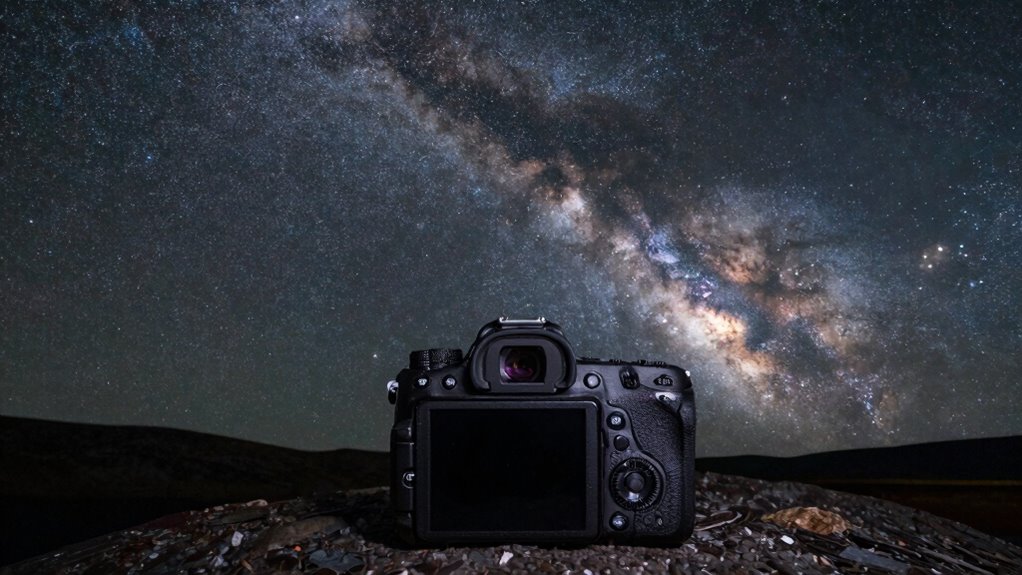
When deciding between RAW and JPEG for astrophotography, understanding their differences is crucial. RAW files offer superior control over color calibration, allowing you to fine-tune hues and brightness after capturing, which is essential for the subtle details in space images. They also preserve the sensor sensitivity data, giving you more flexibility to adjust exposure and noise reduction without sacrificing quality. JPEGs, on the other hand, compress data, limiting your ability to correct colors accurately or recover details in shadows and highlights. Since astrophotography relies heavily on precise color and detail, RAW files provide the depth and latitude needed to produce high-quality images of the night sky. Choosing RAW ensures you retain maximum information, making post-processing more effective and your final images more stunning. Additionally, incorporating natural filtration systems can enhance the overall quality of your astrophotography experience by reducing light pollution in your environment. This adaptability in digital content formats allows for innovative approaches to research topics that can significantly improve your skills and results in astrophotography.

The Astrophotography Manual: A Practical and Scientific Approach to Deep Sky Imaging
As an affiliate, we earn on qualifying purchases.
As an affiliate, we earn on qualifying purchases.
Why Photographers Prefer RAW for Space Images

Photographers prefer RAW for space images because it captures the most detailed and uncompressed data from the camera sensor, giving you greater flexibility in post-processing. RAW files preserve the true color science, allowing you to accurately reproduce subtle color variations in celestial objects. Additionally, RAW preserves the original sensor calibration, ensuring that any adjustments you make are based on precise data rather than compressed or processed images. This flexibility is essential for astrophotography, where fine details and accurate color representation matter. By working with RAW, you can correct sensor noise, improve dynamic range, and fine-tune exposure without sacrificing image quality. Overall, RAW provides the foundation for professional-grade space images, giving you control and confidence in capturing the universe’s true beauty. Moreover, understanding chemical innovations can enhance your overall approach to imaging technology, allowing for even greater advancements in astrophotography. Incorporating techniques from best practices for image processing can further optimize the quality of your astrophotography results. Additionally, the proper handling of window regulator replacement can ensure that your camera’s mechanical components function smoothly, enhancing your shooting experience in the field. Furthermore, color accuracy is crucial in astrophotography as it helps reproduce the vivid hues of distant galaxies and nebulae. Exploring halal-friendly cooking ideas can also inspire creative ways to fuel your astrophotography adventures, ensuring you stay energized during long nights under the stars.

PixInsight User Guide: Practical Image Processing Workflows for Astrophotography and Deep-Sky Imaging
As an affiliate, we earn on qualifying purchases.
As an affiliate, we earn on qualifying purchases.
What’s the Difference Between RAW and JPEG?
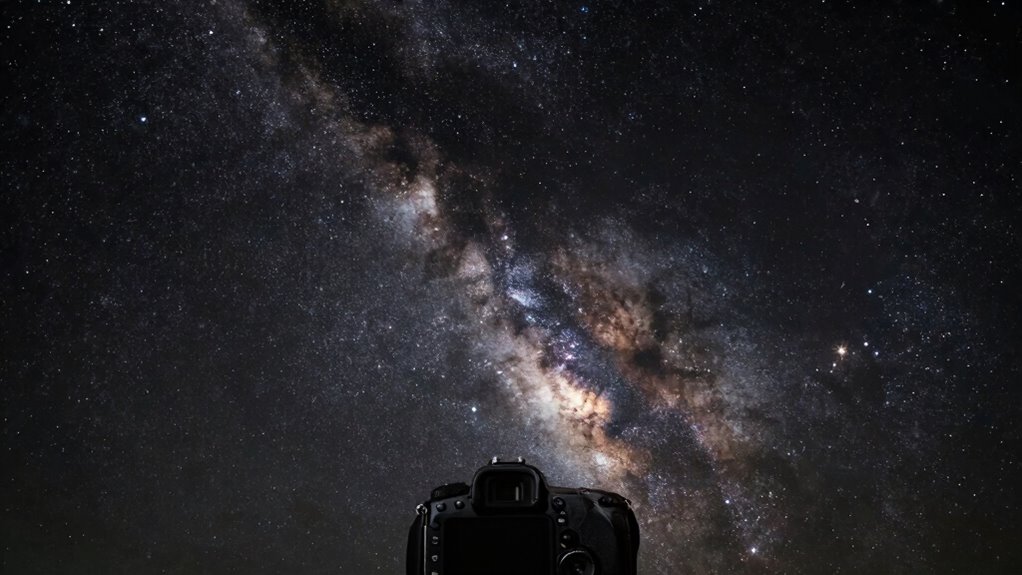
RAW files are larger and retain more image data, providing higher quality and detail compared to JPEGs, which are compressed and smaller. This difference affects how much editing flexibility you have—RAW files allow for extensive adjustments, while JPEGs are more limited. Understanding these distinctions helps you choose the right format for capturing the universe’s subtleties.
File Size and Quality
Understanding the difference in file size and quality between RAW and JPEG is vital for astrophotography. RAW files are much larger because they contain all the data captured by your camera’s sensor, including sensor sensitivity details, with minimal file compression. This means you retain maximum image quality and detail, essential for processing astrophotos. JPEG files, on the other hand, are considerably smaller due to aggressive file compression, which discards some image data to save space. This compression reduces image quality, especially in subtle gradients like star fields or nebulae. While JPEGs are easier to store and share, they don’t offer the same depth of information or flexibility for post-processing as RAW files do. For astrophotography, the larger RAW files are well worth the extra storage. Additionally, investing in top car protection can help safeguard your gear during outdoor shoots, ensuring optimal performance.
Editing Flexibility Levels
When it comes to editing astrophotos, the flexibility you have depends heavily on your file format. RAW files offer far more control over key elements such as sensor sensitivity and color grading. With RAW, you can:
- Adjust exposure and highlight recovery without sacrificing detail
- Fine-tune color balance and grading for accurate star colors
- Correct sensor sensitivity issues easily, reducing noise or enhancing faint signals
- Preserve overall image quality during edits, maintaining greater detail and dynamic range
JPEGs, on the other hand, compress data, limiting your ability to modify these aspects without degrading the image. This makes RAW the clear choice for astrophotographers seeking maximum editing flexibility and precision. Additionally, the importance of media literacy helps photographers understand how to utilize these formats effectively for enhanced results.
Data Retention and Detail
The way your camera captures and stores data directly impacts the amount of detail preserved in your astrophotos. RAW files retain more information because they record unprocessed sensor data, including sensor sensitivity and subtle tonal variations. JPEGs, on the other hand, apply image compression, which reduces file size but sacrifices detail. Compression discards some data to make files smaller, leading to a loss of fine details essential for astrophotography. RAW files preserve the full range of sensor sensitivity, allowing you to capture faint stars and subtle nebula features more accurately. With JPEGs, the compression process limits your ability to recover detail during editing. For astrophotographers aiming for maximum data retention and detail, shooting in RAW is the clear choice.

HOYA 62mm STARSCAPE Light Pollution Astrophotography Filter – Didymium Glass with Enhanced HMC Multicoating Technolgy – Boost Star-to-Sky Contrast – Reduce Night City Sky Color Cast
- Blocks Light Pollution: Reduces skyglow for clearer night shots
- Enhances Night Sky Contrast: Boosts celestial detail and color
- Didymium Glass Construction: Provides high clarity with 97% light transmission
As an affiliate, we earn on qualifying purchases.
As an affiliate, we earn on qualifying purchases.
How RAW Preserves Details for Faint Stars and Nebulae

RAW files excel at capturing faint stars and delicate nebulae because they retain all the original data from your camera’s sensor. This preservation guarantees spectral accuracy, allowing subtle color nuances to come through accurately. With RAW, you can perform significant detail enhancement without losing information. To maximize this:
- Maintain the true brightness of faint objects
- Avoid clipping of delicate details in shadows and highlights
- Preserve the true color spectrum for accurate star and nebula representation
- Enable precise adjustments for contrast and sharpness, revealing faint features
Additionally, using art-room gear like solar shades can improve your workspace ambiance, allowing for better focus on your astrophotography.
The Benefits of RAW Files for Post-Processing Space Photos
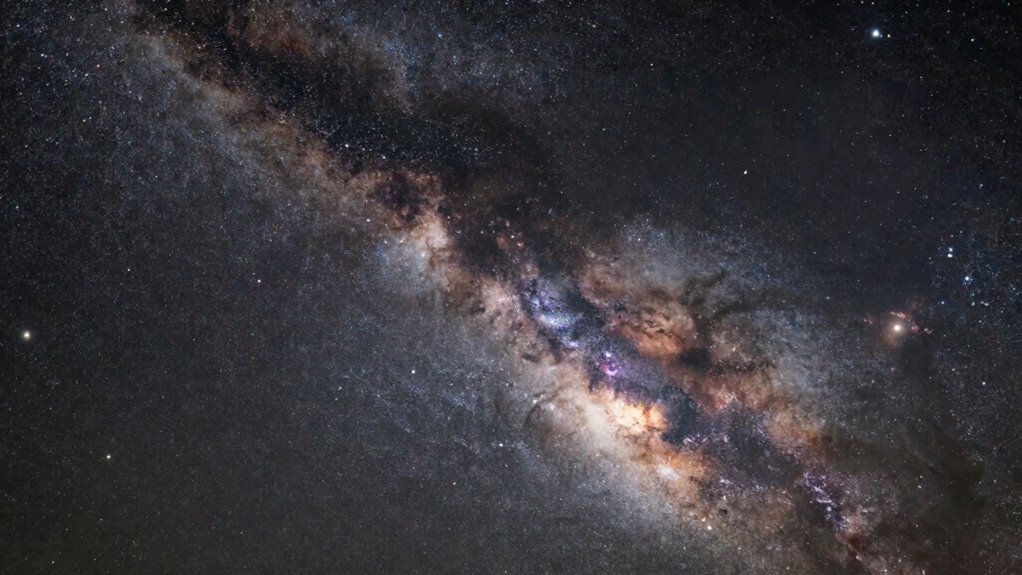
Using RAW files gives you greater flexibility during post-processing, allowing you to adjust exposure, contrast, and color with minimal quality loss. This format also preserves more image detail, especially in faint objects like nebulae and distant stars. As a result, your space photos retain their clarity and depth after editing. Additionally, similar to how gear care enhances the longevity of cycling equipment, managing your RAW files properly can ensure optimal results for your astrophotography projects.
Greater Post-Processing Flexibility
When you capture space photos in RAW format, you gain significant control over the final image, especially during post-processing. RAW files allow you to adjust key elements like color accuracy and histogram control without losing quality. This flexibility means you can:
- Correct color shifts caused by atmospheric conditions or light pollution.
- Fine-tune brightness and contrast with precise histogram adjustments.
- Recover details in shadows and highlights that JPEGs often flatten.
- Maintain the integrity of faint objects, like distant galaxies or nebulae, for more accurate representations.
These capabilities give you the power to enhance your images authentically, preserving the true beauty of the cosmos. RAW files empower you to craft stunning, scientifically accurate astrophotos through flexible, detailed post-processing. Additionally, understanding glycolic acid in scalp care can enhance your overall approach to capturing the beauty of the universe by ensuring you’re looking your best while doing so.
Enhanced Image Detail Preservation
Because space images often contain faint details and subtle tonal variations, capturing them in RAW format helps preserve these nuances with greater accuracy. RAW files retain the full sensor sensitivity, allowing you to extract maximum detail during post-processing. This is especially crucial when reducing noise without sacrificing image clarity. RAW’s extensive data helps you recover faint signals and preserve delicate features, which JPEG compression often diminishes. With RAW, you can fine-tune noise reduction and brightness levels more precisely, ensuring your space photos maintain their intricate details. Additionally, using smart locks and security gear can enhance the overall security of your photography equipment while you explore the cosmos. Proper storage solutions for your equipment also play a vital role in maintaining safety and accessibility, particularly when you’re working in high-traffic areas. Understanding user consent management is essential, especially when sharing your images online and ensuring privacy compliance. Furthermore, capturing images in RAW format allows for improved color accuracy, which is vital for ensuring that the true beauty of celestial objects is represented in your final images.
| Benefit | Description |
|---|---|
| Sensor Sensitivity | Preserves maximum detail from the sensor |
| Noise Reduction | Allows targeted noise suppression without detail loss |
| Tonal Range | Maintains subtle tonal variations |
| Dynamic Range | Captures a broader range of brightness levels |
| Post-Processing | Enables detailed adjustments without quality loss |
Challenges of Using JPEG for Night Sky Photography

JPEG images often fall short in capturing the subtle details and dynamic range of the night sky, making them a poor choice for astrophotography. Their limited color calibration can distort star colors, and low sensor sensitivity hampers capturing faint celestial objects. Additionally, compressed JPEGs lose fine details, making post-processing difficult. Here are some key challenges:
JPEGs struggle with subtle night sky details, color accuracy, and faint objects, making them less ideal for astrophotography.
- Color calibration issues reduce accuracy in star hues, affecting overall image authenticity. Moreover, effective planning in personal finance can help you allocate resources for better photography equipment. This transparency in earning potential can assist you in making informed decisions about upgrading your gear. In the same way, understanding the horsepower of electric dirt bikes can enhance your knowledge of performance in various conditions. Furthermore, lighting techniques in astrophotography can significantly improve the quality of images captured.
- Limited sensor sensitivity prevents capturing dimmer objects, resulting in washed-out details.
- Compression artifacts introduce noise and reduce resolution, compromising clarity.
- Inflexible adjustments hinder correcting exposure or noise without degrading image quality.
These factors make JPEGs less reliable for astrophotography, where capturing the true essence of the night sky is essential. Furthermore, inclusive casting in photography can significantly influence how diverse celestial imagery is portrayed and appreciated.
How RAW Helps Fix Exposure and Reduce Noise in Space Shots

Using RAW files gives you greater control over exposure adjustments and noise reduction in space photography. Because RAW preserves all the sensor data, you can fine-tune exposure without losing detail, fixing underexposed or overexposed areas more effectively. This flexibility is vital when capturing faint celestial objects that require high sensor sensitivity. Outdoor cooking techniques can benefit from similar attention to detail, ensuring every aspect of the process is optimized for the best results. Additionally, projector installation techniques can improve the viewing experience of your astrophotography, providing a clearer picture of your stunning images. RAW also allows you to adjust brightness and contrast without degrading image quality, enhancing color accuracy and detail. When reducing noise, RAW files provide more information, making it easier to target specific areas for noise reduction while preserving sharpness. This results in cleaner, more detailed images with true-to-life colors, even in low-light conditions. Overall, RAW’s extensive data guarantees your space shots are sharper, clearer, and more accurate. Additionally, as noted by the transformative impact of artificial intelligence, these advancements in technology can further enhance the capabilities of RAW image processing in astrophotography. Furthermore, using cookies for analytics can help track visitor interactions, allowing you to understand which aspects of your astrophotography resonate most with your audience.
Best Camera Settings to Maximize RAW Quality in Astrophotography
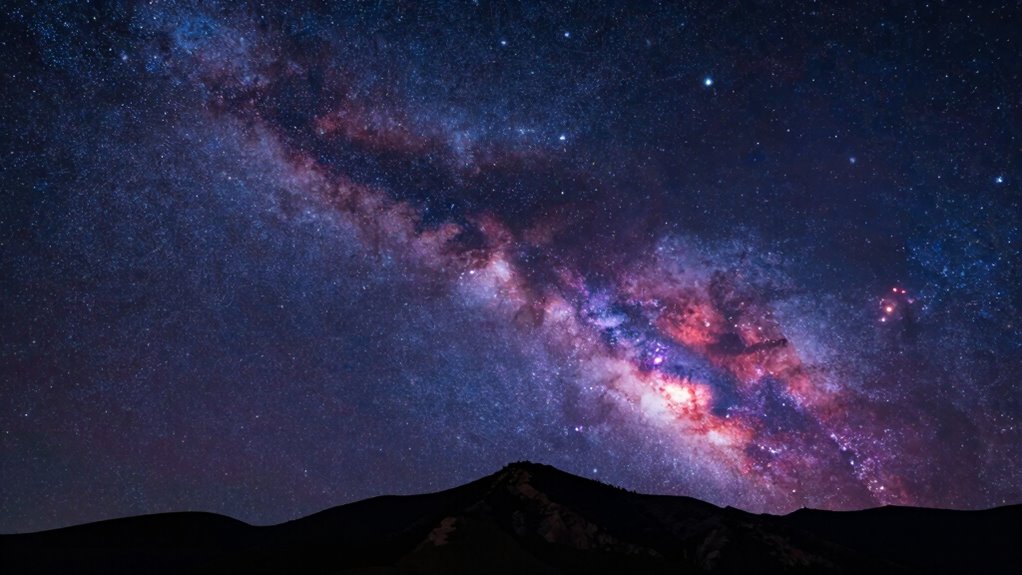
To maximize RAW quality in astrophotography, you need to set your camera for ideal sensor performance and data capture. First, verify your sensor calibration is up-to-date to prevent calibration errors that could affect image quality. Second, choose a low ISO setting to reduce noise and preserve detail. Third, set your aperture to the widest available to gather the most light, but be mindful of lens distortion at the edges. Fourth, disable in-camera noise reduction, so you retain all raw sensor data for better post-processing. These settings help capture the maximum dynamic range and detail in RAW files, making post-processing more effective. Proper sensor calibration and understanding lens distortion are key to ensuring your raw data remains pristine for astrophotography excellence.
Practical Tips for Shooting and Processing RAW Space Images

Capturing stunning space images with RAW files requires careful shooting techniques and thoughtful processing. To optimize your results, adjust sensor sensitivity to reduce noise without overexposing, and keep image compression minimal to preserve detail. Use a sturdy mount and shoot in RAW+JPEG mode to compare quality. During processing, enhance contrast, adjust levels, and carefully reduce noise. The table below highlights key aspects:
| Technique | Purpose | Tip |
|---|---|---|
| Increase sensor sensitivity | Capture faint details | Avoid excessive ISO to prevent noise |
| Minimize image compression | Preserve quality | Save in uncompressed RAW format |
| Use proper exposure settings | Maximize data collection | Avoid overexposure, bracket shots |
These tips help you leverage RAW’s full potential for astrophotography.
Final Thoughts: Why Serious Astronomers Choose RAW

Serious astronomers prefer RAW files because they offer unmatched control over image quality and data integrity. This control is essential for precise color calibration and maximizing sensor dynamic range, ensuring your astrophotography captures the universe’s true details. Choosing RAW means you can:
- Fine-tune color calibration for accurate star and nebula hues.
- Preserve the full sensor dynamic range, revealing faint details.
- Minimize compression artifacts that degrade image quality.
- Perform advanced adjustments without sacrificing original data.
Frequently Asked Questions
Can JPEGS Be Sufficient for Beginner Astrophotography?
JPEGs can be sufficient for beginner astrophotography if you’re just starting out and want quick results. They require less astrophotography gear for processing, and image storage solutions are simpler since JPEGs are smaller files. However, for capturing more detail and flexibility during editing, RAW files are better. As you progress, switching to RAW will help you get the most out of your astrophotography sessions.
How Does Compression Affect Astrophotography Image Quality?
Compression affects astrophotography image quality by potentially introducing compression artifacts, which can obscure fine details essential for capturing stars and nebulae accurately. When you use compressed JPEGs, you risk losing image detail preservation, making it harder to analyze or enhance your images later. To get the best results, avoid heavy compression, and opt for RAW files, which retain maximum detail and allow for better post-processing.
Are There Any Drawbacks to Always Shooting in RAW?
Shooting in raw can reveal more sensor noise and may require extra effort for editing, but it’s worth it for the pristine color accuracy and detail. You might find yourself overwhelmed by large files and longer processing times, which can slow your workflow. However, these drawbacks fade when you realize raw captures give you the best foundation for bringing out the subtle wonders of the night sky.
What Software Is Best for Processing RAW Astrophotos?
You should use software like DeepSkyStacker, AstroPixelProcessor, or PixInsight for processing your raw astrophotos. These tools maximize sensor sensitivity, allowing you to extract more detail from faint objects. They also read and utilize image metadata, helping you align and calibrate your images accurately. This results in cleaner, sharper images that reveal more cosmic detail, making RAW processing essential for serious astrophotography.
How Does ISO Impact RAW Versus JPEG in Space Imaging?
ISO impacts raw and JPEG differently because higher ISO increases sensor sensitivity but also introduces more noise. With RAW images, you can better control noise reduction during processing, preserving details. JPEGs, however, automatically apply compression and noise reduction, which can degrade image quality at high ISOs. So, for space imaging, shooting in RAW lets you adjust ISO and handle noise more effectively, ensuring cleaner, more detailed astrophotos.
Conclusion
In the end, choosing RAW for astrophotography is like wielding a mighty Excalibur in the night sky—your best tool for capturing every faint star and nebula’s true essence. It gives you the power to fix exposure errors, reduce noise, and reveal details others simply can’t see. If you’re serious about your space images, embracing RAW is the secret weapon that transforms your shots from good to legendary—no wizardry needed.