
TL;DR

Prime made for students and young adults
- Fast, free delivery for dorm and study essentials
- Prime Video and Amazon Music included
- Member-only deals
Prebuilt AI workstations are often more cost-effective and reliable now due to component shortages and bulk buying. Building gives you control and customization but requires time and expertise. The best choice depends on your workload, budget, and support needs.
Imagine this: you’re ready to jump into AI development or inference, but the choice isn’t as simple as it used to be. Building your own workstation was once the obvious way to save money and customize, but recent market shifts have flipped the script.
Now, with component shortages and rising prices, prebuilt systems often come with the same or even lower costs, plus the benefit of validated thermals and support. So, should you pull the parts yourself or buy a ready-to-go machine? That’s what we’ll break down — no fluff, just straight talk for your next move.
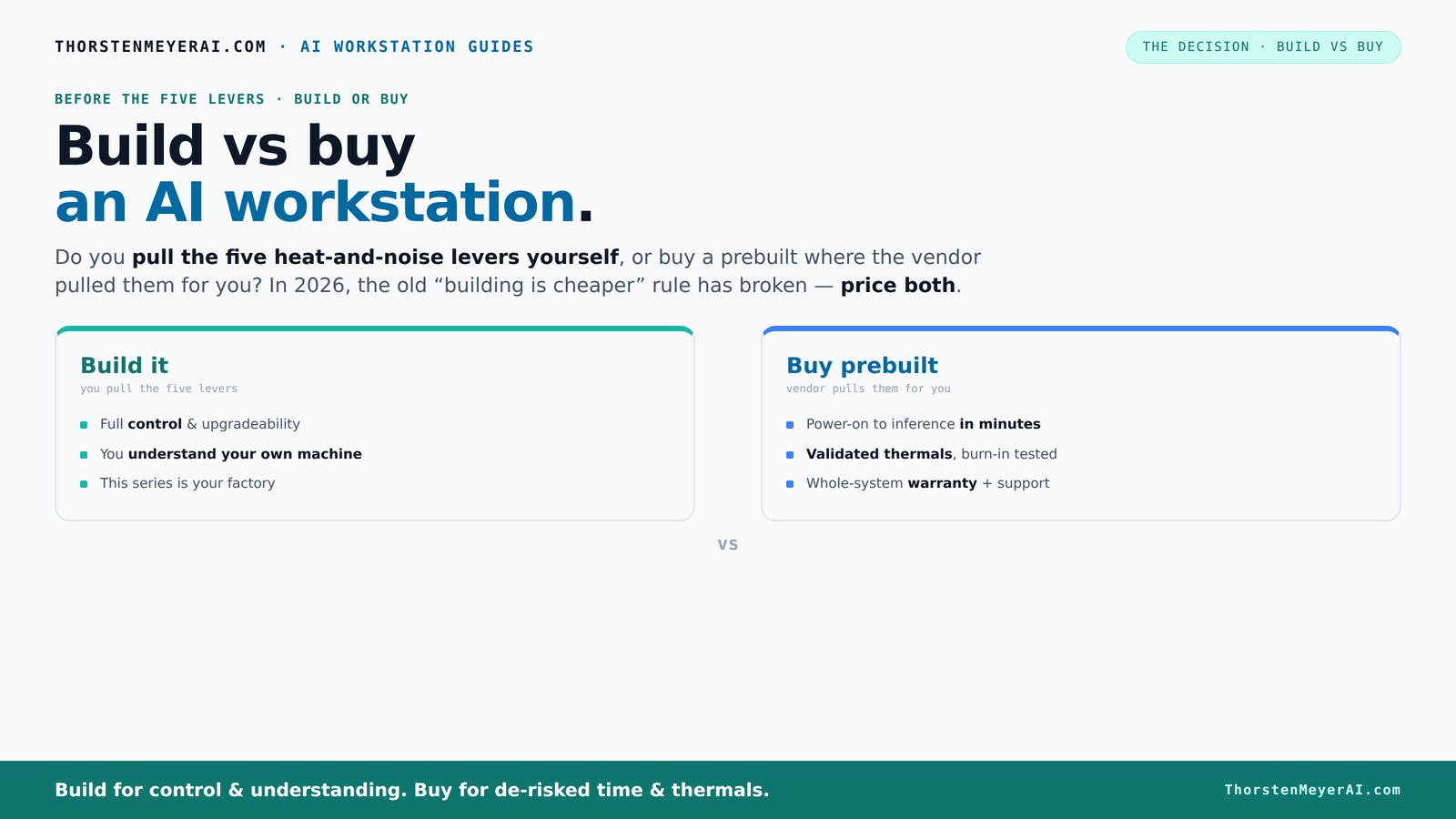
Build vs buy
an AI workstation.
The real question behind this whole series: do you pull the five heat-and-noise levers yourself, or buy a prebuilt where the vendor pulled them for you? And in 2026, the old “building is cheaper” rule has broken. Match your situation in Part 3.
Key Takeaways
- Component shortages in 2026 have made prebuilt systems often more cost-effective than DIY builds for comparable specs.
- Prebuilts offer validated thermals, warranty, and support, reducing the risk of thermal throttling and hardware failure during AI workloads.
- Building your own system provides maximum control and customization but requires time, expertise, and careful thermal tuning.
- For AI tasks like inference or training, match your workload with the right configuration—prebuilts are great for quick start, DIY for deep customization.
- Always compare real prices and consider support and upgrade paths before choosing, as the market landscape has shifted significantly.
As an affiliate, we earn on qualifying purchases.
Why 2026 Changed the Game: Building Isn’t Always Cheaper
Component shortages and inflation have hit the parts market hard. To understand more about how these market dynamics influence technology choices, visit curiousminds.info. DDR5 RAM, GPUs, and SSDs — all of them are pricier now, sometimes 30-50% above 2024 prices. A build that once cost under $1,000 now nudges past $1,250, before you add software or cooling.
Meanwhile, big OEMs bought up stock early, locking in lower prices and passing savings to you. Some prebuilt systems now match or beat DIY prices, especially for high-end, multi-GPU rigs. This flips the long-held belief that building always saves cash. It’s a game of actual prices, not assumptions.
So, before you start sourcing parts, run the numbers for your specific config. The old rule — build for savings, buy for speed — no longer applies universally. Now, it’s a nuanced tradeoff involving cost, time, and control.
Understanding this shift is crucial because it highlights how market dynamics directly influence the value proposition of DIY versus prebuilt. When component prices rise unpredictably, the anticipated cost savings of building diminish, making prebuilt options more attractive. Conversely, if you value customization and upgradeability, the tradeoffs may still favor building, despite the higher initial investment. This nuanced landscape requires careful evaluation of your priorities and the current market conditions.
As an affiliate, we earn on qualifying purchases.
The Five Levers of Heat and Noise — Who Controls Them?
High-power AI systems are like furnaces. Keeping them cool and quiet involves five key levers: undervolting GPUs, matching cooling solutions, optimizing airflow, tuning fan curves, and strategic placement. For more on thermal management, see this guide.
When you buy a prebuilt, the vendor pulls these levers — they validate thermals, run burn-in tests, and often include water cooling for quieter operation. For example, BIZON advertises systems with up to 30% lower noise and temperature, tested at the factory.
If you build, you control every lever. You can choose a quiet GPU like the RTX 4090, undervolt it for less heat, select a case with sound-dampening panels, and set up custom airflow. It’s more effort but gives you a machine precisely tuned to your needs.
Here’s the key: do you want to pull all five levers yourself, or pay a vendor to do it for you? That’s the core of the build vs buy choice.
Understanding how thermal management impacts performance and longevity is vital. Prebuilts often come with factory-optimized thermal solutions, reducing the risk of overheating or throttling during intensive AI workloads. This validation process ensures the system maintains peak performance over time, which is especially critical for long training sessions. DIY builds, while customizable, require you to understand and implement these thermal strategies yourself—mistakes here can lead to thermal throttling, hardware degradation, or noisy operation. The tradeoff involves effort versus peace of mind and performance stability, making thermal control a central factor in your decision.
As an affiliate, we earn on qualifying purchases.
Defining Your AI Workload and Its Requirements
Before deciding whether to build or buy, it’s essential to understand what your AI workload demands. Learn more about defining your AI needs at farmingtips.org. Are you training large models that require multiple GPUs and extensive VRAM? Or are you running inference tasks that need a more modest setup? Knowing your specific needs helps you choose the right components and system type.
For example, training a complex language model might necessitate a high-end GPU with 48GB+ VRAM, a robust CPU, and ample RAM. In contrast, deploying inference services with smaller models may only need a mid-range GPU and less memory. Matching your workload to the system ensures efficiency and cost-effectiveness, preventing over-investment or performance bottlenecks.
Applying this knowledge, you can evaluate whether a prebuilt system provides the right balance or if a custom build can be tailored precisely to your unique requirements. This clarity helps prevent unnecessary expenses and ensures your AI infrastructure is optimized for your specific tasks.
As an affiliate, we earn on qualifying purchases.
The Five Levers of Heat and Noise — Who Controls Them?
High-power AI systems are like furnaces. Keeping them cool and quiet involves five key levers: undervolting GPUs, matching cooling solutions, optimizing airflow, tuning fan curves, and strategic placement.
When you buy a prebuilt, the vendor pulls these levers — they validate thermals, run burn-in tests, and often include water cooling for quieter operation. For example, BIZON advertises systems with up to 30% lower noise and temperature, tested at the factory.
If you build, you control every lever. You can choose a quiet GPU like the RTX 4090, undervolt it for less heat, select a case with sound-dampening panels, and set up custom airflow. It’s more effort but gives you a machine precisely tuned to your needs.
Here’s the key: do you want to pull all five levers yourself, or pay a vendor to do it for you? That’s the core of the build vs buy choice.
Understanding how thermal management impacts performance and longevity is vital. Prebuilts often come with factory-optimized thermal solutions, reducing the risk of overheating or throttling during intensive AI workloads. This validation process ensures the system maintains peak performance over time, which is especially critical for long training sessions. DIY builds, while customizable, require you to understand and implement these thermal strategies yourself—mistakes here can lead to thermal throttling, hardware degradation, or noisy operation. The tradeoff involves effort versus peace of mind and performance stability, making thermal control a central factor in your decision.
Conclusion
In 2026, your choice isn’t just about saving a few dollars or tweaking performance — it’s about making an informed decision. Explore more insights at haltmal.com. about what you value most: speed and support or control and customization. Both paths have their merits, and the market now rewards informed decisions.
So, what’s your next move? If you want a machine that’s ready to run and backed by support, a prebuilt is your best bet. But if you’re a tinkerer at heart, building your own can still pay off in control and learning. Either way, this market shift means you have more options than ever before — choose the one that fits your goals best.
Halloween Picks
halloween
As an affiliate, we earn on qualifying purchases.