Shooting in RAW is essential for night-sky photography because it retains the full dynamic range and subtle tonal details necessary to capture faint stars, nebulae, and subtle light variations. Unlike JPEGs, RAW files preserve all image data, giving you more flexibility for exposure correction, noise reduction, and enhancing faint details during post-processing. This guarantees your night images are sharper and more vibrant. Keep exploring to learn how choosing RAW can elevate your astrophotography results.

Prime made for students and young adults
- Fast, free delivery for dorm and study essentials
- Prime Video and Amazon Music included
- Member-only deals
Key Takeaways
- RAW files preserve full dynamic range, allowing better recovery of details in challenging night scenes.
- Shooting in RAW provides greater flexibility for adjusting white balance and enhancing faint stars during editing.
- RAW allows correction of exposure errors and noise reduction without sacrificing image quality.
- JPEG compression loses tonal nuances crucial for accurately representing the subtle gradations of night skies.
- RAW’s extensive editability helps optimize contrast and brightness, making stars and celestial features stand out effectively.
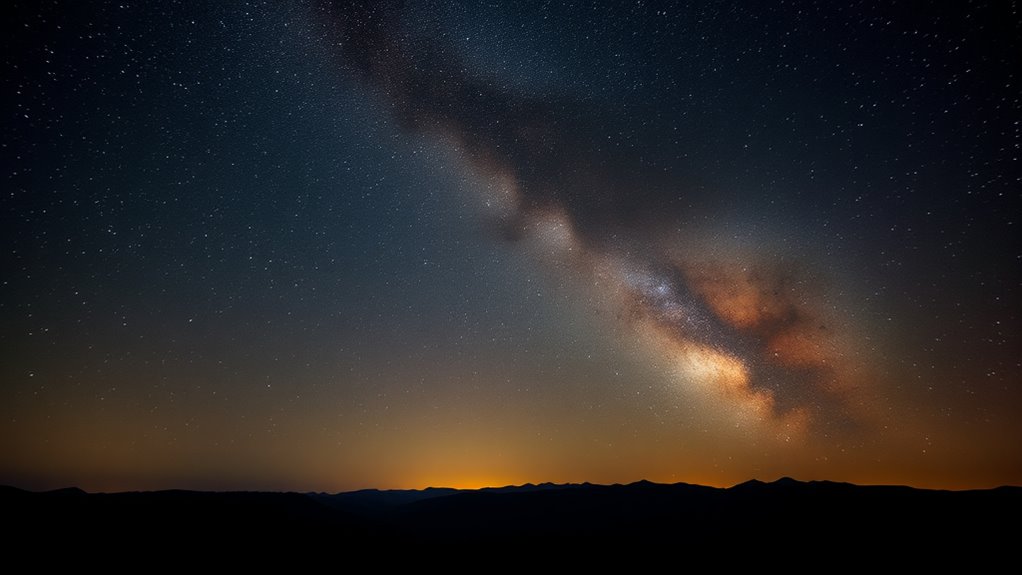
Have you ever wondered whether to shoot in RAW or JPEG? When capturing night-sky scenes, this decision becomes even more critical. Shooting in RAW offers you unparalleled sensor flexibility, which means you retain more of the original data captured by your camera’s sensor. This flexibility is essential because night photography often involves challenging lighting conditions, high contrast, and subtle color gradations. With RAW files, you preserve the full dynamic range, allowing you to recover details in shadows and highlights that would be lost if you shot in JPEG. Since JPEGs compress the image data, you lose some of that tonal information, making it harder to correct exposure issues or bring out faint details like stars or nebulae during editing.
The editing potential of RAW files is a game-changer for night-sky photographers. When you shoot in RAW, you get a digital negative that you can manipulate extensively without degrading image quality. This means adjusting white balance to correct color casts caused by light pollution or atmospheric conditions, enhancing faint stars, or reducing noise while maintaining sharpness. JPEGs, on the other hand, are processed in-camera with baked-in settings, limiting your ability to tweak the image afterward. If you’re serious about capturing the intricate details of the night sky, RAW files give you the flexibility to fine-tune your images post-shoot, ensuring that what you see in your final shot truly reflects the scene you experienced.
Another advantage of shooting RAW is that it provides more latitude when dealing with exposure errors. Night photography often requires long exposures, increasing the risk of overexposure or underexposure in parts of your image. RAW files allow you to correct these issues during editing, recovering details from areas that would be clipped or lost in JPEGs. This flexibility helps you avoid having to take multiple shots or rely heavily on in-camera exposure settings, which may not always be perfect given the unpredictable lighting conditions of the night sky. Additionally, contrast ratio plays a vital role in night-sky photography, as a higher contrast ratio helps in rendering deep blacks and vibrant highlights, making the stars pop against the dark sky.
best RAW camera for night sky photography
As an affiliate, we earn on qualifying purchases.
As an affiliate, we earn on qualifying purchases.
Frequently Asked Questions
How Does Shooting RAW Affect Storage Space Compared to JPEG?
Shooting RAW files considerably increases your file size compared to JPEGs, often taking up several times more storage space. This means you’ll need greater storage capacity on your memory card or computer to accommodate these larger files. While RAW files offer more flexibility for post-processing, you should guarantee your storage solutions are adequate, especially when planning long night-sky shoots, to avoid running out of space during your photography session.
Can RAW Files Be Edited More Easily Than JPEGS?
You can edit RAW files more easily because their higher bit depth captures every subtle hue and shadow detail, like a painter’s palette brimming with endless colors. This flexibility makes color grading smoother, letting you fine-tune starry skies without losing quality. Unlike JPEGs, RAW preserves the nuances of your night sky, so your edits shine with clarity and depth, transforming your images into breathtaking celestial masterpieces.
Is There a Significant Difference in Processing Time Between RAW and JPEG?
Processing speed is generally slower with RAW files because they contain more data, making editing more complex and time-consuming. JPEGs process faster due to their compressed nature, allowing quicker sharing and viewing. However, if you prioritize detailed adjustments and high-quality results, you’ll find that investing time in RAW processing pays off. So, while RAW takes longer to process, it offers greater flexibility for detailed editing, especially in night-sky photography.
Do All Cameras Support Shooting in RAW for Night-Sky Photography?
Did you know that about 85% of modern cameras support shooting in RAW? Most cameras, especially DSLRs and mirrorless models, offer raw support, making them ideal for night-sky photography. However, some compact and budget models lack this feature. Before heading out, check your camera’s compatibility and settings to verify you can shoot in RAW, giving you the flexibility to capture the best possible images of the night sky.
How Does RAW Format Influence Post-Processing Flexibility for Astrophotography?
Shooting in RAW enhances your post-processing flexibility by preserving higher bit depth, usually 12 or 14 bits, which captures more tonal and color information. This allows you to perform precise color grading and adjustments without degrading image quality. With RAW files, you can recover details in shadows and highlights, making your astrophotography images more vivid and detailed. JPEGs lack this depth, limiting your editing potential and overall image quality.
night sky astrophotography camera lens
As an affiliate, we earn on qualifying purchases.
As an affiliate, we earn on qualifying purchases.
Conclusion
Choosing RAW over JPEG for night-sky photography is like planting a seed—you’re giving your images the best chance to flourish. RAW files capture every detail and nuance, allowing you to craft breathtaking shots that truly reflect the cosmos’s majesty. While JPEGs are convenient, they’re like bookmarks—good for a quick glance but lacking the depth you need for a celestial masterpiece. Embrace RAW, and let your night sky images shine as brightly as the stars themselves.
noise reduction software for astrophotography
As an affiliate, we earn on qualifying purchases.
As an affiliate, we earn on qualifying purchases.
As an affiliate, we earn on qualifying purchases.
Fall Picks
fall essentials
As an affiliate, we earn on qualifying purchases.