
TL;DR

Prime made for students and young adults
- Fast, free delivery for dorm and study essentials
- Prime Video and Amazon Music included
- Member-only deals
Iapetus is Saturn’s ‘Painted Moon,’ with a stark contrast between its dark, organic-rich leading hemisphere and icy, reflective trailing side. Recent research suggests dust and debris from Saturn’s rings and moons cause its unique coloration, while its massive equatorial ridge sparks ongoing debate. This moon’s striking appearance makes it a captivating object for astronomers and space enthusiasts alike.
Imagine a moon so striking that it looks like a giant, cosmic two-tone candy. Saturn’s Iapetus, with its stark division of black and white, has puzzled scientists for decades. Its mysterious surface, shaped by ancient debris and possibly tectonic forces, sparks curiosity with every new image.
Tonight, we’re unraveling the secrets behind this painted moon—what makes its dark side so dark, how its iconic ridge formed, and what future missions might reveal. Get ready for a journey into one of the solar system’s most visually arresting worlds.
Iapetus’s dark hemisphere absorbs 96% of sunlight, causing significant temperature differences that influence its surface chemistry.
The massive equatorial ridge may have formed from rapid early rotation or collisional events, giving the moon its distinctive shape.
Dust from Saturn’s rings and moons likely causes the stark two-tone coloration by settling on the leading hemisphere over millions of years.
Despite its dramatic appearance, Iapetus’s surface is too cold and barren to support life, making it an object of purely scientific interest.
Future missions could unlock more secrets about its surface processes, origins, and possibly even reveal new features we haven’t yet imagined.
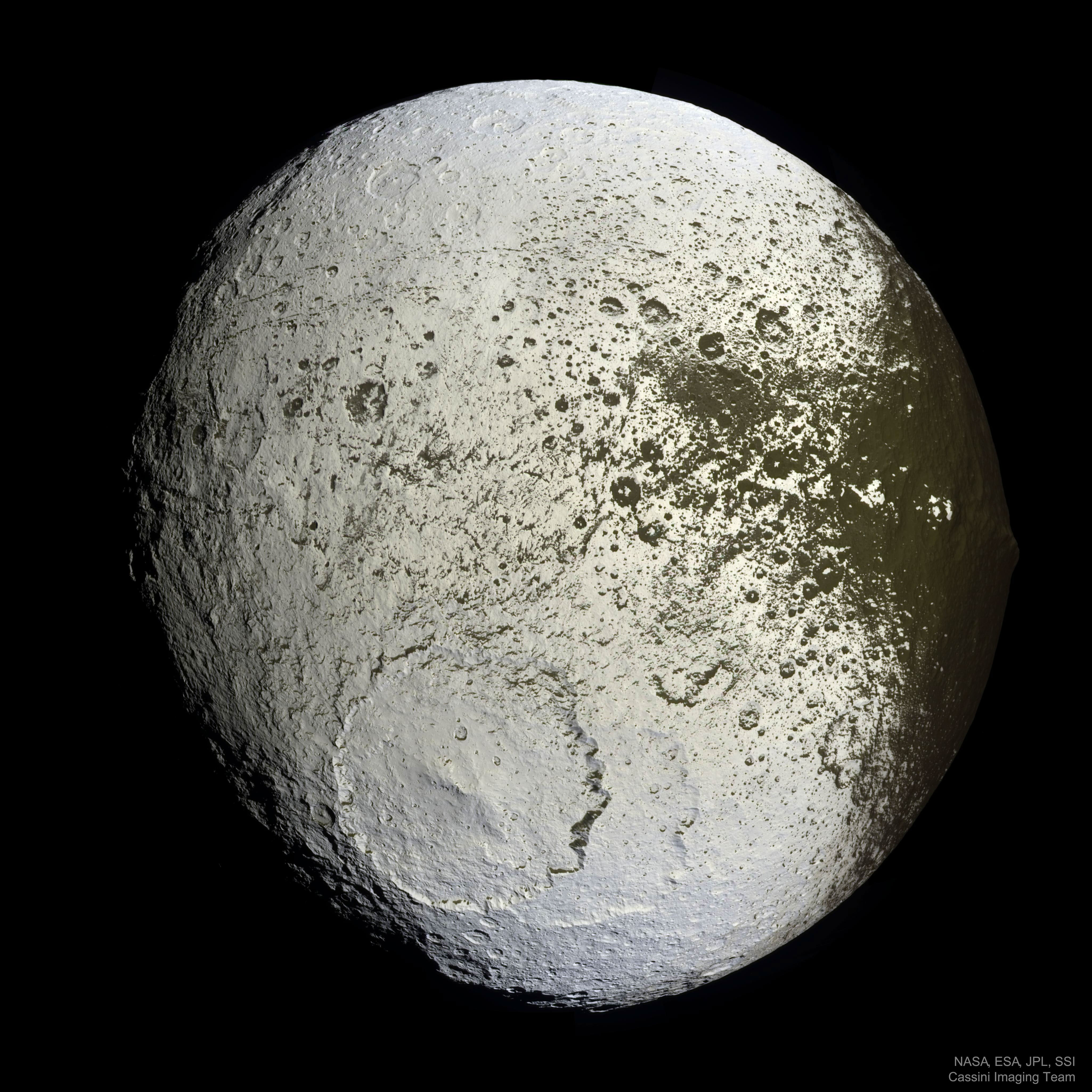
Why does Iapetus look like a moon painted by an artist?
Iapetus’s surface is divided into two vastly different halves. The leading hemisphere, which faces forward in its orbit, is coated with a dark, organic-rich material called “synthetic tholins.” This coating absorbs sunlight—up to 96%—making it scorchingly hot compared to the icy, reflective trailing side, which bounces back about 50% of the sunlight.
Picture walking from a bright snowfield into a shadowed alley—your skin feels the difference. That temperature gap, over 20°C, influences the moon’s surface chemistry and even its appearance. The dark material is thought to be leftover from sublimating, slightly warmed-up ice or debris from other moons and Saturn’s rings.
Understanding this contrast is crucial because it reveals how surface processes like sublimation, debris fallout, and thermal inertia interact. These factors can influence the moon’s long-term evolution—whether the dark side will continue to darken or if some processes might eventually even out the surface coloration. For night sky photographers, the dramatic contrast makes Iapetus a perfect target—especially with a long focal length lens capturing the moon’s stark boundary and surface detail.
As an affiliate, we earn on qualifying purchases.
How did Iapetus get that giant ridge running around its waist?
The massive equatorial ridge is one of Iapetus’s most unusual features and a window into its complex geological history. Rising up to 20 kilometers high, this ridge encircles the moon like a colossal belt, dramatically influencing its overall shape. Its presence suggests that Iapetus experienced significant internal or surface processes that are not yet fully understood.
Scientists debate whether this ridge formed from internal tectonic activity—akin to a planetary scar—or from external impacts or even rapid early spin rates that caused material to pile along the equator. Each hypothesis carries implications about the moon’s internal composition and thermal evolution. For instance, a tectonic origin would suggest a once-active interior, possibly driven by residual heat or differentiation, which could inform models of moon formation and thermal history. Conversely, a formation from rapid spin or debris accumulation highlights the role of angular momentum and external forces in shaping celestial bodies.
This feature’s origin matters because it influences how we understand moon formation, surface stability, and the potential for past geological activity. Photographers and scientists can capture this feature in detailed spacecraft images, offering clues about the processes that sculpt planetary bodies over eons.
astronomy binoculars for moon observation
As an affiliate, we earn on qualifying purchases.
As an affiliate, we earn on qualifying purchases.
What’s behind Iapetus’s two-tone color scheme? Here are 3 main ideas
| Hypothesis | How it works | Supporting clues |
|---|---|---|
| Dust and debris fallout | Dust from Saturn’s rings or ejecta from other moons settles on the leading hemisphere, darkening it over time, creating a persistent color contrast that influences the moon’s thermal environment and surface chemistry. | Spectral analysis shows organic molecules concentrated on the dark side; the pattern matches the leading hemisphere’s orbit, indicating ongoing deposition. This process also affects the moon’s thermal inertia, potentially accelerating surface changes. |
| Solar sublimation and frost migration | Warmer dust and ice sublimates from the dark side, leaving behind darker, carbon-rich residue. This process creates a feedback loop where the dark areas heat up more, sublimating faster and maintaining their darker appearance, which influences surface stability and albedo. | Temperature differences support this; dark areas heat up more, accelerating sublimation. This dynamic might explain the persistence of the two-tone pattern over geological timescales, influencing the moon’s surface evolution. |
| Ancient surface evolution | Early impacts and geological activity may have created initial color differences that persisted through surface aging and space weathering, with subsequent processes reinforcing or modifying these patterns. | Crater patterns and surface ages suggest a long history of surface alteration. The existence of older impact basins and varying crater densities across the surface indicate a complex history of surface modification that contributed to the current dichotomy. |
Each idea has merit, but dust fallout remains the leading explanation, especially given recent spectral data. Understanding which process dominates can reveal much about the moon’s environmental history and the ongoing interactions between celestial bodies within the Saturn system. It’s a cosmic version of paint being splattered by debris during a space storm—these processes shape Iapetus’s striking appearance and offer clues to its past.
moon photography long focal length lens
As an affiliate, we earn on qualifying purchases.
As an affiliate, we earn on qualifying purchases.
Frequently Asked Questions
Why does Iapetus have such a huge ridge around its middle?
The ridge likely formed from early rapid rotation or a collision early in Iapetus’s history. Its massive size and shape suggest complex internal and surface processes still debated by scientists.Can Iapetus’s dark material be seen from Earth?
Not easily. Its dark hemisphere is faint, and Iapetus is generally too small and distant for amateur telescopes to distinguish surface details. Most detailed views come from spacecraft like Cassini.Will Iapetus ever be visited by a spacecraft?
No dedicated mission is currently planned, but future Saturn explorations or orbiter missions could target Iapetus for closer study, especially as technology advances.What makes Iapetus different from other moons around Saturn?
Its stark two-tone surface, the massive equatorial ridge, and its size set it apart. Few moons display such dramatic surface dichotomies or features like the ridge.Is there any chance Iapetus could hold liquid water someday?
Unlikely. Its surface temperatures are far too cold, and it lacks the internal heat needed to sustain liquid water, making it more of a frozen relic than a potential habitat.space-themed telescope accessories
As an affiliate, we earn on qualifying purchases.
As an affiliate, we earn on qualifying purchases.
Conclusion
Iapetus’s hauntingly beautiful split—dark and icy—reminds us how dynamic and mysterious our solar system really is. Its contrasting surfaces tell a story of debris, heat, and ancient forces still echoing through space.
Keep an eye on the skies and future space missions—this painted moon still holds secrets waiting to be uncovered, possibly rewriting what we think we know about planetary moons.
Halloween Picks
halloween
As an affiliate, we earn on qualifying purchases.