
Choosing between off-axis guiders and separate guide scopes affects your focusing. Off-axis guiders share the same optical path as your main telescope, making precise alignment and focus adjustments more challenging but stabilizing long focal length imaging. Separate guide scopes allow independent focusing and easier setup, but they require rigid mounting to prevent flexure at higher magnifications. Understanding how each system impacts focusing helps you optimize guiding accuracy—keep exploring to learn the key differences.
Key Takeaways
- Off-axis guiders require precise optical alignment, making focusing more challenging compared to separate guide scopes.
- Separate guide scopes allow independent focusing, simplifying focus adjustments at various focal lengths.
- Off-axis guiders may have limited focus flexibility due to their integrated optical path.
- Guide scopes can be easily refocused to maintain guiding accuracy, especially at longer focal lengths.
- Proper mounting and regular focus checks are essential for both systems to ensure optimal focusing performance.
When choosing a guiding system for astrophotography, you’ll often compare off-axis guiders and separate guide scopes to find the best fit for your setup. One of the key factors in this decision is how each system affects your ability to maintain precise polar alignment and achieve sharp focus, especially when dealing with different focal lengths. Your choice influences how easily you can keep your target steady during long exposures, which directly impacts image quality.
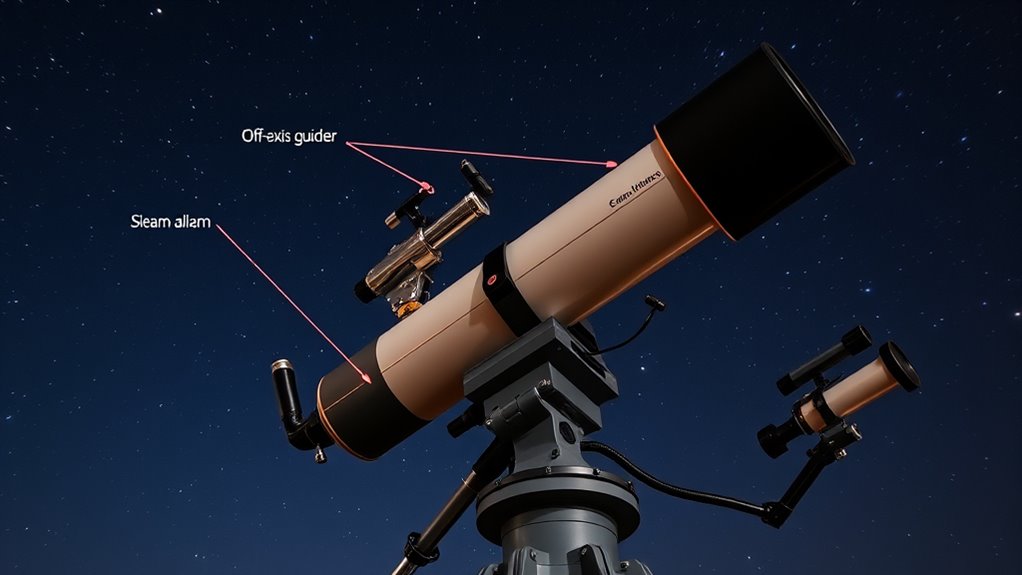
Off-axis guiders are compact and mount directly in the optical path of your telescope. Because they share the same optical axis, they can be less affected by flexure or misalignment, making them ideal for maintaining accurate polar alignment. When working with longer focal lengths, this stability becomes even more critical, as small misalignments can cause star trailing. Off-axis guiders typically require less setup time, but they demand a high-quality, well-aligned optical train. Achieving perfect focus can be tricky since the guider is integrated into the main optical path, so fine-tuning focus often involves adjusting your primary scope as well as the guider. Additionally, because they share the same optical axis, off-axis guiders can provide more consistent guiding performance during long exposures.
Off-axis guiders are compact, stable, and ideal for maintaining precise polar alignment at longer focal lengths.
Separate guide scopes, on the other hand, are mounted alongside your main telescope. They provide a dedicated optical path for guiding, which can make focusing easier because you’re adjusting a separate, smaller scope. This separation allows you to focus independently on your guide star, often resulting in more precise guiding at high focal lengths. However, separate guide scopes are more susceptible to flexure, especially if not rigidly mounted, which can cause drift over time. Flexure becomes particularly problematic when you’re working at longer focal lengths, as even tiny shifts can blur your images. Proper mounting and regular checks of the guide scope’s focus are essential to prevent misalignment and ensure consistent guiding performance.
Both systems influence your ability to maintain perfect polar alignment. Off-axis guiders tend to make it easier to verify and adjust your polar alignment because they often include reticles or crosshairs that help you pinpoint your star. With separate guide scopes, you might need additional equipment or procedures to ensure your guiding star remains accurately tracked, especially during long exposures. Achieving and maintaining focus at different focal lengths also varies: off-axis guiders require careful initial setup to ensure the optical path is well aligned, while separate guide scopes benefit from independent focusing, which can streamline the process. It is also important to consider the impact of optical train stability when choosing between these systems, as stability directly affects guiding accuracy and image quality.
Ultimately, your choice hinges on your focal length and how stable your setup is. Off-axis guiders excel in tight, high-magnification setups where stability and minimal flexure matter most. Separate guide scopes work well across a range of focal lengths but demand secure mounting and regular focus checks. Both systems impact your ability to keep your images sharp, but understanding how they interact with polar alignment and focal adjustments helps you pick the right guiding tool for achieving pinpoint stars and crisp astrophotos.
Frequently Asked Questions
How Does Guider Type Affect Imaging Exposure Times?
The guider type impacts your imaging exposure times because guide accuracy varies. Off-axis guiders often provide more precise tracking, reducing the need for longer exposures, while separate guide scopes may introduce slight inaccuracies, requiring longer exposures for proper image calibration. By choosing the right guider, you optimize your exposure times, minimizing star trailing and ensuring sharper images. Proper guide accuracy is key to efficient imaging and achieving clear, detailed results.
Can Off-Axis Guiders Cause Vignetting or Image Obstruction?
Off-axis guiders can sometimes be the sneaky gremlins in your setup, causing vignetting issues or image obstruction. As they sit close to the main camera, they might block part of your field of view, leading to darkened corners or shadows. While they save space and are convenient, you should carefully align and test to prevent these issues, ensuring your images stay bright and clear without unwanted obstructions.
Are Separate Guide Scopes Suitable for Astrophotography With Fast Telescopes?
Separate guide scopes are suitable for astrophotography with fast telescopes, provided you choose models with good guide scope durability. They often offer better guider compatibility, making it easier to find a setup that works well with your main telescope. Just make certain the guide scope is sturdy and properly aligned, so you maintain accurate guiding even with fast optics. This setup helps you achieve sharper images and consistent tracking during your astrophotography sessions.
What Maintenance Differences Exist Between Off-Axis and Separate Guide Systems?
You’ll find that maintenance differs mainly in alignment challenges and optical alignment. Off-axis guiders require less cleaning and fewer adjustments since they’re built into the main scope, but you need to check alignment regularly to avoid focusing issues. Separate guide scopes demand more frequent optical alignment and cleaning, especially if you transport or handle your setup often. Regularly inspecting and calibrating both systems helps maintain peak focusing and guiding performance.
How Do Guider Choices Influence Overall Astrophotography Setup Complexity?
You might worry that guider choices complicate your setup, but focusing on mounting compatibility and weight considerations helps. Off-axis guiders are lighter and easier to mount, reducing setup time, while separate guide scopes add weight and require more mounting options. This impacts overall astrophotography setup complexity, making off-axis systems more straightforward for beginners, whereas separate guides demand careful planning and additional equipment, increasing the setup’s intricacy.
Conclusion
Choosing between off-axis guiders and separate guide scopes really depends on your setup. Did you know that off-axis guiders can reduce image downtime by up to 30%? They’re more convenient for compact setups, but might require more precise focusing. On the other hand, separate guide scopes offer easier focusing but take up more space. Whichever you pick, understanding their impact on focusing helps you capture clearer images and improves your astrophotography experience.