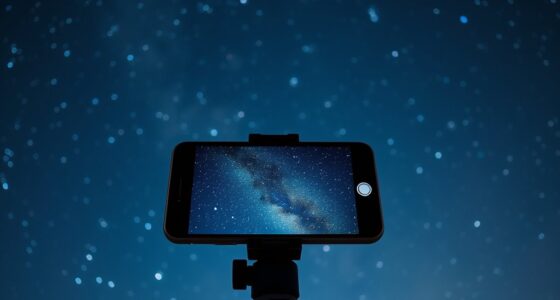

When choosing between planetary and deep-sky cameras, consider what you’re imaging. Planetary cameras need high frame rates and sensors optimized for capturing sharp details of bright objects, making short exposures ideal. Deep-sky cameras require larger sensors and long exposures to gather faint signals from galaxies and nebulae. Your choice of sensor—CCD or CMOS—affects image quality and processing. To make the best pick for your goals, continue exploring how sensor features influence each type’s performance.
Key Takeaways
- Planetary cameras use sensors optimized for high frame rates and short exposures to capture detailed planetary features.
- Deep-sky cameras feature larger sensors with higher pixel counts for long exposures of faint celestial objects.
- Sensor sensitivity influences exposure times: planetary cameras favor short, high-speed captures; deep-sky cameras need longer exposures.
- CCD sensors excel in deep-sky imaging for capturing faint signals, while CMOS sensors provide high frame rates suitable for planetary imaging.
- Selecting the right sensor depends on your target objects and preferred imaging workflow, balancing exposure, sensitivity, and processing needs.
When choosing a camera for astrophotography, understanding the differences between planetary and deep-sky cameras is essential. One of the most critical factors to consider is sensor sensitivity. Planetary cameras typically have sensors designed to capture sharp, high-contrast images of objects like planets and the moon. These sensors often feature high frame rates and are optimized for capturing rapid, detailed images despite shorter exposure times. This high sensitivity allows you to freeze atmospheric turbulence and produce clear, detailed planetary images. On the other hand, deep-sky cameras usually have larger sensors with greater pixel counts, enabling them to gather more light over longer exposures. This increased sensor sensitivity is vital for capturing faint galaxies, nebulae, and star clusters, which require prolonged exposure times to reveal their intricate details.
Another key aspect to consider is the application of image processing techniques. With planetary imaging, you tend to rely heavily on stacking hundreds or thousands of short-exposure frames to enhance detail and reduce noise. Advanced stacking and sharpening algorithms help to bring out subtle surface features on planets, making the most of the camera’s sensor capabilities. Deep-sky imaging, however, involves stacking multiple long-exposure frames to build up signal and suppress noise. Post-processing techniques such as noise reduction, contrast enhancement, and color balancing are crucial here, as they help to reveal faint structures within nebulae or the subtle glow of distant galaxies. Your choice of camera influences which processing techniques will be most effective; planetary cameras often benefit from real-time stacking and stacking software, while deep-sky cameras require robust post-processing workflows. Additionally, the sensor type plays a significant role in determining your overall imaging experience, with CCD sensors excelling at capturing faint signals over long exposures, and CMOS sensors offering high frame rates suitable for planetary imaging.
Frequently Asked Questions
How Does Sensor Size Affect Image Quality in Planetary and Deep-Sky Cameras?
Sensor size impacts image quality by influencing sensor resolution and pixel size. A larger sensor typically offers higher resolution, allowing you to capture more detailed images. Smaller pixels can increase the sensor’s ability to resolve fine details, especially in planetary imaging, while larger pixels excel in low-light conditions common in deep-sky photography. Ultimately, choosing the right sensor size depends on balancing resolution and pixel size to suit your specific imaging needs.
What Are the Maintenance Requirements for Different Sensor Types?
You might worry about maintenance, but with proper care, it’s manageable. Regular sensor calibration guarantees essential image quality, so perform it as recommended. Dust management is vital; keep your sensor clean by gently using an air blower or specialized tools, avoiding harsh cleaning. Check for dust buildup periodically, especially if you change lenses often. Staying consistent with these steps keeps your sensor in top shape and your images sharp and clear.
Can a Single Camera Be Versatile for Both Planetary and Deep-Sky Imaging?
Yes, you can use a single camera for both planetary and deep-sky imaging if it offers good camera compatibility. Look for a versatile sensor with easy sensor calibration options, ensuring high-quality images across different targets. Keep in mind that you might need to adjust settings or accessories, but a well-chosen camera can handle both types effectively, making it a practical choice for an all-around astrophotography setup.
Which Sensor Types Perform Best in Low-Light Conditions?
Sensors with superb sensitivity and sharp noise reduction perform best in low-light conditions. You benefit from sensors that boost brightness while minimizing noise, ensuring clearer captures of faint celestial objects. Look for sensors with high quantum efficiency and effective noise reduction technology, which allows you to gather more light and produce cleaner images. This helps you achieve detailed, vibrant deep-sky shots even in dim environments.
How Does Sensor Noise Impact Astrophotography Results Over Time?
Sensor noise can considerably impact your astrophotography results over time by reducing image clarity and detail. To combat this, you should perform regular sensor calibration and apply noise reduction techniques during post-processing. These steps help minimize the effects of thermal and electronic noise, ensuring your images stay sharp and clean, even after multiple exposures. Proper maintenance and processing are key to achieving high-quality, long-term astrophotography results.
Conclusion
Choosing between planetary and deep-sky cameras is like picking the right tool for a job—you’ll get the best results when you match the camera to your specific interests. If you’re after crisp, detailed planetary images, go for a dedicated planetary camera. For capturing vast, faint nebulae and galaxies, deep-sky cameras are your best bet. Ultimately, selecting the right sensor helps you discover the universe’s secrets, like a key opening a treasure chest of cosmic wonders.