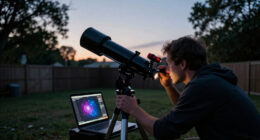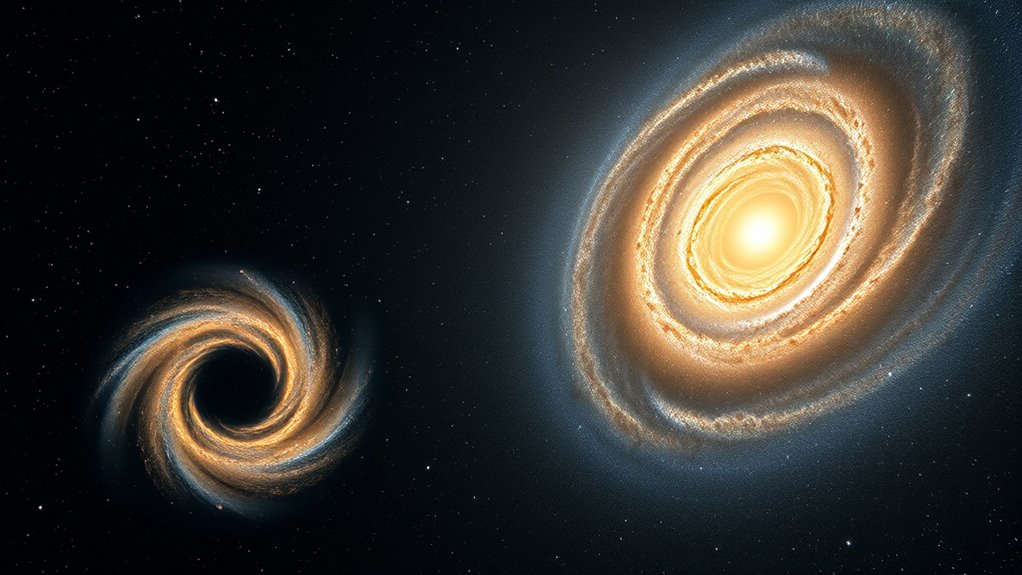
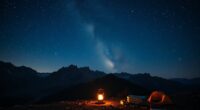
Choosing a wide-angle lens lets you capture the expansive view of the Andromeda Galaxy, including its faint arms and surrounding stars, providing rich scene context. A telephoto lens zooms in on specific details or the galaxy’s core, revealing finer structures but narrowing your field of view. Your choice affects how much of the galaxy and its environment you show. If you want to explore these options further, you’ll find valuable insights as you continue to explore.

Prime made for students and young adults
- Fast, free delivery for dorm and study essentials
- Prime Video and Amazon Music included
- Member-only deals
Key Takeaways
- Wide lenses capture a large portion of the galaxy and its surroundings, providing context and showing the galaxy’s sprawling structure.
- Telephoto lenses focus on specific features or the galaxy’s core, revealing fine details and internal structures.
- Wide framing offers a broad scene with more celestial objects, while telephoto framing isolates the galaxy for detailed analysis.
- Wide shots are ideal for showcasing the galaxy’s relationship with nearby stars and nebulae, whereas telephoto shots emphasize intricate features.
- Lens choice influences composition: wide lenses for context and atmosphere, telephoto for close-up detail and structure.
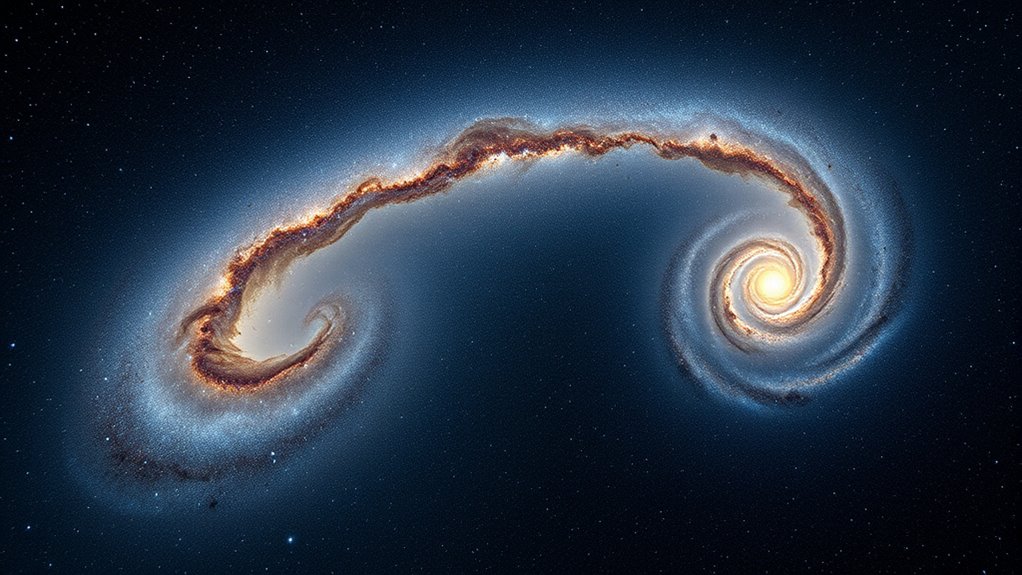
Have you ever wondered how astronomers capture such stunning images of distant galaxies? It all begins with lens selection and camera settings, which play vital roles in framing the Andromeda Galaxy perfectly. When you’re choosing a lens, consider whether you want to emphasize the galaxy’s broad expanse or focus on its intricate details. A wide-angle lens is ideal if your goal is to capture a large portion of the night sky, including the galaxy’s faint, sprawling arms. This type of lens allows you to take in more of the scene, making Andromeda appear as a majestic, sprawling object within a vast cosmic landscape. Its wide field of view is perfect for capturing the galaxy in context, showing its relationship with nearby stars and nebulae, but it doesn’t offer the same level of detail as a telephoto lens.
On the other hand, if you’re aiming to zoom in on the galaxy’s core or specific features, a telephoto lens is your best bet. This lens selection compresses the scene, bringing far-off details closer and revealing finer structures within Andromeda. Keep in mind, though, that using a telephoto lens requires you to be more precise with your camera settings. Because these lenses have a narrower field of view, you’ll need to carefully set your aperture, ISO, and exposure time to gather enough light without introducing noise or blur. Typically, a wider aperture (like f/2.8 or lower) helps maximize light intake, which is essential for capturing faint galaxy details. Adjust your ISO according to your camera’s capabilities—the higher the ISO, the more sensitive it is to light but also more prone to noise.
Use a telephoto lens with a wide aperture and careful ISO settings for detailed galaxy shots.
When shooting with either lens, your camera settings need to be carefully balanced. Longer exposures are usually necessary to reveal the galaxy’s faint features, but they also increase the risk of star trails if your mount isn’t tracking properly. Use a tracking mount if possible to keep stars and galaxy details sharp during extended exposures. For wide shots, a moderate exposure time combined with a wide aperture can produce stunning results without overexposing brighter stars. For close-up shots with a telephoto lens, you’ll want to experiment with shorter exposures to prevent star trails, or use stacking techniques to combine multiple images for a crisper, more detailed result. Additionally, understanding the role of AI-driven security systems in modern technology can help optimize your camera’s automation and image processing capabilities.
In essence, your choice of lens and camera settings shapes how you frame the Andromeda Galaxy. Wide lenses provide context and a sense of scale, while telephoto lenses offer detailed, close-up views. Mastering both approaches allows you to capture the galaxy in all its cosmic beauty, whether as a sweeping celestial landscape or a detailed, glowing core.
wide-angle camera lens for astrophotography
As an affiliate, we earn on qualifying purchases.
As an affiliate, we earn on qualifying purchases.
Frequently Asked Questions
What Camera Settings Are Optimal for Astrophotography?
You should set your camera’s sensor sensitivity high, around ISO 800 to 1600, to capture faint stars clearly. Use a long exposure duration, typically 15 to 30 seconds, to gather enough light without overexposing. Keep your aperture wide open, like f/2.8 or lower, and use a sturdy tripod. Adjust these settings based on your scene and equipment to get sharp, detailed astrophotography shots.
How Does Atmospheric Distortion Affect Galaxy Imaging?
Atmospheric turbulence can distort your galaxy images, causing blurriness and reducing detail. It’s mainly caused by atmospheric turbulence, which creates shifting air currents. Sky clarity considerably impacts this, as clearer skies minimize distortion. To improve your imaging, choose nights with stable air and high sky clarity, and consider using adaptive optics or stacking multiple shots. These methods help counteract atmospheric effects, resulting in sharper, more detailed galaxy images.
What Post-Processing Techniques Enhance Galaxy Photos?
To enhance your galaxy photos, you should use star trail techniques to add dynamic motion and apply color correction methods to improve color accuracy. These techniques help reduce noise, enhance details, and bring out the galaxy’s true colors. Post-processing software like Adobe Photoshop or Lightroom allows you to fine-tune contrast, sharpness, and saturation, making your images more vivid and mesmerizing. Always experiment to find your preferred aesthetic.
Which Lens Brands Are Best for Astrophotography?
Think of your lens as a trusted compass guiding your night sky journey. Brands like Canon, Nikon, and Sigma excel because they offer precise lens calibration, ensuring clear, sharp images. Pair them with a reliable star tracker to keep your shots steady amid the cosmos. These brands stand out for their durability and optical quality, making them ideal choices to capture the beauty of galaxies like Andromeda.
How Do Light Pollution Levels Impact Framing Choices?
Light pollution from urban skies considerably impacts your framing choices. In areas with high light pollution, you might prefer wider lenses to capture more of the sky and minimize the effects of local light sources. Narrower, telephoto lenses can help isolate the galaxy but may require longer exposures and more post-processing to reduce light pollution’s impact. Adjust your approach based on light pollution levels to get clearer, more detailed astrophotos.
telephoto lens for galaxy photography
As an affiliate, we earn on qualifying purchases.
As an affiliate, we earn on qualifying purchases.
Conclusion
Whether you choose wide or telephoto, framing the Andromeda Galaxy invites you to see its beauty from new perspectives, to embrace its vastness and detail, to capture its mystery and majesty. Each lens offers a different story, a different view, a different experience. By exploring both options, you deepen your connection, expand your understanding, and enrich your appreciation. In framing the galaxy, you frame your passion, your curiosity, and your love for the cosmos itself.
astro tracking mount for long exposures
As an affiliate, we earn on qualifying purchases.
As an affiliate, we earn on qualifying purchases.
camera lens aperture for night sky
As an affiliate, we earn on qualifying purchases.
As an affiliate, we earn on qualifying purchases.
Halloween Picks
halloween
As an affiliate, we earn on qualifying purchases.