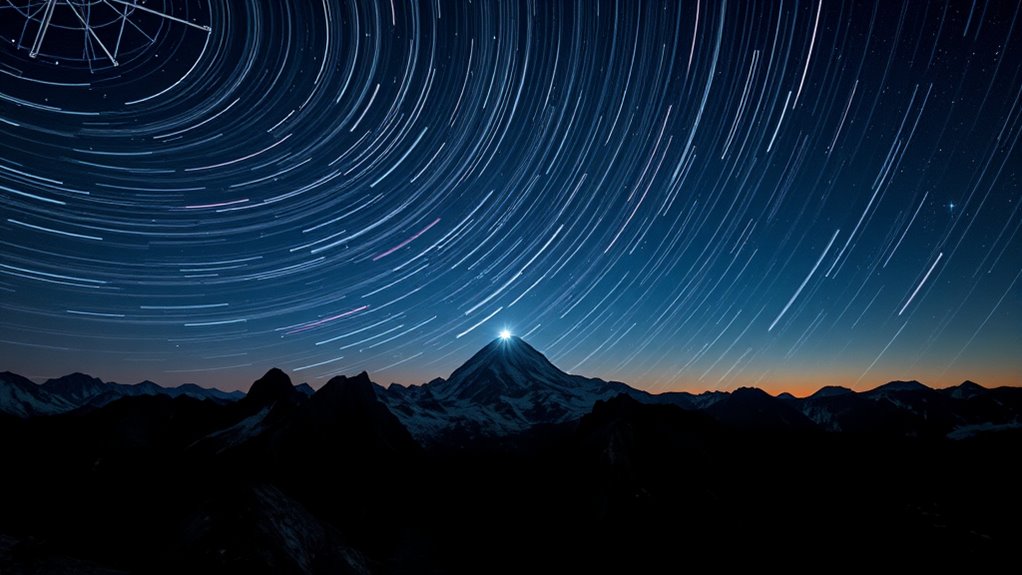
To image Polaris and surrounding star trails, you need to master polar alignment, ensuring your telescope or camera points precisely at the north celestial pole. With proper setup, your long exposures will capture stunning star trails that circle around Polaris, which appears nearly fixed due to its proximity to the pole. This technique reveals Earth’s rotation and helps you create mesmerizing images. Keep exploring, and you’ll uncover how to optimize your astrophotography and capture truly breathtaking circumpolar scenes.
Key Takeaways
- Polaris, near the celestial pole, remains nearly fixed, making it an ideal anchor point for circumpolar star trail imaging.
- Accurate polar alignment ensures star trails are smooth and well-defined, preventing blurring during long exposures.
- Imaging Polaris alongside surrounding star trails reveals Earth’s rotation and axial tilt through star movement patterns.
- Multiple short exposures stacked together enhance detail and reduce noise in star trail photographs of circumpolar regions.
- Studying Polaris and star trails provides scientific insights into Earth’s rotational dynamics and celestial mechanics.
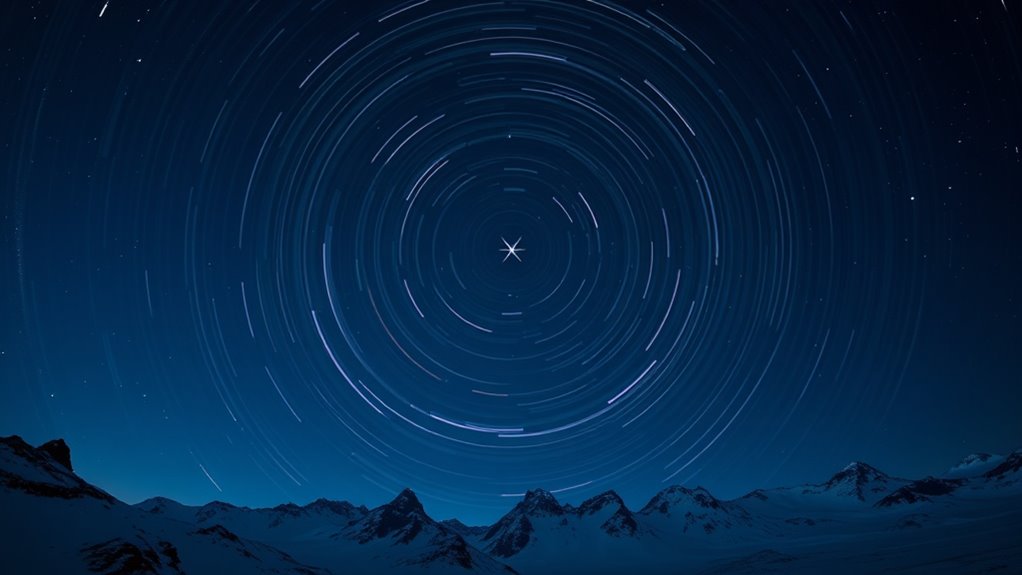
Have you ever wondered how scientists identify and study regions around the Earth’s poles? It’s a fascinating process that involves precise techniques and a good understanding of celestial mechanics. When imaging circumpolar targets like Polaris and its surrounding star trails, your first step is achieving accurate polar alignment. This alignment ensures your telescope or camera is pointed exactly at the celestial pole, allowing for long exposures without star trails blurring across the sky. Proper polar alignment is essential because it keeps the stars and Polaris in a fixed position relative to your setup, making it possible to capture stunning, detailed images of these regions.
Once your mount is accurately aligned with the Earth’s axis, star trail techniques come into play. These techniques involve capturing extended exposures of the night sky, which reveal the apparent motion of stars as they circle around the celestial pole. As you take these long exposures, stars appear as streaks or trails, with Polaris often remaining nearly stationary due to its position very close to the north celestial pole. This makes Polaris an ideal target for astrophotographers interested in circumpolar imaging, as it provides a fixed point amidst the swirling star trails. By stacking multiple shorter exposures, you can also reduce noise and enhance the clarity of your images, revealing the intricate patterns of star movement around the pole.
Imaging Polaris and its surrounding star trails isn’t just about capturing beautiful photos; it’s also a way to study Earth’s rotation and the geometry of our planet’s axis. When you use star trail techniques in conjunction with precise polar alignment, you effectively map out the celestial sphere’s rotation, giving you insight into the dynamics of the night sky. This process helps scientists and astronomers understand phenomena like axial tilt and precession, which influence Earth’s orientation over time. Additionally, understanding polar alignment is key to maintaining accurate tracking during long exposures, preventing star trails from blurring. When you master these techniques, you can observe and analyze subtle shifts in Earth’s orientation over extended periods. For amateur astronomers, mastering these techniques offers a deeper appreciation of how celestial bodies move and interact, and it allows you to create stunning visual representations of the Earth’s polar regions in the sky.

iEXOS-100-2 PMC-Eight Equatorial Tracker System Tripod and Mount for Astrophotography with WiFi and Bluetooth Compatible
- Advanced Multi-CPU System: Eight independent CPUs for fast responsiveness
- Quiet Dual-Axis Gears: Clutched worm gears with precision stepper motors
- User-Friendly App: ExploreStars app for easy alignment and navigation
As an affiliate, we earn on qualifying purchases.
As an affiliate, we earn on qualifying purchases.
Frequently Asked Questions
What Equipment Is Best for Capturing Polaris and Star Trails?
You should use a sturdy tripod and a camera with good low-light performance for capturing Polaris and star trails. For sharp images, guarantee precise polar alignment to keep your star trails smooth. Select a wide-angle lens with a large aperture, like f/2.8, to gather more light and capture the trails effectively. Use a remote shutter release or intervalometer to avoid camera shake during long exposures.
How Does Weather Affect Circumpolar Imaging Quality?
Weather can turn your night sky into a turbulent sea, disrupting your circumpolar imaging. If the sky isn’t clear and sky clarity is low, your star trails will appear dim or broken, like fading whispers in the dark. Strong wind disturbance shakes your camera, causing blur and streaks that ruin sharpness. To get perfect captures, choose nights with calm winds and clear skies, letting your stars shine their brightest without interruption.
What Are Optimal Exposure Times for Star Trail Photography?
For star trail photography, you should aim for exposure times between 20 to 30 minutes to capture smooth trails. Use a wide-angle lens with calibrated settings to guarantee sharp images. Set your aperture to its widest to gather maximum light, typically f/2.8 or lower, and keep ISO low to reduce noise. Regularly check your lens calibration to prevent star trails from appearing distorted or uneven.
Can Amateurs Successfully Photograph Polaris’ Movement?
You can definitely capture Polaris’ movement with amateur gear using clever astrophotography techniques. As you set up your camera for celestial navigation, focus on long exposures to reveal its slow, graceful rotation. With patience and precise timing, you’ll create stunning star trail images that showcase Polaris as the center of celestial motion. Don’t underestimate your skills—your passion and technique can turn night into a mesmerizing display of the sky’s dance.
How Do I Process and Stack Star Trail Images Effectively?
You can effectively process and stack star trail images by first applying dark frame calibration to remove sensor noise. Use stacking software like StarStaX or DeepSkyStacker to combine your images, ensuring proper alignment. Adjust the settings to optimize trail continuity and brightness. Finally, perform minor post-processing in photo editing software to enhance contrast and detail, resulting in clear, stunning star trail images that showcase Polaris’ movement beautifully.

Sky Watcher Star Adventurer Tripod – Star Adventurer Accessory – Compatible with AZGT Series and AZ5 Mounts (S20555)
- Compatible with Star Adventurer GTi: Fits GTi, AZ-GT, and AZ5 mounts
As an affiliate, we earn on qualifying purchases.
As an affiliate, we earn on qualifying purchases.
Conclusion
By tracking Polaris and surrounding star trails, you gain a unique perspective of the sky’s constant motion. Did you know that Polaris remains nearly fixed over the North Pole, making it a reliable celestial marker? This stability helps you capture stunning, long-exposure images of star trails around the pole. With just a few minutes of exposure, you can visualize hundreds of stars swirling in perfect circles, creating breathtaking celestial artworks right in your camera.

Celestron Polar Finderscope for CG-5 German Equatorial Mount
- Mount Compatibility: Fits CG-5, AVX, CGEM mounts
- Simple Installation: Easily inserts into mount port
- Hemispheric Use: Works in both hemispheres
As an affiliate, we earn on qualifying purchases.
As an affiliate, we earn on qualifying purchases.

SVBONY SC311 Upgraded WiFi Telescope Camera,IMX662 Astrophotography Camera
- Extended Exposure Time: Supports up to 30-second exposures for clearer images
- IMX662 Sensor: Low noise, no amp glow, enhanced NIR sensitivity
- Built-in WiFi: Creates hotspot for direct connection to devices
As an affiliate, we earn on qualifying purchases.
As an affiliate, we earn on qualifying purchases.