TL;DR

Prime made for students and young adults
- Fast, free delivery for dorm and study essentials
- Prime Video and Amazon Music included
- Member-only deals
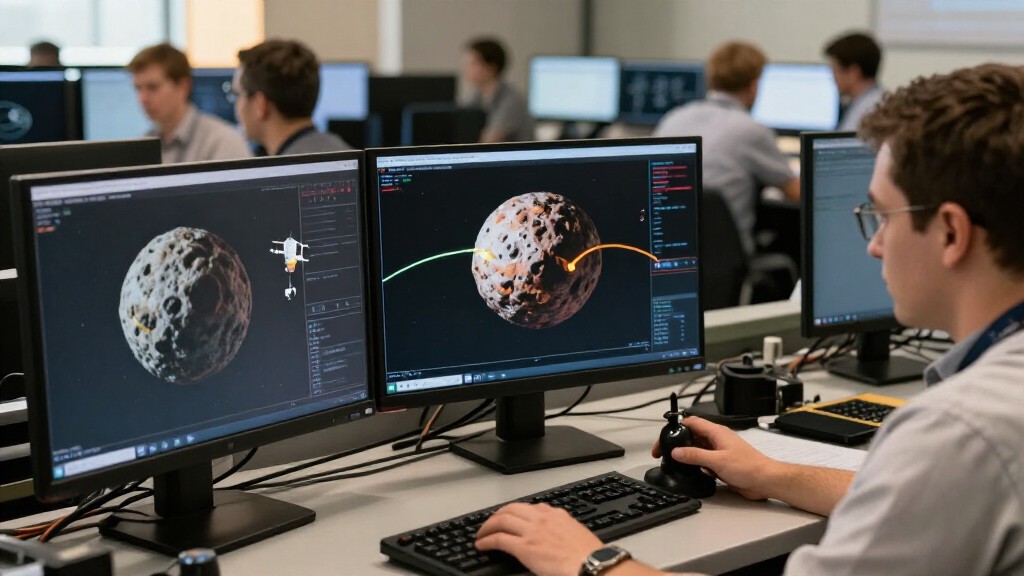
The European Space Agency’s Hera spacecraft is due to reach the Didymos asteroid system during November, according to ESA. It will study Dimorphos, whose orbit NASA’s DART spacecraft changed in 2022, to examine the impact site and investigate broader questions about how asteroids behave.
The European Space Agency’s Hera spacecraft is due to reach the Didymos asteroid system during November, where it will survey the aftermath of NASA’s 2022 impact on the smaller asteroid Dimorphos. The mission is intended to provide close-up measurements of a test that changed an asteroid’s orbit and to investigate ten outstanding questions about asteroid structure and behavior, ESA says.
Hera is heading to Dimorphos, about 151 meters across, which orbits the roughly 780-meter Didymos. NASA’s DART spacecraft struck Dimorphos on Sept. 26, 2022. ESA describes Dimorphos as the first object in the Solar System whose orbit was changed by human action. The impact produced a brightening observed by telescopes on Earth, but those distant observations did not show the detailed condition of the asteroid or its impact site.
Hera’s central task is to make a close-up survey of the crash site and gather data on the kinetic-impact method of asteroid deflection. That method seeks to change an asteroid’s path by striking it with a spacecraft. ESA says the measurements are intended to help researchers better understand DART’s experiment and the factors that determine how an impact affects an asteroid.
ESA also frames the mission as an opportunity for broader asteroid science. The agency’s report says earlier spacecraft encounters have shown that asteroids can be dynamic environments with complex histories. It presents ten mysteries for Hera to explore, but the supplied report does not list those questions individually or describe specific findings in advance. The observations remain to be made; the mission’s scientific goals should not be mistaken for confirmed answers.
Turning DART Into a Deflection Test
The mission matters because a change in an asteroid’s orbit is not, by itself, a full account of how the impact worked. A close inspection can help connect the observed orbital change with the physical aftermath on Dimorphos, including the nature of the impact site. ESA says those data could make the kinetic-impact approach better understood as a planetary-defence technique.
That distinction is relevant to any future effort to deflect a hazardous asteroid. Scientists need to know not only whether a spacecraft strike can alter motion, but also how the target’s properties shape the result. Hera’s measurements may help researchers interpret the DART test and improve estimates for other asteroids. They will not, on their own, establish that the same outcome can be expected for every object; the source describes an investigation, not a guarantee.
Popular right now

Shark HydroVac MessMaster Corded Wet Dry Vacuum and Mop (WD161)

LG 85-Inch QNED73B Mini LED 4K Smart TV (2026)

Vitamix Propel Series 510 Professional-Grade Blender, 3 Programs, Black
As an affiliate, we earn on qualifying purchases.
From DART’s 2022 Strike to Hera
DART carried out its impact on Sept. 26, 2022, striking Dimorphos as the smaller member of the Didymos pair. The change to Dimorphos’s orbit made the event a real-world test of kinetic impact rather than a laboratory simulation. Telescopes on Earth recorded a brightening after the collision, but their distance limited what could be seen directly at the site.
Hera is ESA’s first mission for planetary defence, according to the agency. Its journey to the same asteroid system is designed to follow up the DART experiment with measurements made nearby. The source says the spacecraft is expected to arrive during November, but does not give a year in the material provided here. The mission’s planetary-defence purpose sits alongside the scientific questions raised by the complex behavior of small Solar System bodies.
“Hera is the European Space Agency’s first mission for planetary defence.”
— European Space Agency
What the Impact Site May Reveal
The detailed condition of Dimorphos after DART’s strike remains unknown in the source material. ESA says the impact caused a brightening visible to distant telescopes, but that observation did not resolve what happened to the asteroid itself. Hera’s survey is intended to provide a closer look; until those observations are made and analyzed, the impact site’s specific features and what they imply about the asteroid remain unsettled.
The supplied report also refers to ten mysteries without naming or explaining them one by one. It gives no mission results, detailed observation schedule, or separate predictions for each question. The November arrival timing is stated without a year, so the date cannot be made more precise from this material.
Hera’s Close Survey of Dimorphos
Hera is expected to arrive at the Didymos system during November and begin the close-up work described by ESA. Its next key contribution will be the collection and analysis of data from Dimorphos and the DART impact site. Those observations should help researchers assess how the collision altered the asteroid and what the result says about kinetic impact as a deflection method.
Further conclusions will depend on what Hera observes and how scientists interpret the measurements. ESA’s report sets out the mission’s aims, not outcomes; answers to the asteroid questions remain pending.
Key Questions
What is Hera going to study?
ESA says Hera will survey Dimorphos and the site of NASA’s DART impact, while investigating broader questions about asteroid science.
What happened to Dimorphos in 2022?
NASA’s DART spacecraft struck Dimorphos on Sept. 26, 2022. ESA says the impact changed the asteroid’s orbit, but the detailed physical result at the site remains to be examined.
How large are Dimorphos and Didymos?
ESA gives Dimorphos’s diameter as about 151 meters and Didymos’s as about 780 meters.
Will Hera prove that asteroid deflection works?
Hera will gather data to help researchers understand the DART kinetic-impact experiment. The source describes that as a mission goal; it does not report Hera’s findings or claim that one test establishes results for all asteroids.
When will Hera arrive?
ESA’s report says the spacecraft is due to arrive during November, but the source material provided here does not specify the year.
Source: esa.int