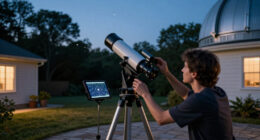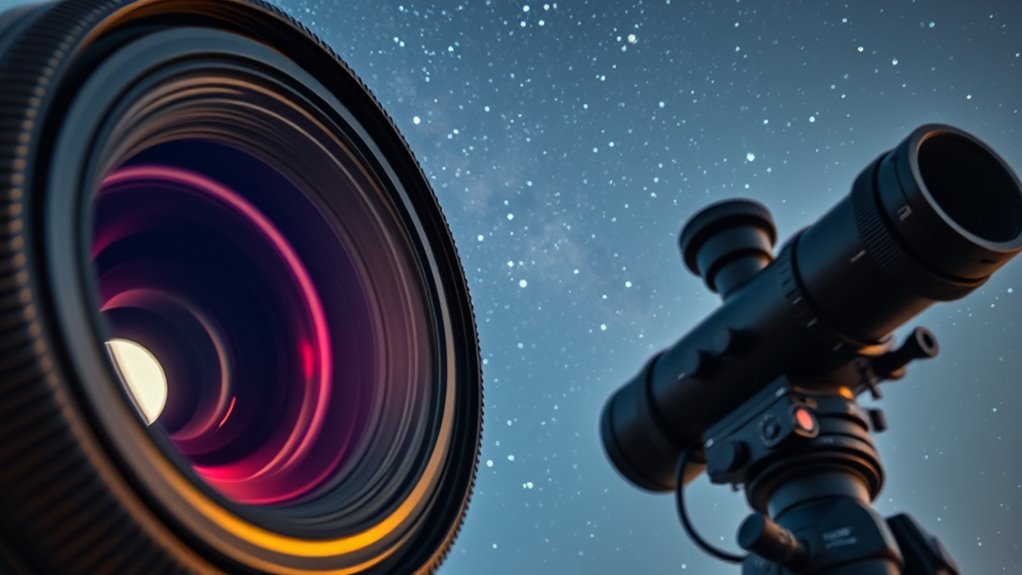
If you’re looking to capture wide-field views or take detailed planetary shots, camera lenses are your best choice, especially with their zoom capabilities and ease of use on tripods. On the other hand, if you want to explore faint objects or do deep-sky imaging, telescopes provide the light-gathering power and high magnifications needed. Understanding these differences helps you pick the right tool for your astronomical goals—keep exploring to discover more about each option.

Get school and study supplies delivered free — and shop member deals
- Fast, free delivery on millions of items
- Access to Prime Big Deal Days deals on October 6–7
- Prime Video, Amazon Music and more included
Key Takeaways
- Use camera lenses for wide-field views, planetary photography, and astrophotography with portable, versatile equipment.
- Choose telescopes for deep-sky imaging, faint object observation, and high-magnification detailed astronomical exploration.
- Opt for camera lenses when mobility and quick setup are priorities; select telescopes for specialized, high-magnification viewing.
- Camera lenses excel in terrestrial and planetary shots with long exposures; telescopes gather more light for faint celestial objects.
- Select camera lenses for general astrophotography and wide landscape shots; opt for telescopes when aiming for detailed cosmic observations.
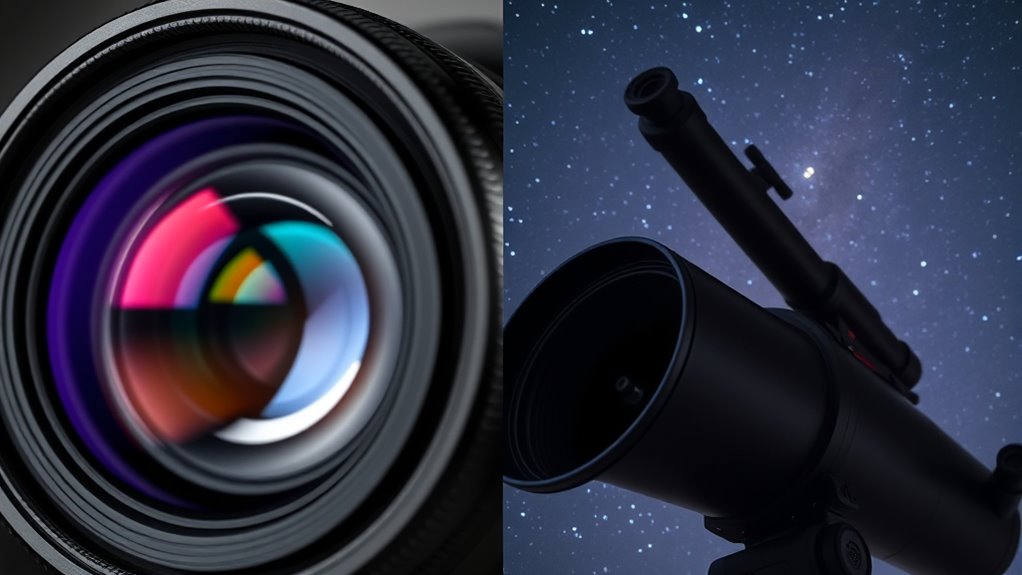
When you compare camera lenses and telescopes, you’ll find that both are designed to magnify distant objects, but they serve different purposes and operate in distinct ways. If you’re venturing into astrophotography, understanding these differences is essential. Camera lenses, especially telephoto lenses, offer optical zoom capabilities that allow you to get close-up shots of distant terrestrial subjects or celestial objects. However, their zoom differences are limited compared to telescopes, which are built for high-magnification viewing of faint celestial bodies. Astrophotography techniques often involve long exposures and careful stabilization, which camera lenses can accommodate with the right equipment, such as sturdy tripods and tracking mounts. Telescopes, on the other hand, are designed specifically to gather light from distant stars, planets, and galaxies, making them ideal for detailed astronomical observations.
The key difference in optical zoom is that camera lenses have a finite zoom range, often varying from 3x to 50x or more, depending on the lens. This optical zoom directly adjusts the lens elements to magnify the image, offering versatility in framing scenes. Telescopes don’t have zoom in the traditional sense; instead, they rely on different eyepieces to change magnification levels. Changing an eyepiece can markedly alter your view, and this adaptability makes telescopes better suited for specific observational goals rather than quick framing adjustments. When it comes to astrophotography techniques, camera lenses excel in capturing wide fields of view or specific celestial objects like the moon or planets, especially with high-resolution sensors. Telescopes are better for deep-sky imaging, where gathering as much light as possible is essential for revealing faint nebulae or distant galaxies.
While both tools require patience and practice, your choice depends on what you want to observe or photograph. If you’re aiming to photograph the night sky with a focus on wide-field views or capturing planetary details, a good telephoto lens coupled with astrophotography techniques should suffice. But if your goal is to explore the cosmos in detail and push the boundaries of what you can see with your eyes, investing in a telescope makes more sense. Understanding the optical zoom differences helps you decide whether you need the flexibility of variable focal lengths or the specialized power of a telescope. Both tools are valuable, but knowing their strengths and limitations guarantees you pick the right one for your astronomical adventures.
camera telephoto lens for astrophotography
As an affiliate, we earn on qualifying purchases.
As an affiliate, we earn on qualifying purchases.
Frequently Asked Questions
Can I Use a Camera Lens for Astrophotography?
Yes, you can use a camera lens for astrophotography, but keep in mind the magnification differences and field of view. Camera lenses generally offer a wider field of view, making them ideal for capturing large star fields or the Milky Way. However, their magnification isn’t as high as telescopes, so if you’re aiming for detailed planetary shots, a telescope might be a better choice. Adjust your lens and settings accordingly for best results.
What Are the Cost Differences Between Lenses and Telescopes?
The pricing comparison shows camera lenses are generally more affordable, starting at a few hundred dollars, while telescopes can range from several hundred to thousands of dollars. When considering investment, think about your goals; a good lens offers versatility for photography, but a telescope is a specialized tool for astronomy. Your budget and intended use will guide you toward the best choice for your needs.
Do Camera Lenses Require Special Mounts for Telescopic Use?
Nearly 80% of camera lenses can be adapted for telescopic use, but you’ll often need specific mount compatibility or adapters. Most camera lenses don’t require special mounts, but you might need an adapter to fit your telescope’s eyepiece or mount system. Always check your lens’s mount compatibility and guarantee you have the right adapter to connect it securely, preventing damage and ensuring clear astronomical views.
How Does Image Quality Compare Between Lenses and Telescopes?
You’ll notice that telescopes generally offer better image resolution for distant objects, with less chromatic aberration compared to camera lenses. Cameras lenses can sometimes suffer from chromatic aberration, which blurs images, especially at the edges. Telescopes are optimized for high contrast and detail in astronomical views, making them superior for deep-sky observation. However, modern high-quality camera lenses can still produce sharp images, but they usually don’t match telescopic clarity for distant celestial objects.
Are There Hybrid Devices Combining Camera Lenses and Telescopes?
Think of hybrid devices as the Swiss Army knives of optics—they combine the best of both worlds. Yes, you can find hybrid devices that fuse camera lenses and telescopes, offering combined optics for versatile use. These innovations let you capture stunning terrestrial shots and observe celestial bodies without switching equipment. With such combined optics, you get portability, convenience, and expanded creative possibilities, making your photography and astronomy adventures more seamless and enjoyable.
deep sky telescope for faint objects
As an affiliate, we earn on qualifying purchases.
As an affiliate, we earn on qualifying purchases.
Conclusion
Whether you should choose a camera lens or a telescope depends on what you want to capture. If you’re aiming for detailed close-ups of distant planets or stars, a telescope is your best bet. But don’t worry—if you prefer versatile, everyday photography, a good camera lens will serve you well. Imagine capturing stunning night skies or vibrant wildlife—your choice enhances your adventure. Just pick what excites you most, and start exploring the universe today!
high zoom camera lens for celestial photography
As an affiliate, we earn on qualifying purchases.
As an affiliate, we earn on qualifying purchases.
astronomy telescope with interchangeable eyepieces
As an affiliate, we earn on qualifying purchases.
As an affiliate, we earn on qualifying purchases.
Halloween Picks
halloween
As an affiliate, we earn on qualifying purchases.