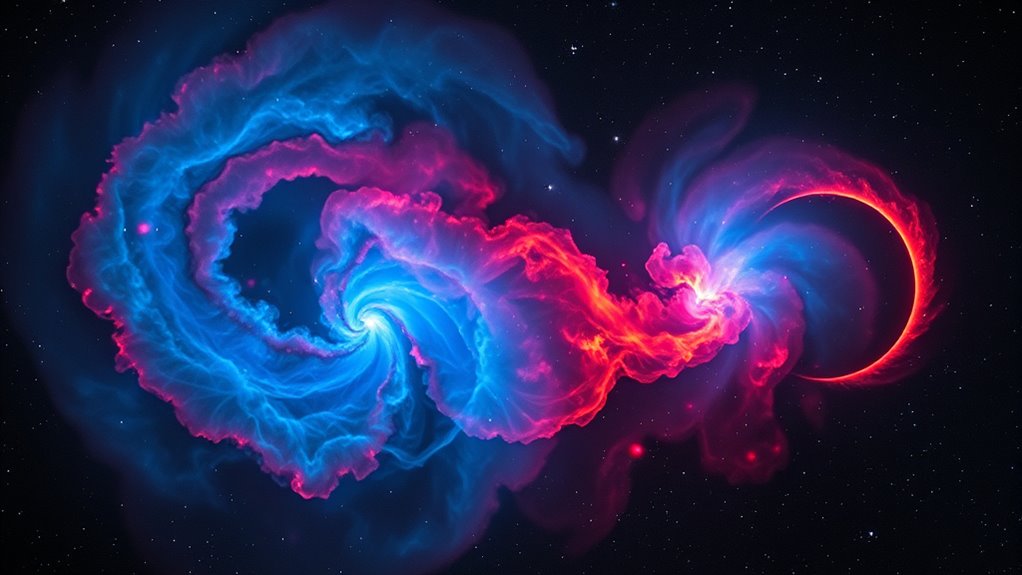
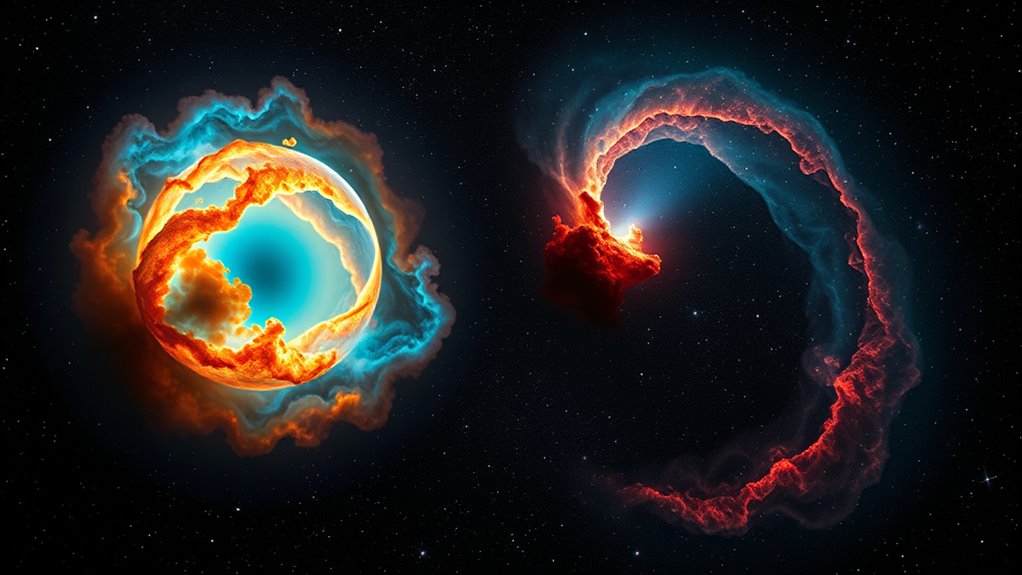
You see the striking bubble and crescent-shaped supernova remnants, which form from the explosive death of massive stars. These structures result from shockwaves that heat and push interstellar gas, shaping their unique forms. Magnetic fields and surrounding materials influence their appearance, creating dynamic shapes that evolve over thousands of years. Exploring these remnants reveals how stellar explosions enrich space and accelerate high-energy particles. Keep exploring, and you’ll uncover more about the fascinating processes that craft these cosmic masterpieces.
Key Takeaways
- Supernova remnants often form bubble-like structures as expanding shockwaves interact with surrounding interstellar material.
- Crescent-shaped nebulae result from environmental factors like magnetic fields and uneven gas distribution shaping remnant morphology.
- Studying these structures reveals insights into shockwave dynamics, magnetic influences, and high-energy particle acceleration processes.
- Observations across multiple wavelengths help uncover physical conditions and evolution of bubble and crescent-shaped remnants.
- These nebulae serve as natural laboratories for understanding cosmic ray origins and the aftermath of stellar explosions.
Have you ever wondered what happens after a star explodes in a supernova? When a massive star reaches the end of its life, its core collapses and triggers a supernova explosion, ejecting stellar material into space at incredible speeds. This explosive event is a vital phase in stellar evolution, transforming the star into a supernova remnant. As the debris expands outward, it interacts with the surrounding interstellar medium, creating complex structures like bubble and crescent-shaped nebulae. These remnants are not just beautiful; they are active regions where high-energy processes unfold. One of the most fascinating aspects is their role in cosmic ray acceleration. The shockwaves generated by the explosion accelerate particles to near-light speeds, contributing to the population of cosmic rays that permeate our galaxy. This process is fundamental to understanding the energetic phenomena in space, as the remnants serve as natural particle accelerators.
As the supernova remnant expands, the shockwave plows through space, heating and compressing interstellar gas and dust. This interaction forms intricate shapes, including the bubble-like structures seen in some remnants, where the explosion’s energy pushes outward in a roughly spherical fashion. In other cases, magnetic fields and uneven distribution of interstellar material influence the structure, producing crescent or filamentary features. These shapes are not static; they evolve over thousands of years, gradually dispersing into the galaxy and enriching it with heavier elements forged in the star’s interior. Observing these nebulae allows astronomers to trace the remnants of stellar evolution and better understand how elements essential for life are distributed throughout the universe. Additionally, studying these structures helps scientists understand the shockwave dynamics involved in high-energy astrophysics.
The bubble and crescent nebulae also act as laboratories for studying high-energy astrophysics. The shock fronts generate intense radiation across multiple wavelengths, from radio waves to X-rays, revealing details about the physical conditions within the remnants. By analyzing these emissions, scientists gain insights into cosmic ray acceleration mechanisms, helping to answer fundamental questions about the origins of high-energy particles that reach Earth. The structures’ shapes and behaviors are clues to the dynamics of shockwaves and magnetic fields, providing a window into the violent processes that shape our universe. As you explore images and data of these nebulae, you’re witnessing the aftermath of stellar death that fuels cosmic evolution, illustrating how supernova remnants are both relics of the past and catalysts for future cosmic phenomena.

DWARFLAB Dwarf Mini Smart Telescope – 1.85lb Ultra-Portable Astronomy Telescope for Astrophotography with Built-in Filters, Auto GOTO, AZ/EQ Mode and Cloud Processing, Ideal for All Ages
【Pocket-Sized & Ultra-Lightweight】 Weighing just 1.85 lbs (840g), the DWARF mini easily fits into a backpack or large…
As an affiliate, we earn on qualifying purchases.
As an affiliate, we earn on qualifying purchases.
Frequently Asked Questions
What Causes the Distinct Shapes of the Bubble and Crescent Nebulae?
The distinct shapes of the bubble and crescent nebulae result from shock waves and magnetic fields shaping expanding gas. In the bubble nebula, shock waves from stellar winds push out gas, creating a spherical form. The crescent nebula‘s shape forms as shock waves interact with magnetic fields and surrounding material, bending the gas into a curved, crescent shape. These forces work together, sculpting the nebulae’s unique appearances.
How Do Supernova Remnants Influence Star Formation in Their Regions?
Supernova remnants influence star formation by triggering stellar wind interactions that compress nearby gas clouds, leading to new star births. As shockwaves from the explosion propagate, they can also accelerate cosmic rays, which further energize the surrounding environment. This process can either promote or hinder star formation, depending on factors like gas density and the remnant’s energy, shaping the future generations of stars in the region.
Can These Nebulae Be Observed With Amateur Telescopes?
Like a cosmic detective, you can observe these nebulae with amateur telescopes. Using simple observational techniques and amateur equipment, you might catch glimpses of their faint glow. The Crescent and Bubble Nebulae are challenging but accessible targets under dark skies. Patience and a steady hand will help you spot these remnants of stellar explosions, revealing the universe’s explosive beauty through your own telescope.
What Are the Future Evolutionary Paths of the Bubble and Crescent Nebulae?
You’ll see that the Bubble and Crescent Nebulae are part of their nebula lifecycle, eventually dispersing into space as stellar evolution continues. Their future paths involve expansion and fading as the central stars shed more material. Over time, these nebulae will blend into the interstellar medium, enriching it with elements. This process highlights the ongoing cycle of stellar evolution, where nebulae serve as cosmic nurseries and remnants.
How Do These Nebulae Compare to Other Supernova Remnants in the Galaxy?
Think of these nebulae like delicate fireworks compared to other supernova remnants. They’re relatively young, with distinct shapes shaped by stellar winds. Using spectral analysis, you can identify their composition, and distance measurement helps compare their size and age to others in the galaxy. These features make the Bubble and Crescent nebulae unique, standing out with their intricate structures and vibrant emissions against the more chaotic remnants elsewhere.

Celestron SkyMaster 25×70 Binoculars – Powerful Binoculars for Detailed Long-Distance Viewing and Binocular Astronomy – Multi-Coated Optics – Tripod Adapter & Carrying Case
POWERFUL 25X MAGNIFICATION: Giant astronomy binoculars with massive 70mm objective lenses and 25x power. Pair them with any…
As an affiliate, we earn on qualifying purchases.
As an affiliate, we earn on qualifying purchases.
Conclusion
As you gaze into the night sky, these nebulae become cosmic paintings—vivid bubbles and crescents carved by explosive forces. They remind you that even in chaos, beauty emerges, echoing the universe’s endless cycle of birth and destruction. Like celestial sculptures crafted by nature’s hand, the bubble and crescent nebulae invite you to see the universe not just as distant stars, but as a dynamic, evolving masterpiece. Embrace this cosmic artistry—it’s a story written in light and shadow.
Observer's Sky Atlas: The 500 Best Deep-Sky Objects With Charts and Images
As an affiliate, we earn on qualifying purchases.
As an affiliate, we earn on qualifying purchases.

DWARFLAB Dwarf 3 Smart Telescope – Portable Astrophotography Camera, Capture Astronomy/Wildlife/Panorama, AZ/EQ Mode, Built-in Processing, 4K Auto-Tracking, Ultra-Light 3lb, Ideal for All Ages
【Ultra-Light Design for All Adventures】Only 3lb/1.35kg – World's Most Portable Smart Telescope! Fits perfectly in standard backpack for…
As an affiliate, we earn on qualifying purchases.
As an affiliate, we earn on qualifying purchases.