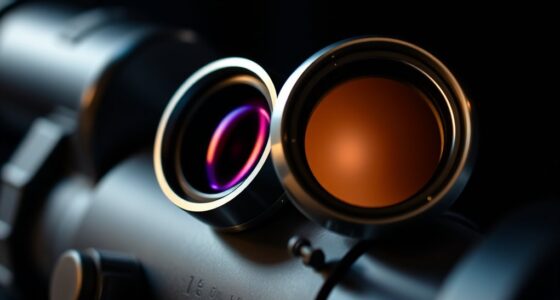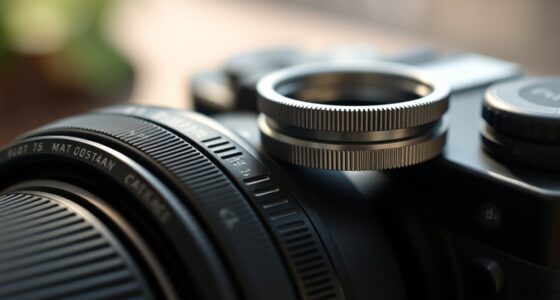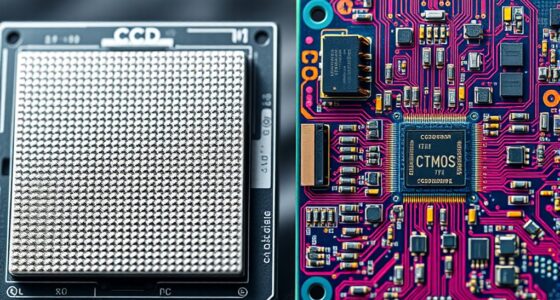
Full-well depth refers to the maximum amount of light a camera sensor pixel can hold before it saturates, which helps you avoid blown-out highlights in your astrophotos. Dynamic range measures the difference between the darkest and brightest details your sensor can capture, essential for balancing faint stars and bright objects like planets. Understanding these limits helps you set proper exposures and prevent overexposure. Keep exploring to discover how to optimize your astrophotography for stunning results.
Key Takeaways
- Full-well depth determines the maximum light a pixel can hold before saturation, affecting bright object detail capture.
- Dynamic range indicates the sensor’s ability to record both faint and bright details simultaneously.
- A higher full-well depth allows for better handling of bright objects without clipping.
- Managing dynamic range helps prevent highlight clipping and shadow loss in astrophotography images.
- Proper exposure and sensor settings optimize full-well capacity and dynamic range for clearer, more detailed astrophotos.
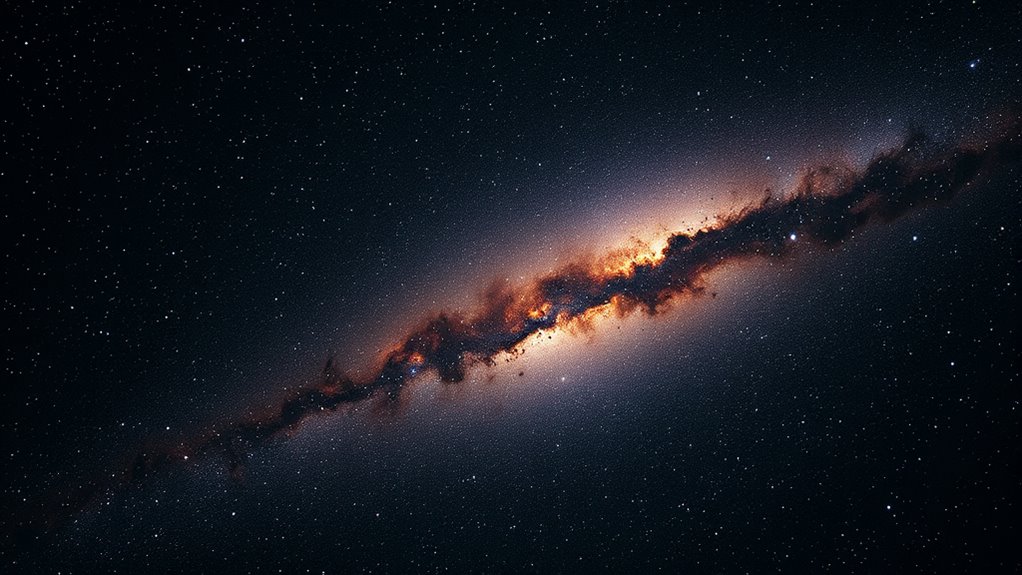
Understanding full-well depth and dynamic range is essential for capturing high-quality images. These concepts determine how well your camera sensor can record the full spectrum of light in a scene, especially in the challenging conditions of astrophotography. When you’re photographing the night sky, bright stars or planets can cause sensor saturation if your exposure settings aren’t carefully managed. Sensor saturation happens when the amount of light hitting a pixel exceeds its full-well capacity, leading to bloated highlights that lose detail and cause a loss in overall image contrast. If you don’t monitor this carefully, your images can end up looking washed out or overly bright in certain areas, diminishing the richness of the night sky. Additionally, understanding the full-well depth of your sensor helps you determine the maximum brightness level it can handle before clipping occurs.
Your camera’s dynamic range plays a crucial role here. It defines the difference between the darkest and brightest parts of an image that your sensor can capture simultaneously. A wider dynamic range allows you to retain detail in both faint stars and bright celestial objects without sacrificing contrast. When you understand the limits of your camera’s dynamic range, you can fine-tune your settings—like ISO, exposure time, and aperture—to prevent clipping in the highlights or crushing shadow details. This balance is especially vital in astrophotography, where the luminance levels can vary dramatically within a single shot.
In practical terms, managing sensor saturation involves adjusting your exposure to avoid overexposing bright objects like the moon or nearby planets, which can quickly lead to loss of detail. Using techniques like exposure bracketing or stacking multiple images helps you preserve detail across the entire image. You might also consider using filters or graduated ND filters to control extreme brightness differences, enabling you to capture more detail without hitting the sensor’s saturation point. When you keep an eye on your histogram, you can see if highlights are clipping, indicating sensor saturation, which helps you make real-time adjustments.

SVBONY SV305C Astrophotography Camera, 2.1MP IMX662 Color Telescope Camera with Removable UV IR Cut Glass, 1.25" Electronic Telescope Eyepiece for Planetary Moon Astrophotography&EAA
SV305C is a color entry-Level telescope camera; which has good performance in planetary photography; lunar photography; and is…
As an affiliate, we earn on qualifying purchases.
As an affiliate, we earn on qualifying purchases.
Frequently Asked Questions
How Does Sensor Size Affect Full-Well Depth?
Sensor size impacts full-well depth because larger sensors typically have bigger pixel areas. This means each pixel can hold more charge before saturating, increasing the full-well depth. With a bigger pixel area, you get better dynamic range and reduced noise, which is especially useful for astrophotography. So, if you want higher full-well depth, choosing a camera with a larger sensor and bigger pixels is a smart move.
Can Post-Processing Improve Dynamic Range?
Yes, post-processing can improve your dynamic range. Using HDR techniques, you combine multiple exposures to capture both bright and dark details, effectively expanding the range. Raw processing also helps, as it preserves more image data and allows you to adjust shadows and highlights more precisely. This way, you can maximize your image’s detail, making your astrophotography shots more vibrant and balanced.
Is Higher Full-Well Depth Always Better for Astrophotography?
Think of your camera sensor as a delicate balance beam. Higher full-well depth isn’t always better if it introduces more sensor noise or requires longer exposures that risk star trails. More depth helps capture brighter details, but only if your exposure settings are optimized. Ultimately, focus on balancing full-well depth with noise control to get clearer astrophotos, rather than just chasing the highest number.
How Do Different Camera Brands Compare in Dynamic Range?
When comparing camera brands, you’ll notice significant differences in sensor performance and dynamic range. For instance, Sony and Canon often lead with higher dynamic range, allowing you to capture more detail in bright and dark areas. Nikon also offers excellent options. Your choice depends on your needs, but generally, Sony’s sensors excel in dynamic range, giving you better flexibility in astrophotography to preserve detail across various exposures.
What Role Does ISO Play in Dynamic Range?
ISO sensitivity directly affects your camera’s dynamic range by increasing sensor noise at higher settings. When you raise ISO, your sensor becomes more sensitive to light, but this also amplifies noise, reducing the range between the darkest and brightest details. To preserve dynamic range, keep ISO as low as possible, especially in astrophotography, where capturing faint details is essential. Lower ISO helps minimize sensor noise and maintains image quality.

Underwater Fishing Camera, Portable Fish Finder Camera 1080P HD LED Cam with 220° Wide View and 4.3 Inch Monitor for Ice Lake Sea Boat Kayak Fishing
High Definition Imaging: The underwater camera is equipped with a 500W sensor, bringing 1080P high definition images, 220…
As an affiliate, we earn on qualifying purchases.
As an affiliate, we earn on qualifying purchases.
Conclusion
So, now that you know about full-well depth and dynamic range, go ahead—capture those starry skies with the confidence of a cosmic wizard. Just remember, more isn’t always better; unless you want your camera to burst into a glittering explosion of data. Embrace the limits, push the boundaries, and enjoy the celestial show. After all, in astrophotography, it’s less about the camera and more about fooling it into thinking it’s a black hole of brilliance.

K&F CONCEPT 67mm Variable ND2-ND400 ND Lens Filter (1-9 Stops) for Camera Lens Adjustable Neutral Density Filter with Microfiber Cleaning Cloth (B-Series)
【Import Optical Glass】Crafted from premium AGC optical glass with 8 multi-layer coatings, this ND filter reduces reflections and…
As an affiliate, we earn on qualifying purchases.
As an affiliate, we earn on qualifying purchases.

Telescope Camera 4K, 8MP Astrophotography Camera – 1.25" Telescope Electronic Eyepiece Camera with IR Filter, Plug & Play for Astronomy, Planetary Imaging, Compatible with Windows/Mac/Linux
✅【Plug & Play Multi-OS Support】 No drivers needed! Automatically recognized by Windows 10/11, macOS 12+, and Linux via…
As an affiliate, we earn on qualifying purchases.
As an affiliate, we earn on qualifying purchases.