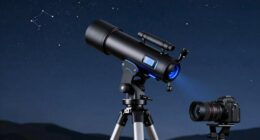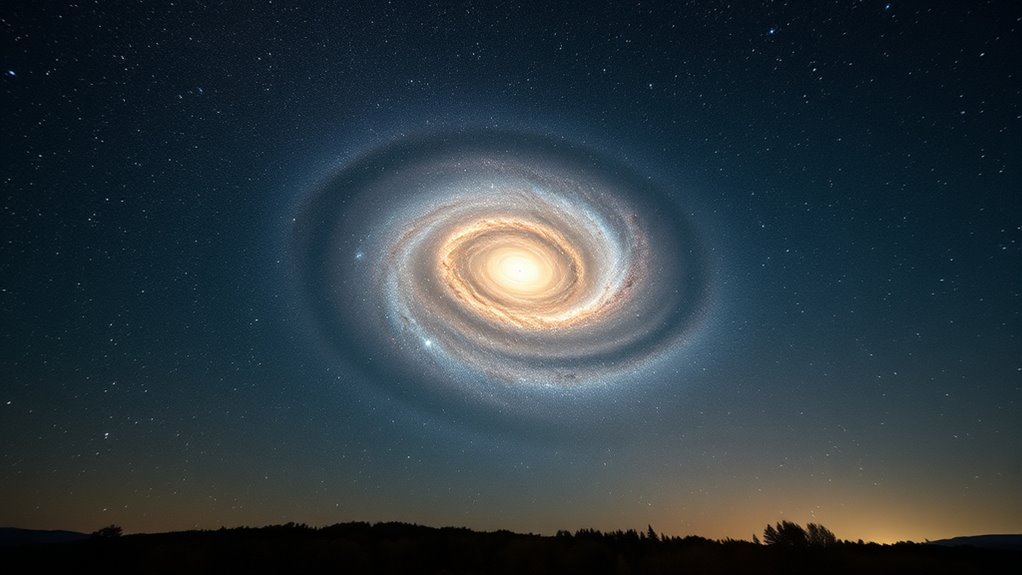
To image the Andromeda Galaxy in autumn skies, select a telescope with a large aperture and a stable mount for sharp, detailed pictures. Capture multiple long exposures during clear, dark nights to improve image quality. Use specialized software to stack and enhance your photos, revealing features like spiral arms and dust lanes. Adjust levels, contrast, and color for the best effect. Continuing will guide you through step-by-step techniques to maximize your astrophotography results.
Key Takeaways
- Use a large-aperture telescope with stable tracking for detailed deep-sky imaging of M31 in autumn.
- Capture multiple long exposures during clear autumn nights to enhance image depth and detail.
- Optimize sky conditions by choosing nights with minimal light pollution and good transparency for better results.
- Apply stacking and advanced processing techniques to reveal faint features like spiral arms and dust lanes.
- Leverage resources and tutorials to refine imaging and processing skills for capturing stunning autumn views of M31.

Have you ever wondered what it takes to capture stunning images of distant galaxies? When it comes to imaging the Andromeda Galaxy (M31) during autumn skies, the process begins with choosing the right equipment. Your telescope selection plays a vital role in how much detail you can reveal. For deep-sky imaging of Andromeda, a telescope with a large aperture is ideal because it gathers more light, allowing you to see faint structures and dust lanes. Many astronomers prefer reflector telescopes or high-quality refractors for this purpose, as they offer sharp images and better light collection. Pairing your telescope with a stable mount and precise tracking system ensures that you can keep Andromeda centered in your field of view, even during long exposures.
Once you’ve set up your gear, capturing the galaxy is only part of the journey. The real magic happens during image processing. Raw images from your camera or DSLR will likely be affected by noise, light pollution, and other distortions that obscure the galaxy’s intricate details. Using dedicated image processing software, you can enhance your captures by stacking multiple exposures, which reduces noise and increases signal clarity. This technique involves aligning and combining several images to produce a cleaner, more detailed result. After stacking, you can adjust levels and curves to bring out the subtle features of Andromeda’s spiral arms, core, and surrounding halos. Color balancing is also essential, especially if you’re working with broadband filters, to accurately represent the galaxy’s hues and dust lanes.
Processing isn’t just about improving aesthetics; it’s about revealing the galaxy’s true structure and beauty. You might experiment with different contrast, saturation, and sharpening techniques to highlight specific features. It’s important to remember that each image is a combination of your equipment, sky conditions, and processing skills. The better your initial data, the more detailed and vibrant your final image will be. During autumn, the longer nights and clearer skies offer extended opportunities for capturing multiple long exposures, which profoundly improve your results. Additionally, understanding astrophotography techniques can help you optimize your setup and processing workflow for better images.
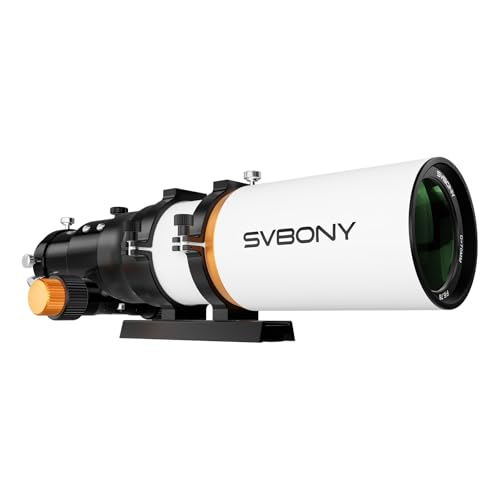
SVBONY SV503 Refractor Telescope with Built-in Field Flattener, 70mm F6.78 Extra Low Dispersion Achromatic Refractor OTA, Telescope for Adults, for Astrophotography Visual Astronomy
Outstanding flat-field correction; built-in field flattener of SVBONY SV503 telescope eliminates field curvature; offering a flat; wide view;…
As an affiliate, we earn on qualifying purchases.
As an affiliate, we earn on qualifying purchases.
Frequently Asked Questions
What Is the Best Time of Night to Observe M31 in Autumn?
You should observe M31 in the late evening to early night, ideally when the moon is in a new or crescent phase, to minimize its brightness. Choose a time when the sky is dark and free from light pollution, usually after astronomical twilight ends. This way, you’ll get the clearest view of Andromeda, making it easier to see its details and enjoy a stunning autumn sky observation.
Which Camera Settings Optimize Imaging of Andromeda in Autumn Skies?
You’ll want to open your camera aperture wide to gather as much celestial light as possible, making Andromeda shine like a distant lighthouse. Increase your sensor sensitivity, boosting ISO settings without introducing too much noise, to reveal intricate details. Use a slow shutter speed to allow the galaxy’s glow to paint your image softly. These settings turn your camera into a stargazing telescope, capturing autumn’s celestial jewel beautifully.
How Does Autumn Weather Affect Astronomical Imaging Conditions?
Autumn weather can impact your astronomical imaging by causing temperature fluctuations that lead to unstable air, which blurs your images. Atmospheric moisture increases during fall, creating more turbulence and reducing clarity. These conditions make it harder to get sharp, detailed shots of Andromeda. To counteract this, choose nights with stable temperatures and lower humidity, and give your telescope time to acclimate to the outdoor environment for better results.
Can I See Andromeda With Binoculars During Autumn?
Yes, you can see Andromeda with binoculars during autumn. Binocular clarity helps you spot the galaxy, even with some light pollution, but keep in mind that autumn sky brightness can reduce contrast. Find a dark spot away from city lights, give your eyes time to adapt, and use a steady hand or mount. With patience, you’ll enjoy a clear view of this stunning galaxy in the autumn sky.
What Are Common Challenges Faced When Imaging M31 in Autumn?
When imaging M31 in autumn, you face challenges like light pollution, which can wash out faint details, and atmospheric turbulence, causing image distortion. You’ll need to choose a dark sky location and use filters to reduce light pollution. Patience is key, as atmospheric conditions change rapidly, affecting clarity. Using stable mounts and adjusting for turbulence improves your chances of capturing a clear, detailed image of the galaxy.
autoguide mount for deep sky imaging
As an affiliate, we earn on qualifying purchases.
As an affiliate, we earn on qualifying purchases.
Conclusion
So, as you chase the faint glow of M31 this autumn, remember you’re just a tiny speck trying to capture eternity with a tiny lens. Sure, you might think you’re mastering the universe, but really, you’re just gazing at a glittering reminder that even in the vast cosmos, we’re all just trying to make sense of a giant, beautiful chaos — one pixel at a time. Keep dreaming, starry-eyed explorer; the universe’s secrets are just out of reach, after all.

4K Telescope Camera for Astrophotography with 2.8" LCD, 1.25/2 Inch Universal Eyepiece Adapter, 16x Zoom & IR Filter, Telescope Accessory & Gift for Astronomy Enthusiasts
【4K Video & 8MP High-Resolution Imaging】Features an 8MP CMOS sensor supporting 4K video recording and up to 64MP…
As an affiliate, we earn on qualifying purchases.
As an affiliate, we earn on qualifying purchases.
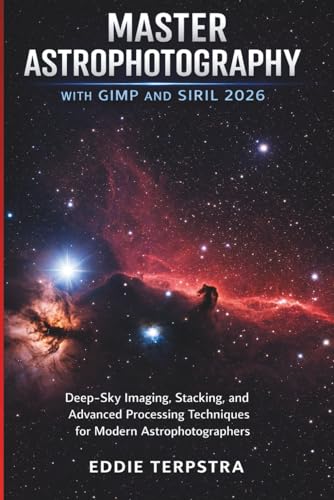
MASTER ASTROPHOTOGRAPHY WITH GIMP AND SIRIL 2026: Deep-Sky Imaging, Stacking, and Advanced Processing Techniques for Modern Astrophotographers
As an affiliate, we earn on qualifying purchases.
As an affiliate, we earn on qualifying purchases.