To capture the Milky Way’s core, plan your trip based on your latitude: in the Northern Hemisphere, best from late spring to summer (May–August), while in the Southern Hemisphere, you’ll have viewing opportunities from February to October, especially in late autumn to winter. The core’s visibility depends on moon phases, weather, and light pollution, which vary by location. Keep these factors in mind to maximize your chances—if you look further, you’ll discover even more tips for stunning photos.
Key Takeaways
- The Milky Way core is best visible in the Northern Hemisphere from late spring to summer (May–August).
- In the Southern Hemisphere, optimal months are February through October, peaking in late autumn and winter.
- Closer to the equator, the core appears higher in the sky, making it easier to observe and photograph.
- Higher latitudes see the core near the horizon, limiting viewing windows mostly to specific months.
- Clear, moonless nights with low light pollution are essential for capturing the Milky Way’s core effectively.

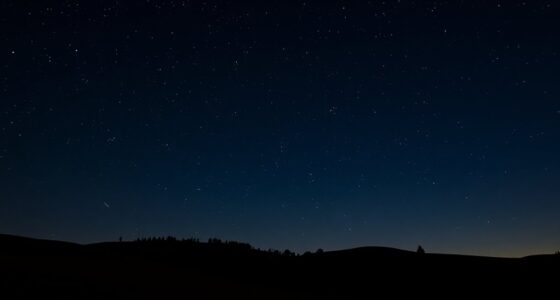
Have you ever wondered when the best time to see the Milky Way is? The answer depends on your location and the time of year, but understanding galaxy visibility and optimal timing can help you plan your stargazing adventures. The core of the Milky Way, the brightest and most detailed part of the galaxy, is visible during specific months when conditions align perfectly. Typically, in the Northern Hemisphere, you’ll find that the best viewing occurs from late spring through summer, roughly from May to August. During these months, the galaxy’s core rises high enough in the night sky to be seen clearly, and the nights are often warm enough to stay out late. Conversely, in the Southern Hemisphere, the core is visible for a longer period, from February to October, with peak visibility from late autumn to winter.
The best time to see the Milky Way varies by location, typically May to August in the Northern Hemisphere and February to October in the South.
The key to maximum timing is understanding when the Galactic Center is above the horizon during the night. This varies with latitude: closer to the equator, the core appears higher in the sky, making it easier to capture stunning views. As you move toward higher latitudes, the core’s position shifts, often skimming the horizon, which can make photographing or observing it more challenging. Hence, your location influences the galaxy visibility and the best months to plan your trip. For example, if you’re at a higher latitude in the Northern Hemisphere, the core may only be visible during a few months when it is sufficiently elevated during the night.
To maximize your chances of seeing the Milky Way’s core, aim for nights when the moon is new or in a crescent phase, as moonlight can wash out the galaxy’s faint details. Clear, dark skies away from city lights are essential, so check local light pollution maps and choose nights with minimal moonlight. The perfect timing also involves considering local weather conditions—cloud cover and humidity can obstruct your view, so keep an eye on weather forecasts.
In essence, understanding the timing of galaxy visibility and planning around the moon’s cycle, weather, and your latitude will help you find the perfect window to observe or photograph the Milky Way’s core. It’s a matter of patience and preparation; when the conditions align, you’ll be rewarded with breathtaking views of our galaxy’s heart, a spectacle that’s well worth the wait.

Night Sky Photography for Beginners: A Practical Guide to Capturing Stars, Milky Way Scenes, and Astrophotography Masterpieces Using Any Camera or Smartphone (Night Sky Photography Mastery Series)
As an affiliate, we earn on qualifying purchases.
As an affiliate, we earn on qualifying purchases.
Frequently Asked Questions
How Does Moon Phase Affect Milky Way Visibility?
Your ability to see the Milky Way depends heavily on the moon phase and lunar illumination. During a new moon, with minimal lunar illumination, the sky is darkest, making the Milky Way more visible. Conversely, a full moon increases lunar illumination, washing out the stars and dimming the Milky Way’s core. To capture the best images, plan your sessions during new moon phases when the sky is darkest.
What Equipment Is Best for Capturing the Milky Way?
You need the best equipment essentials to capture the stunning Milky Way! A fast wide-angle lens with a large aperture (f/2.8 or lower) dramatically pulls in light, making stars pop like fireworks. Use a sturdy tripod to keep your camera steady during long exposures, and set your camera to manual mode with high ISO and long shutter speeds. These gear choices turn your night sky into a breathtaking cosmic masterpiece!
Can I See the Milky Way From Urban Areas?
You can see the Milky Way from urban areas, but urban light and sky brightness make it challenging. To improve your view, find spots away from bright streetlights, use light shields, and go out during new moon or when skies are darker. Using a camera with long exposures can also help capture the Milky Way despite the light pollution, giving you a better chance to enjoy this stunning sight.
How Does Light Pollution Influence Photography?
Light pollution considerably impacts your astrophotography, reducing visibility of celestial objects. Did you know that over 80% of the world’s population lives under light-polluted skies? When light pollution is high, it washes out the dark sky needed for clear Milky Way shots, making it harder to capture details. To improve your photos, seek out dark sky locations where minimal light pollution allows the stars and core of the Milky Way to shine brightly.
Are There Specific Apps to Help Locate the Milky Way?
Yes, you can use star chart apps and augmented reality tools to locate the Milky Way. These apps, like SkyView, Star Walk, or Stellarium, help you identify the core’s position easily by pointing your phone at the sky. They provide real-time star maps and augmented reality features, making it simple to plan your photography sessions and find the best spots for capturing the Milky Way’s core.

Sky-Watcher Star Adventurer 2i Pro Pack – Motorized DSLR Night Sky Tracker Equatorial Mount for Portable Nightscapes, Time-Lapse and Panoramas – Wi-Fi App Camera Control – Long Exposure (S20512)
Portable nightscape tracking platform: Motorized portable tracking platform perfect for capturing incredible detail of the Milky Way, eclipses…
As an affiliate, we earn on qualifying purchases.
As an affiliate, we earn on qualifying purchases.
Conclusion
Now that you know when and where to see the Milky Way’s stunning core, gear up and plan your night under the stars. No matter your latitude, you’re about to witness a celestial masterpiece that outshines even the brightest dreams—an awe-inspiring sight that’ll leave you breathless and craving more. So, keep your camera ready and your eyes open; this cosmic show is the universe’s greatest gift, waiting for you to capture its celestial brilliance.

2026 Wall Calendar – Moon Calendar 2026, Jan. 2026 – Dec. 2026, 12" x 24" (Open), 2026 Calendars, 12-Month Wall Calendar with Moon Phases, Perfect for Office & Home
2026 WALL CALENDAR – 12 monthly wall calendar pages with moon phases from Jan. 2026 to Dec. 2026…
As an affiliate, we earn on qualifying purchases.
As an affiliate, we earn on qualifying purchases.

Light Pollution Map – Dark Sky Finder Astro Tools
Uses your device's GPS to help you find nearby dark locations.
As an affiliate, we earn on qualifying purchases.
As an affiliate, we earn on qualifying purchases.