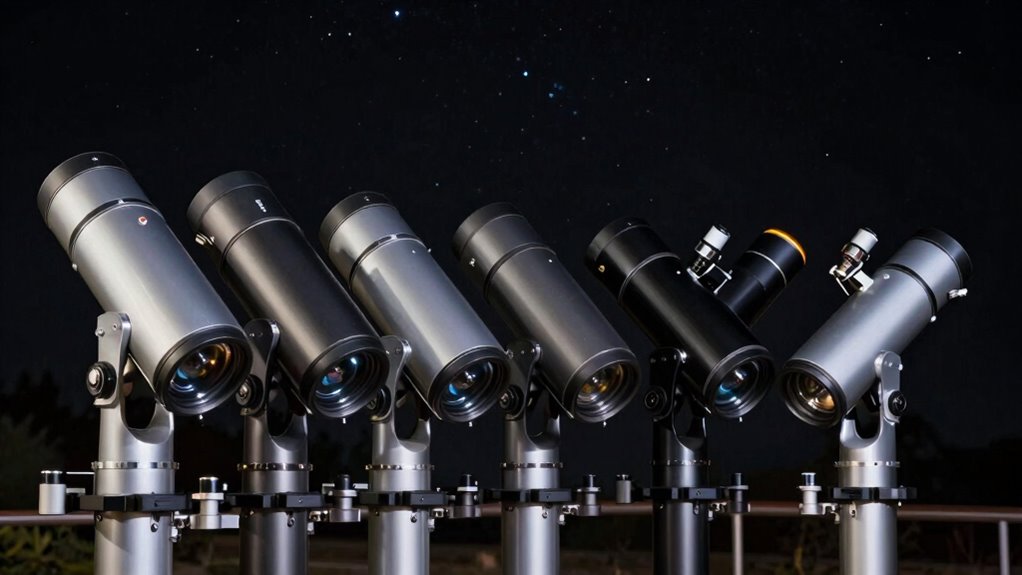
If you’re searching for a maksutov cassegrain for planetary imaging, you’re likely looking for a compact, high-contrast telescope that can deliver sharp, detailed planetary shots. The Sky-Watcher Skymax 180mm stands out as the best overall choice, offering a larger aperture for better detail. The SVBONY MK127 provides excellent value with a solid aperture at a lower price, while the Skymax 102mm is ideal for beginners due to its portability and ease of use. The main tradeoffs involve balancing aperture size with portability and budget. Continue reading to see how each model compares and which might suit your planetary imaging needs best.

Prime made for students and young adults
- Fast, free delivery for dorm and study essentials
- Prime Video and Amazon Music included
- Member-only deals
Key Takeaways
- Larger apertures, like the Skymax 180mm, significantly improve planetary detail but come with increased weight and setup complexity.
- Budget options such as the SVBONY MK127 deliver surprisingly good performance for their price, but may lack some premium features.
- Opting for a compact model like the Skymax 102mm is ideal for beginners or those with limited space, though it may sacrifice some resolution.
- Build quality and mount stability are critical for sharp planetary imaging, often more so than aperture size alone.
- Tradeoffs between portability, ease of use, and image quality should guide your choice based on your experience level and imaging ambitions.
| SVBONY MK127 Telescope for Adults, 127mm Aperture f/11.8 Mak Telescope OTA |  | Best Overall for Deep-Sky and Planetary Imaging | Aperture: 127mm | Focal Ratio: f/11.8 | Optical Design: Maksutov-Cassegrain | VIEW ON AMAZON | See Our Full Breakdown |
| Sky-Watcher Skymax 150mm Maksutov-Cassegrain Telescope |  | Best for High-Contrast Visual Observation and Entry-Level Imaging | Aperture: 150mm | Optical Design: Maksutov-Cassegrain | Mirror Coating: Aluminum with quartz overcoat | VIEW ON AMAZON | See Our Full Breakdown |
| Sky-Watcher Skymax 180mm Maksutov-Cassegrain Telescope |  | Best for Serious Enthusiasts and High-Resolution Imaging | Aperture: 180mm | Optical Design: Maksutov-Cassegrain | Mirror Coating: Aluminum with quartz overcoat | VIEW ON AMAZON | See Our Full Breakdown |
| Sky-Watcher Skymax 127mm Maksutov-Cassegrain Telescope |  | Best for Beginners and Versatile Use | Aperture: 127mm | Optical Design: Maksutov-Cassegrain | Reflectivity: 94% | VIEW ON AMAZON | See Our Full Breakdown |
| Sky-Watcher Skymax 102mm Maksutov-Cassegrain Telescope |  | Best for Compactness and Everyday Astronomy | Aperture: 102mm | Optical Design: Maksutov-Cassegrain | Reflectivity: 94% | VIEW ON AMAZON | See Our Full Breakdown |
| SVBONY MK127 Telescope for Adults Astronomy, 127mm Aperture f/11.8 Maksutov Cassegrain OTA Bundle with SV225 Mini Alt-Azimuth Mount |  | Best Overall for Versatile Planetary and Deep-Sky Observation | Objective Lens Diameter: 127mm | Focal Ratio: f/11.8 | Mount Type: Altazimuth | VIEW ON AMAZON | See Our Full Breakdown |
| SVBONY MK105 Maksutov-Cassegrain Telescope, 105mm Aperture |  | Best for Compact, High-Contrast Planetary Imaging | Aperture: 105mm | Focal Length: 1365mm | Focal Ratio: f/13 | VIEW ON AMAZON | See Our Full Breakdown |
| maksutov cassegrain for planetary imaging | Aperture | Optical Design | Reflectivity | Dovetail |
|---|---|---|---|---|
| SVBONY MK127 Telescope for Adu | 127mm | Maksutov-Cassegrain | — | — |
| Sky-Watcher Skymax 150mm Maksu | 150mm | Maksutov-Cassegrain | 94% | Vixen-style |
| Sky-Watcher Skymax 180mm Maksu | 180mm | Maksutov-Cassegrain | 94% | Vixen-style |
| Sky-Watcher Skymax 127mm Maksu | 127mm | Maksutov-Cassegrain | 94% | Vixen-style |
| Sky-Watcher Skymax 102mm Maksu | 102mm | Maksutov-Cassegrain | 94% | Vixen-style |
| SVBONY MK127 Telescope for Adu | — | — | — | — |
| SVBONY MK105 Maksutov-Cassegra | 105mm | — | — | — |
More Details on Our Top Picks
SVBONY MK127 Telescope for Adults, 127mm Aperture f/11.8 Mak Telescope OTA
The SVBONY MK127 stands out for combining a large 127mm aperture with a fast f/11.8 focal ratio, making it highly capable for planetary imaging and deep-sky astrophotography. Compared with smaller options like the Skymax 102mm, the MK127 offers more light-gathering power and sharper detail, especially useful for capturing planetary features in high resolution. Its flat-field reducer and dual-speed focus enhance image quality, but the increased weight and bulk mean it’s less portable and requires a sturdy mount. While it needs additional accessories for optimal performance, its versatile eyepiece compatibility and coatings provide a significant advantage for advanced users seeking detailed planetary images. This pick makes the most sense for dedicated amateur astronomers who want a reliable, high-quality imaging platform without sacrificing optical performance.
Pros:- High-quality optics with minimal aberration
- Versatile eyepiece compatibility
- Flat-field reducer enhances imaging of large celestial objects
- Dual-speed focus for precise adjustments
Cons:- Heavy and bulky, less portable
- Requires additional accessories for full capability
- Potentially steep learning curve for setup
Best for: Experienced planetary imagers needing high resolution and deep-sky versatility
Not ideal for: Beginners or those prioritizing portability and simple setup
- Aperture:127mm
- Focal Ratio:f/11.8
- Optical Design:Maksutov-Cassegrain
- Focus Mechanism:Dual-speed
- Flat-field reducer:0.65x
- Eyepiece Interfaces:2″ and 1.25″
Our verdict“This telescope offers excellent optical quality for serious planetary and deep-sky imaging, best suited for experienced users willing to handle its size.”
Sky-Watcher Skymax 150mm Maksutov-Cassegrain Telescope
The Skymax 150mm offers a substantial aperture that delivers bright, high-contrast views of planets and the moon, making it ideal for visual observers and entry-level astrophotographers. Its coated optics and fully baffled tube minimize stray light, producing crisp images similar to the Skymax 180mm, but with less weight and cost. While it’s more portable than the larger models, it still requires a sturdy mount and may need additional accessories for astrophotography beyond basic visual use. Compared to the smaller Skymax 102mm, the 150mm model provides a significant boost in detail and brightness, though it’s bulkier and slightly more challenging to handle. This telescope is well-suited for amateurs seeking a step-up in planetary detail without the complexity of larger systems.
Pros:- Large 150mm aperture for bright, detailed images
- Coated optics and baffled tube reduce stray light
- Includes useful accessories like eyepiece and finderscope
- High-contrast views suitable for planetary imaging
Cons:- Heavy and less portable than smaller scopes
- Requires sturdy mount and some setup knowledge
- Limited motorized tracking capabilities
Best for: Amateurs wanting a more detailed planetary view and basic astrophotography capabilities
Not ideal for: Travelers or those with limited space seeking ultra-portable setups
- Aperture:150mm
- Optical Design:Maksutov-Cassegrain
- Mirror Coating:Aluminum with quartz overcoat
- Reflectivity:94%
- Dovetail:Vixen-style
- Included Accessories:28mm eyepiece, 2-inch star diagonal, 9×50 finderscope
Our verdict“A strong choice for amateur astronomers aiming for detailed planetary imaging with a manageable size compared to larger models.”
Sky-Watcher Skymax 180mm Maksutov-Cassegrain Telescope
The Skymax 180mm excels in delivering high contrast, detailed planetary images thanks to its large aperture and high-quality coated optics. It surpasses the Skymax 150mm in light gathering and resolution, making it the preferred choice for dedicated planetary imagers who want exceptional detail. Its included accessories streamline initial setup, but the scope’s weight and size make it less suitable for frequent transport or casual observing. Compared to the Skymax 127mm, the 180mm offers more brightness and finer detail, though at a higher cost and with increased handling complexity. This telescope is aimed at advanced amateurs who want the best possible planetary images and are prepared for more involved setup and transportation.
Pros:- Exceptional optics with high light transmission
- Large aperture for finer planetary details
- Includes essential accessories for imaging
- High contrast and sharpness
Cons:- Heavy and difficult to move frequently
- Requires more setup expertise
- Higher price point
Best for: Advanced amateur astronomers focused on high-resolution planetary imaging
Not ideal for: Beginners or users seeking a portable or budget-friendly option
- Aperture:180mm
- Optical Design:Maksutov-Cassegrain
- Mirror Coating:Aluminum with quartz overcoat
- Reflectivity:94%
- Dovetail:Vixen-style
- Included Accessories:28mm eyepiece, 2-inch star diagonal, 9×50 finderscope
Our verdict“Best suited for dedicated planetary imagers who prioritize maximum detail over portability or budget concerns.”
Sky-Watcher Skymax 127mm Maksutov-Cassegrain Telescope
The Skymax 127mm offers a well-balanced combination of size, weight, and optical quality, making it an accessible choice for amateur astronomers interested in planetary detail and casual astrophotography. Its coated optics and baffled tube provide clear, high-contrast views comparable to larger models but in a more manageable form factor. It’s compatible with standard photographic tripods, adding to its versatility. However, compared with larger scopes like the Skymax 150mm, it offers less light gathering power, limiting its capability for fine planetary imaging. Its lack of motorized tracking could be a drawback for longer exposures or detailed astrophotography sessions. It’s a solid entry-level choice but less suited for high-end imaging or extended sessions.
Pros:- Compact, lightweight, easy to handle
- Good optical quality with coatings
- Includes essential accessories for beginners
- Compatible with standard tripods
Cons:- Limited to optical viewing without motorized tracking
- Less light-gathering than larger models
- Not ideal for high-precision imaging
Best for: Beginner astronomers looking for a straightforward, portable planetary scope
Not ideal for: Advanced users seeking detailed astrophotography or large deep-sky targets
- Aperture:127mm
- Optical Design:Maksutov-Cassegrain
- Reflectivity:94%
- Dovetail:Vixen-style
- Tripod Thread:¼-20
- Included Accessories:28mm eyepiece, star diagonal, finderscope
Our verdict“A practical starter scope that balances ease of use with decent planetary viewing, best for beginners on a budget.”
Sky-Watcher Skymax 102mm Maksutov-Cassegrain Telescope
The Skymax 102mm provides a compact, lightweight option for amateur astronomers interested in planetary observation and casual imaging. Its coated optics and baffled tube produce sharp, high-contrast images comparable to larger scopes, but in a smaller package. While it’s easy to carry and set up, its limited aperture restricts detailed planetary imaging compared to larger models like the Skymax 127mm or 150mm. It’s best suited for those who want a portable scope for quick observations rather than serious astrophotography. Its lack of motorized tracking further limits its use for prolonged imaging sessions. This scope is a good entry point for beginners who want a straightforward, high-quality planetary view without added complexity.
Pros:- Very portable and lightweight
- High-contrast, sharp images
- Includes basic accessories for beginners
- Simple to set up and use
Cons:- Limited aperture for detailed imaging
- No motorized tracking for long exposures
- Less suitable for advanced astrophotography
Best for: Beginners seeking a portable, easy-to-use planetary scope for casual observing
Not ideal for: Imagers aiming for high-resolution planetary photography or deep-sky work
- Aperture:102mm
- Optical Design:Maksutov-Cassegrain
- Reflectivity:94%
- Dovetail:Vixen-style
- Tripod Thread:¼-20
- Included Accessories:eyepieces, star diagonal, red-dot finder
Our verdict“A compact and reliable scope ideal for casual planetary observation by newcomers, but not for high-end imaging.”
SVBONY MK127 Telescope for Adults Astronomy, 127mm Aperture f/11.8 Maksutov Cassegrain OTA Bundle with SV225 Mini Alt-Azimuth Mount
This 127mm Maksutov Cassegrain stands out for its combination of a substantial aperture and portability, making it ideal for planetary imaging and general astrophotography. Compared with the SVBONY MK105, it offers a larger aperture that captures more detail on planets and faint deep-sky objects, though it requires more careful manual focusing. Its lightweight, adjustable alt-azimuth mount provides stability and ease of use, especially for beginners who want quick setup and reliable tracking. While the mount’s 5kg capacity limits heavier accessories, it’s a worthwhile tradeoff for its versatility and ease of handling. This model suits amateur astronomers who want a balanced mix of performance and portability, particularly for planetary imaging sessions in various locations. However, users seeking high-end astrophotography with motorized tracking or astrophotography-specific features might find it limiting.
Pros:- High-quality 127mm aperture for detailed planetary images
- Lightweight and portable, easy to transport
- Stable, backlash-free alt-azimuth mount with full rotation
Cons:- Manual focusing can be challenging for precise planetary imaging
- Limited to visual observation and basic astrophotography
- Mount capacity restricts heavier accessories
Best for: Beginners and casual enthusiasts seeking a portable, all-rounder telescope capable of detailed planetary imaging and deep-sky views.
Not ideal for: Advanced astrophotographers or those needing motorized tracking and heavy accessory support for serious astrophotography projects.
- Objective Lens Diameter:127mm
- Focal Ratio:f/11.8
- Mount Type:Altazimuth
- Focus Type:Manual
- Weight Capacity:5kg
- Additional Features:Backlash-free and play-free design
Our verdict“This telescope makes the most sense for amateur astronomers who want a versatile, portable setup with solid planetary imaging capabilities.”
SVBONY MK105 Maksutov-Cassegrain Telescope, 105mm Aperture
The SVBONY MK105 offers a compact, high-contrast optical system, making it well-suited for planetary imaging in tight spaces or for users prioritizing portability. Its 105mm aperture and f/13 focal ratio produce dispersion-free images with minimal chromatic aberration, similar to the Sky-Watcher Skymax 127 but with a shorter barrel length that enhances ease of transport. While it doesn’t match the larger apertures of the MK127 or Skymax 150, its reflective optical design ensures sharp, high-contrast views of planets, making it an attractive choice for enthusiasts focused solely on planetary imaging. However, it lacks a built-in mount or tripod, requiring additional accessories, and its limited aperture restricts deep-sky capabilities. This pick is ideal for users who value a lightweight, high-contrast planetary scope that can be easily stored or carried to different observing sites.
Pros:- Compact and lightweight for portability
- Reflective optical system minimizes chromatic aberration
- High contrast images with dispersion-free imaging
- Includes dovetail slots for easy accessory attachment
Cons:- Limited aperture reduces suitability for deep-sky imaging
- Requires additional accessories for mounting and tracking
- No included mount or tripod, increasing setup complexity
Best for: Planetary imaging enthusiasts who need a compact, high-contrast telescope for focused planetary detail and easy transport.
Not ideal for: Users aiming for deep-sky astrophotography or those who prefer an all-in-one package with integrated mount and accessories.
- Aperture:105mm
- Focal Length:1365mm
- Focal Ratio:f/13
- Maximum Magnification:210x
- Weight:2.19kg / 4.83lb
- Barrel Length:377mm
- Interface:1.25″
- Adapter Thread:M42x0.75
Our verdict“This telescope makes the most sense for planetary imaging purists who want a high-contrast, portable optical system without the bulk of larger scopes.”

How We Picked
The telescopes in this roundup were evaluated based on their optical quality, aperture size, build robustness, ease of setup, and overall value for planetary imaging. We prioritized models that offer high contrast, sharp image resolution, and reliable tracking capabilities. Durability and ease of use also played key roles, especially for beginner-friendly options. The rankings reflect how each telescope balances these factors against price, making it clear which models excel as performance leaders versus those better suited for entry-level use or portability.Factors to Consider When Choosing Maksutov Cassegrain For Planetary Imaging
Choosing the right maksutov cassegrain for planetary imaging involves considering several key factors. Not all telescopes are created equal in terms of optical quality, portability, or mount compatibility. Understanding these aspects can help you avoid common pitfalls like underestimating the importance of a stable mount or overestimating the benefits of larger apertures for your specific needs. The guide below highlights the most important considerations to keep in mind before making your purchase.Optical Quality and Aperture
Optical quality directly impacts the sharpness and contrast of planetary images. Larger apertures, such as 150mm or more, typically deliver finer detail, but they also increase weight and cost. For planetary imaging, a well-made 127mm or 150mm maksutov can provide excellent results without the logistical challenges of larger scopes. Be wary of cheap optics that may produce fuzzy or inconsistent images, especially at high magnifications.
Mount Stability and Tracking
A stable mount is essential for capturing clear, detailed planetary images. Even the best telescope can underperform if mounted on an unstable or shaky tripod. For imaging, consider mounts with slow-motion controls or motorized tracking, which help maintain precise focus over extended exposures. Combining a good optical tube with a solid mount is often more effective than upgrading to a larger scope with a weak mount.
Portability and Size
Portability can be a decisive factor if you plan to transport your setup frequently or have limited storage space. Compact maksutov models like the Skymax 102mm are easier to handle and quicker to set up, making them suitable for quick imaging sessions or travel. Larger models, however, provide better resolution but may require more time and effort to deploy, which can be a drawback for casual users.
Budget and Value
While higher-end models offer superior optics and features, they come with a higher price tag. Budget-friendly options, like the SVBONY MK127, often provide excellent image quality for their cost but may lack advanced features like motorized mounts or premium coatings. Consider what features are essential for your experience level and future plans to avoid overspending or settling for subpar optics.
Compatibility and Accessories
Ensure your chosen telescope is compatible with your imaging camera and accessories. Some maksutov scopes have limited back-focus or require specific adapters, which can complicate setup. Additionally, investing in good eyepieces, filters, and a sturdy mount can dramatically improve your imaging results. Compatibility considerations are often overlooked but are essential for a seamless imaging experience.
Frequently Asked Questions
Is a larger aperture always better for planetary imaging?
While a larger aperture generally captures more detail and produces sharper images, it also introduces challenges such as increased weight, longer setup times, and higher cost. For planetary imaging, an aperture around 127mm to 150mm strikes a good balance, offering excellent detail without becoming unwieldy. The key is choosing a scope with quality optics and a stable mount rather than size alone.
Can I use a Maksutov-Cassegrain telescope with a smartphone or small camera?
Yes, many maksutov scopes can be adapted for smartphone or small camera imaging with the right adapters. However, the success depends on the scope’s back-focus distance and the stability of your mount. For serious planetary imaging, a dedicated camera with tracking capabilities will yield better results, but for casual or beginner use, smartphone adapters can be sufficient if mounted securely.
What is the most important feature for planetary imaging in a Maksutov scope?
Optical quality and contrast are the most critical features, as they determine how much detail you can resolve on planets. Additionally, a stable, motorized mount with precise tracking helps prevent motion blur during long exposures. The combination of a high-quality optical tube and a reliable mount usually dictates the overall image quality more than aperture size alone.
Is a Maksutov-Cassegrain scope suitable for deep-sky imaging?
While a maksutov can be used for some deep-sky objects, their design favors high-contrast, high-magnification views ideal for planets. The long focal length limits wide-field imaging, making it less versatile for deep-sky targets. If deep-sky imaging is a priority, a different type of telescope, like a refractor or a reflector, may be more appropriate.
How important is the quality of the eyepiece and accessories when planetary imaging?
The quality of eyepieces and accessories significantly influences image clarity and detail. High-quality, well-corrected eyepieces reduce aberrations and provide sharper images, which is vital for planetary detail. Additionally, good filters, adapters, and a sturdy mount help stabilize the image and improve overall results, making investment in accessories worthwhile.
Conclusion
For dedicated planetary imaging, the Sky-Watcher Skymax 180mm emerges as the best overall choice, offering a compelling balance of aperture, optical quality, and stability. The SVBONY MK127 makes sense for budget-conscious users who want decent results without breaking the bank. Beginners should consider the Skymax 102mm for its portability and ease of use, while advanced users aiming for top-tier detail might lean toward larger apertures paired with high-quality mounts. Ultimately, your choice depends on your experience level, portability needs, and imaging ambitions.Evergreen bestsellers Picks
bestsellers
As an affiliate, we earn on qualifying purchases.